12:35 pm
February 18, 2026
Today, State Superintendent Reykdal noted the improved state revenue forecast and asked legislators to continue to increase state funding for K–12 education:
With additional revenue expected, it is unclear whether further cuts to education are being considered. With a shortfall of nearly $1 billion per year in funding for the basic education that is granted by our state’s constitution, it is counterproductive to keep cutting supports for students and educators. The Legislature should avoid another legal showdown over the state’s paramount duty.
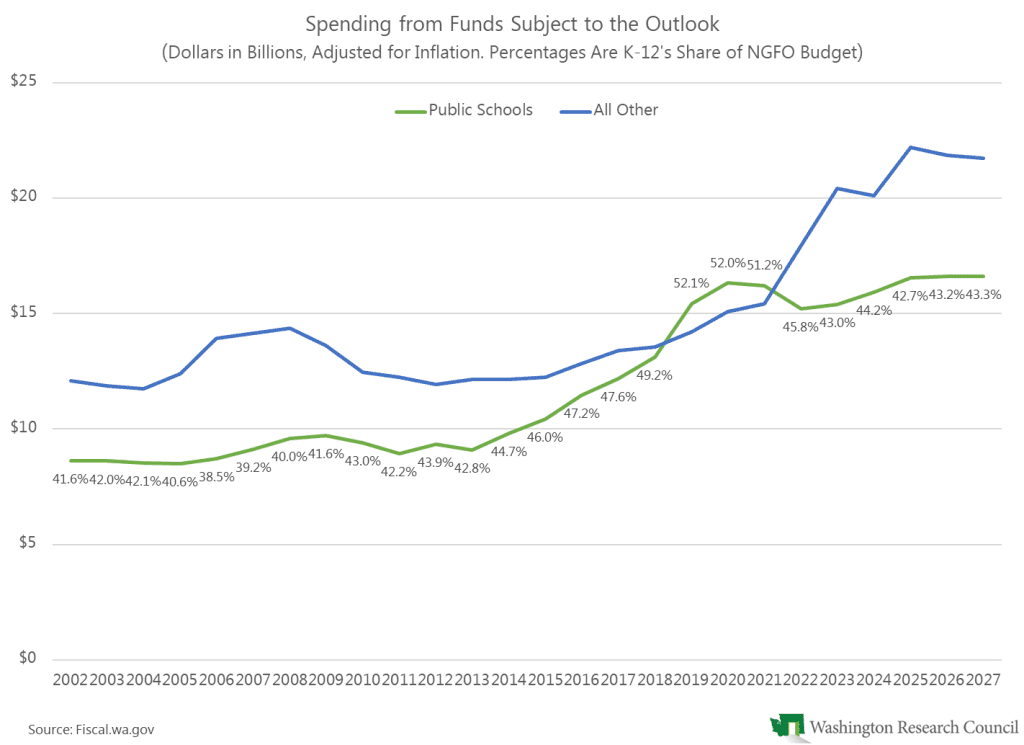
Despite consistent misinformation about public school funding, state funding for public education has lost ground to inflation over seven years. Education funding as a share of the state budget is below the ratio it was when the State Supreme Court held the Legislature in contempt in 2014.
The source of the claim that the state has a $1 billion-a-year shortfall in basic education is unclear and certainly an opinion. Just over a year ago, in his budget request for 2025–27, Superintendent Reykdal said that Washington “underfunds K–12 education by around $4 billion per year.”
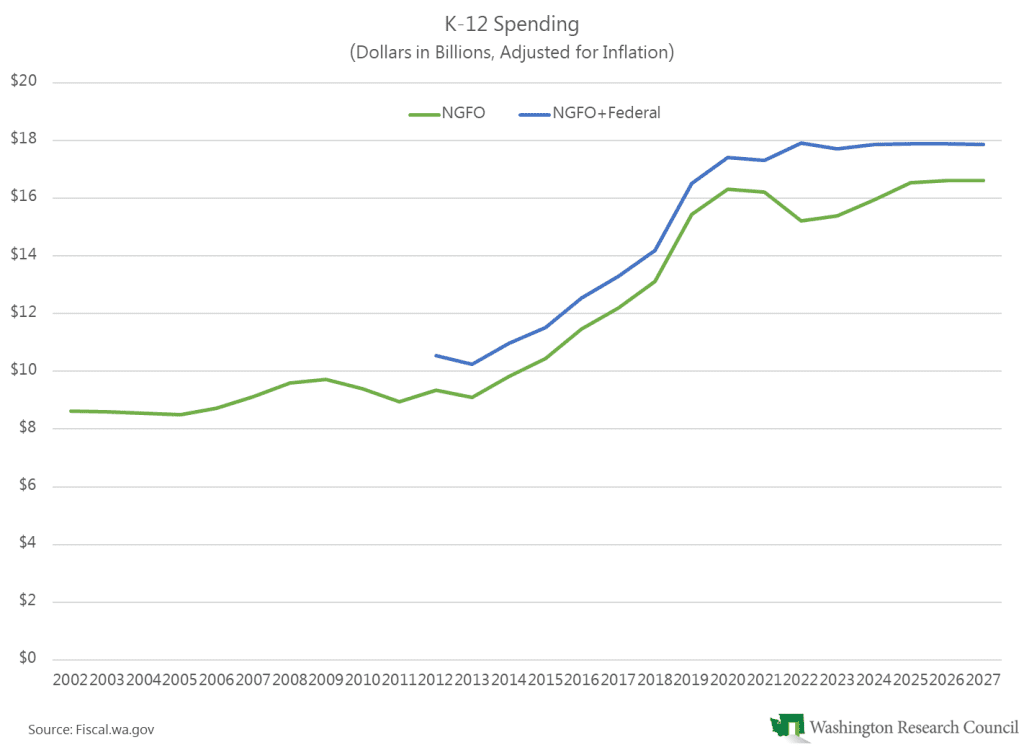
Additionally, state funding for public education has increased, even adjusted for inflation. (I am using the implicit price deflator to adjust for inflation. That is the inflation adjustment used for state allocations for K–12 salaries and material, supplies, and operating costs.) As the chart below shows, inflation-adjusted appropriations from funds subject to the outlook (NGFO) for K–12 in 2026 and 2027 are slightly above 2020 spending. (Note that federal pandemic relief was used to supplant state funding for several years. Note, too, that these charts do not include local revenues for schools.)
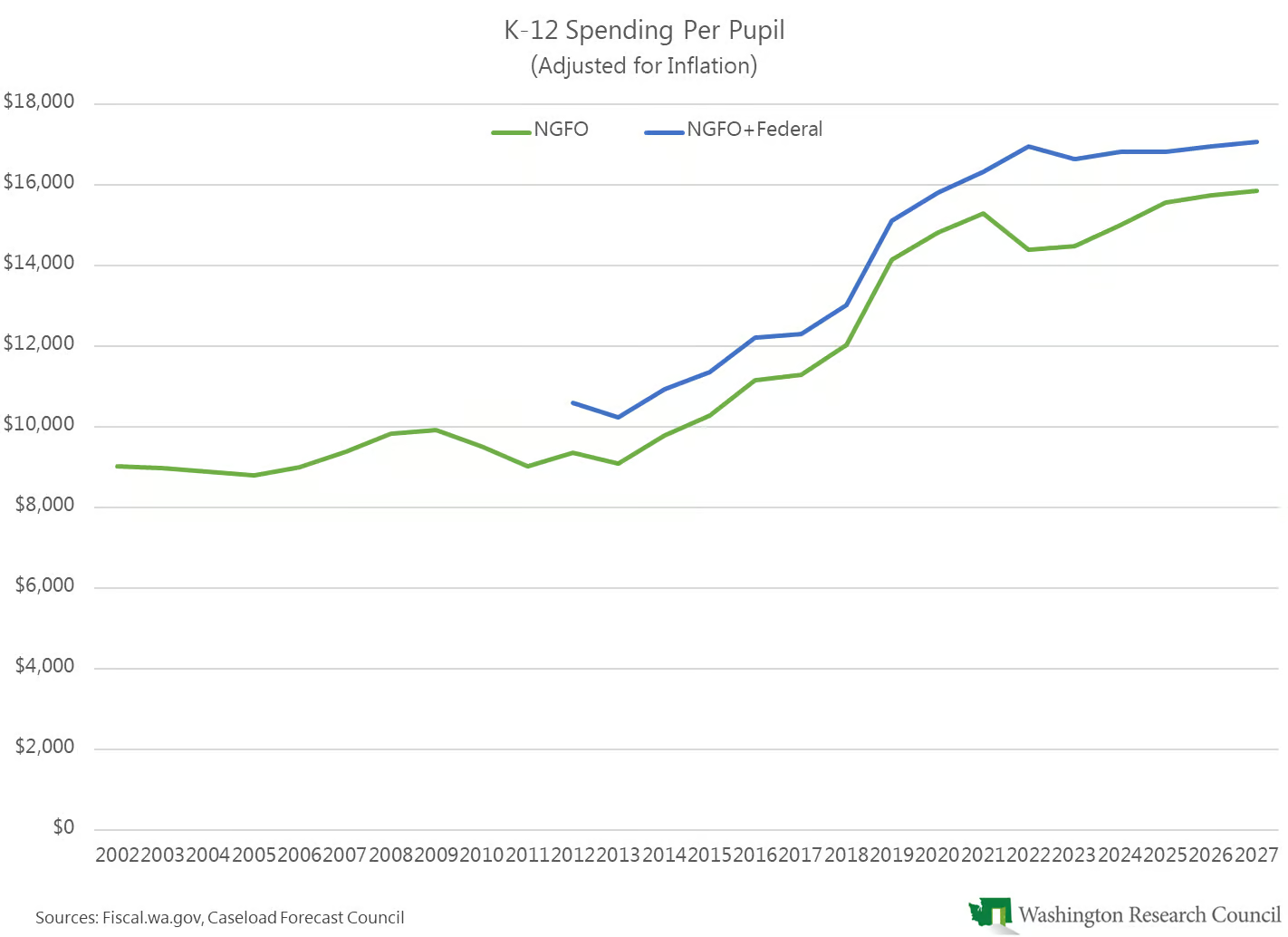
Further, K–12 enrollment is expected to continue to decline. Consequently, inflation-adjusted per-pupil appropriations are also higher than in 2020.
Finally, the share of the budget devoted to K–12 has no relationship to the adequacy of K–12 funding. Further, targeting K–12 funding to a specific percentage of the overall budget would result in bad budget policy, as I have explained here, here, here, and here.