2:12 pm
February 16, 2026
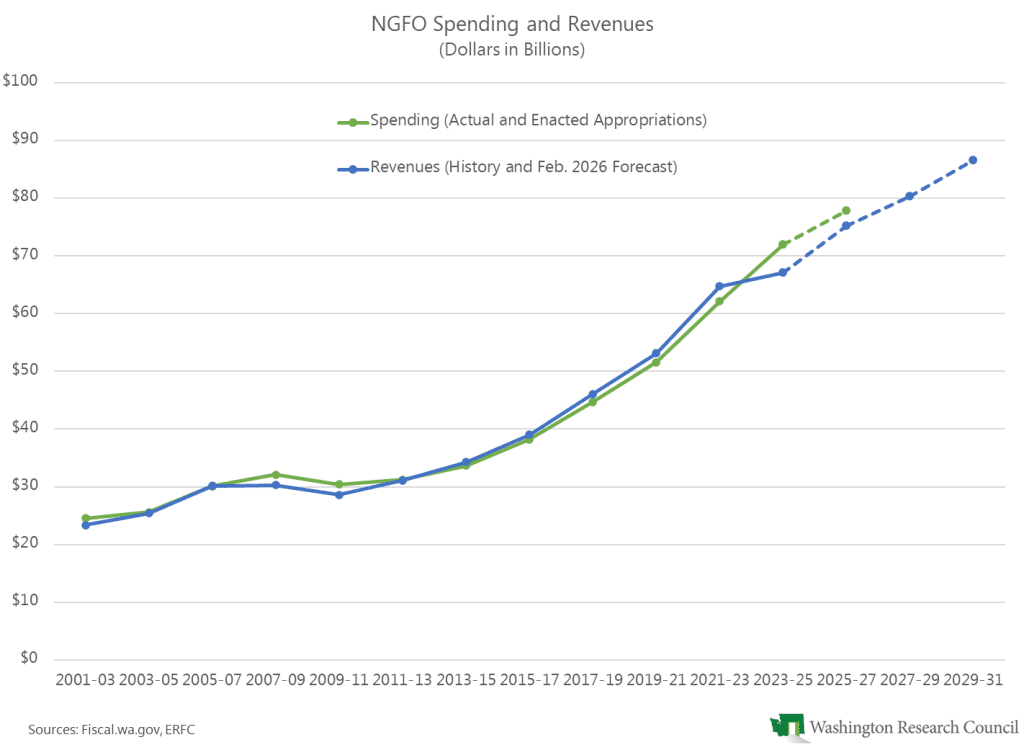
According to the Economic and Revenue Forecast Council (ERFC), revenues for funds subject to the outlook (NGFO) are now forecasted to be $1.856 billion higher over the outlook period (2023–25, 2025–27, and 2027–29) than had been forecasted in November. The forecast for 2025–27 increased by $827.4 million, to $75.276 billion. The forecast for 2027–29 increased by $1.028 billion, to $80.381 billion. Revenues for 2029–31 are forecasted for the first time; they are expected to total $86.568 billion.
From the prior biennium, revenues are forecasted to increase by 12.1% in 2025–27, 6.8% in 2027–29, and 7.7% in 2029–31.
ERFC Director Reich noted that one reason for the improved revenue growth is that the effects of the tax increases adopted last year are now starting to show up in the data. Notably, the current forecast for 2025–27 estimates that revenues to the workforce education investment account (WEIA) will increase by $172 million compared to November. The WEIA is funded by the advanced computing B&O tax surcharge, which increased from 1.22% to 7.5% on Jan. 1. (Additionally, on Jan. 1, the cap on the surcharge amount increased from $9 million to $75 million.) Regarding the advanced computing surcharge, Director Reich said, “Just the tax base in the last four quarters has grown over 45%.” Additionally, the change in the general fund–state compared to November (for 2025–27) was $656 million. Almost $300 million of that is from B&O taxes. So, combined with the increase to WEIA revenues, about 57% of the 2025–27 NGFO revenue increase from November was from the B&O tax.

Since the 2025–27 operating budget was enacted, revenues are up by $166 million over the outlook period. This is good news, but it does not solve the budget problem. In December, non-partisan legislative staff estimated that, given the November 2025 revenue forecast and a preliminary maintenance level (the cost of continuing current services, adjusted for enrollment and inflation) estimate, the unrestricted NGFO ending balance would be -$1.519 billion in 2025–27 and -$4.3 billion at the end of the outlook period.
Using the same maintenance level estimate and the February revenue forecast, I estimate that the unrestricted NGFO ending balance is -$691 million in 2025–27 and -$2.446 billion at the end of the outlook period. That does not include an estimate of how the February caseload forecast will affect the maintenance level, nor does it include any new policy spending the Legislature could adopt.
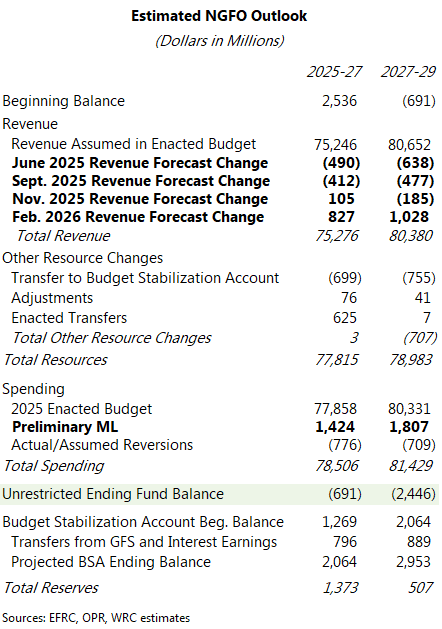
With the caseload and revenue forecasts complete, the Legislature can now finalize its operating budget proposals.
Despite the improvement to the revenue forecast, the ERFC is still forecasting employment growth to be less than 1% each year. This means that legislators can make appropriations from the budget stabilization account with a simple majority. And, if they do so, they are not required by statute to balance the budget over four years.
Nevertheless, the Legislature should bring spending back in line with revenues and balance the budget over four years. Even with the increase to the forecast, appropriations still exceed revenues in 2025–27 by $2.582 billion.