
2:03 pm
July 31, 2024
The Seattle Times interviewed the gubernatorial candidates about education spending. The resulting news story makes editorial comments about the adequacy of state spending and is inaccurate about the use of capital gains revenues.
First, in a few places the story ties the capital gains tax to the Fair Start for Kids Act, which made enhancements to child care and early learning programs: “The Fair Start for Kids Act was passed in 2021 and will use money from Washington’s new capital gains tax to fund early learning and child care, unless that tax is overturned in the upcoming election.”
Later, the reporter writes, “Despite naming other funding priorities, like statewide preschool, Mullet supports the initiative to repeal the capital gains tax. That repeal would cut money from the Fair Start For Kids Act.”
Repealing the capital gains tax would not necessarily cut funding for the Fair Start for Kids Act, because the capital gains tax is not dedicated to the Fair Start for Kids Act. When the Legislature enacted the Fair Start for Kids Act, it anticipated that capital gains tax revenues would help to fund the program down the road (see this post). However, as Sen. Claire Wilson told the Times in 2021, funding for the Fair Start for Kids Act “is not contingent on the capital gains tax revenue being collected, and it will be funded regardless of what the courts decide.”
Further, it is impossible to tell exactly what the capital gains tax revenue is being spent on. It is commingled with other sources of funds in the education legacy trust account (ELTA). Funds in the ELTA may be spent on public schools, higher education, early learning and child care. Additionally, the ELTA is not the only account that supports these programs.
Second, according to the Times article, the McCleary decision on school funding “led to a historic increase in K-12 dollars in the 2018-2019 school year, but it didn’t fully fund the educational needs of Washington students and didn’t fund districts equitably.”
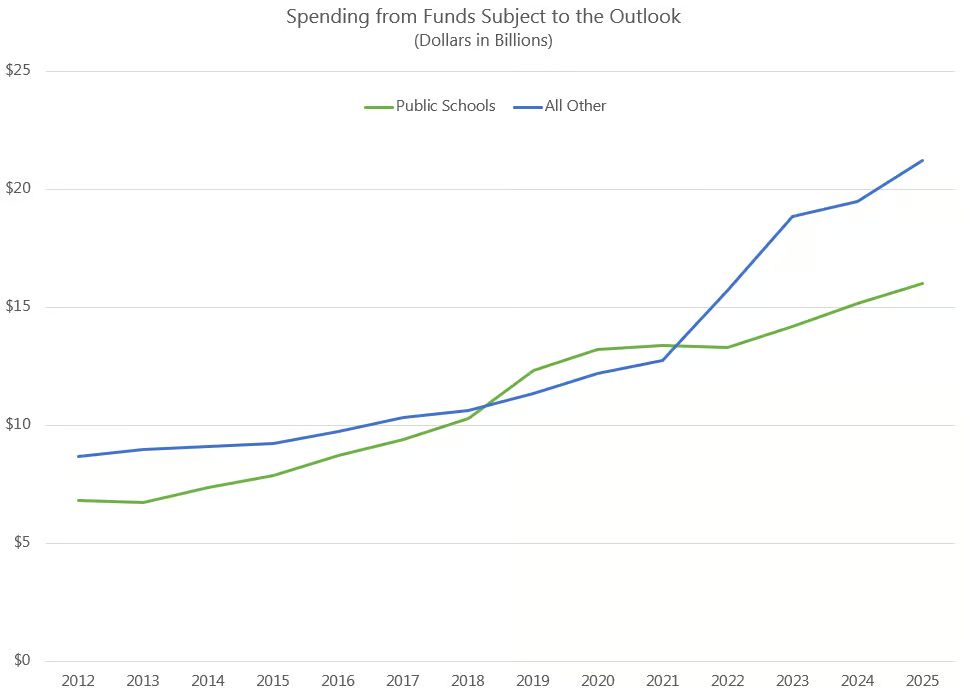
K–12 spending did indeed increase substantially in response to the McCleary decision. From FY 2012 to FY 2019, K–12 spending from funds subject to the outlook (NGFO) increased by 81.2%. With the focus on addressing McCleary, the growth in spending on all other budget areas over that period was just 30.6%.
In 2018, the state Supreme Court ruled that the state was in full compliance with the orders in the case. The state was thus meeting its paramount duty “to make ample provision for the education of all children” at that point, and the amount spent by the state has continued to increase since then, even as the number of students has been flat or declining. State NGFO spending per pupil, adjusted for inflation, increased by 67.4% from FY 2012 to FY 2025 (based on the June 2024 caseload forecast).
Since FY 2019, funding increases for non-K–12 budget areas have exceeded state funding increases for K–12. This is in part due to a backlog of spending items that were not funded during the McCleary era and in part due to changing needs. For example, during the pandemic, the state had new health-related costs and the federal government provided substantial relief funds for schools that supplanted some state funding temporarily. From 2020 to 2025 (as budgeted in the 2024 supplemental), spending on K–12 increased by 21.3% and spending on all other budget areas increased by 73.8%.
The statement in the Times article that the state’s K–12 spending increases “didn’t fully fund the educational needs of Washington students and didn’t fund districts equitably” is an opinion. If the Supreme Court was wrong about schools being fully funded, what amount would be adequate? (Note that a 2017 order from the Supreme Court in the McCleary case specified, “This court has never held that to meet its constitutional obligation, the State must precisely account for every school district’s actual expenditures in providing basic education.” In other words, the state is not required to fund every spending decision made by districts.)
One target for adequacy that has been circulating is 50% of the state budget. As I wrote last year, such a target has no connection to actual educational needs. It is also unworkable given the nature of state budget constraints.
For example, in 2023–25, the state has appropriated $31.202 billion for public schools. That represents 43.4% of total NGFO appropriations. To bring appropriations for public schools up to 50% of the current budget, the state would have to shift $4.8 billion from other priorities to schools. Alternatively, the state could increase total appropriations by $9.5 billion and devote the entire increase to schools, holding all other spending this biennium constant.
Then, going forward, for every dollar the state spends on another priority, it would have to spend a dollar on education in order to maintain the 50% share. Consider, too, that our population is aging, which will naturally shift state costs away from schools.
Nevertheless, according to the Times article, both Bob Ferguson and Dave Reichert apparently think the state should be targeting education funding as a percentage of the budget.
The Times reports that Ferguson said, “Since McCleary, the percentage of our budget that goes to education has gone down since that case [about state education funding] was resolved . . . . That is going in the wrong direction.”
The Times also reports, “Reichert said it was important to spend as much on education as the McCleary ruling dictated. He said his goal would be to make sure 50% of the state’s general fund goes toward education.”
Categories: Budget , Education , Tax Policy.