12:39 pm
November 4, 2022
The City of Seattle’s Office of Economic and Revenue Forecasts (OERF) presented its November revenue forecast on Wednesday. General fund revenues over the 2022 through 2024 period are now estimated to be down by a net of $9.4 million compared to the revenues anticipated in Mayor Harrell’s proposed 2023–24 budget. General fund revenues over that three year period are estimated to total $5.008 billion; so, as OERF Director Ben Noble told the city’s Economic and Revenue Forecast Council, the reduction is “relatively small.” (The forecast is down by just 0.2%.)
There are a number of unusual revenue items in 2021 and 2022 that complicate year-over-year general fund revenue comparisons:
- 2021 payroll expense taxes were deposited in the general fund; after that, they are dedicated to a separate account. (Note that 2021 payroll expense taxes keep rolling in: total collections for the year are now up to $291.6 million. However, just $248.2 million of that is accounted for in 2021. The remaining $43.4 million—collected after the 2021 books were closed—has been deposited in the general fund for 2022.)
- The city transferred $85.4 million from the payroll expense tax to the general fund for 2022.
- There were major one-time general fund revenues for 2022: the Mercer megablock sale ($65.0 million) and a transfer of federal COVID relief dollars ($64.2 million).
As the chart shows, with the payroll expense tax, general fund revenues jumped in 2021 and they remain elevated in 2022 (with the payroll expense tax transfers and one-time items). General fund revenues in 2023 appear to drop. However, when you strip out the payroll expense tax and one-time items to compare apples-to-apples, regular general fund revenues (the solid blue bars) are about flat from 2021–2023 and begin to rise in 2024.
Additionally, the revenues in the mayor’s budget and in the November revenue forecast assume transfers of some payroll expense taxes to the general fund in 2023 and 2024.

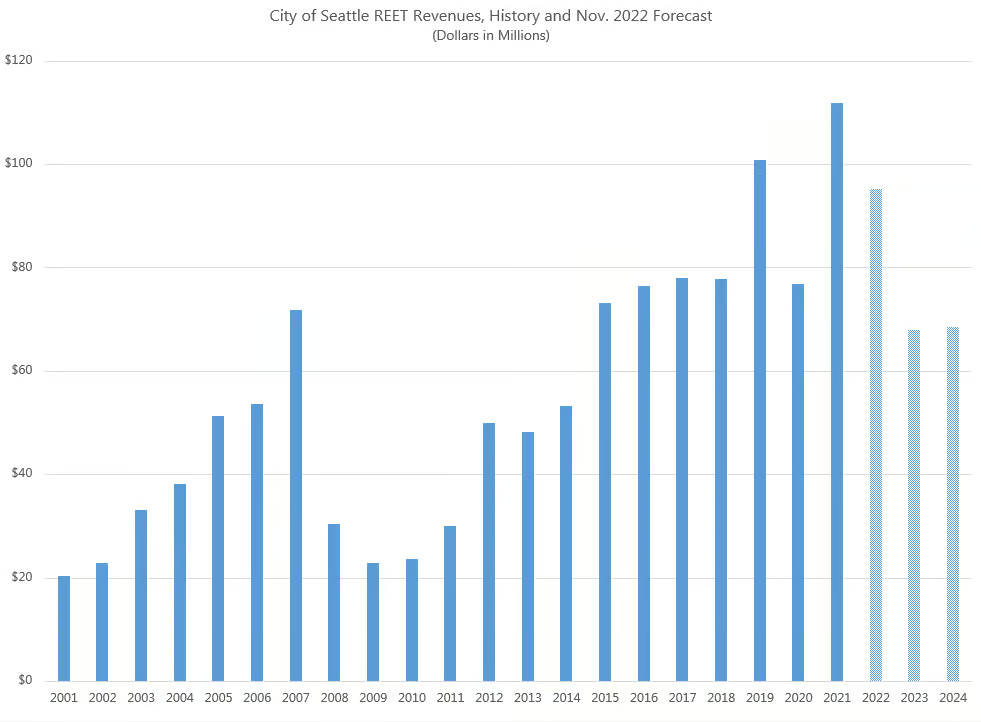
A more significant reduction is now forecast in real estate excise taxes (REET). Compared to the REET revenues assumed in the mayor’s budget over three years, the new forecast estimates that they will be down by $64.1 million (21.6%). REET collections are outside of the general fund and are used for capital purposes. Director Noble said that REET is “one of the revenue sources that is most volatile and difficult to predict.” The mayor’s budget includes a proposal for an economic forecast reserve, “to help absorb significant fluctuations in the REET revenue forecast, as well as right size the cash reserve size in proportion to the 10 year increase in REET revenue.”
(For more on Seattle revenues, see here, here, and here.)