
1:23 pm
May 6, 2022
On Wednesday, the Finance and Housing Committee of the Seattle City Council discussed general fund financial planning. Last month, the committee received the full general fund (GF) revenue forecast. Revenues are expected to be up compared to the forecast on which the 2022 adopted budget was based.
However, this week city staff told the committee, “since at least 2019, future GF expenditures have been projected to outpace GF revenues. This projected imbalance has become more pronounced in recent years, as the revenue challenges from the pandemic have been met with one-time funding solutions.”
Each city budget includes a financial plan for each fund that shows the balance sheet for the adopted budget and projections for the following three years. (Here’s the document for the 2022 budget.) The spending shown for the out years is essentially the maintenance level (the cost of continuing current services).
Under RCW 35.32A.040, cities must adopt budgets that balance within revenues (including the beginning fund balance). Seattle has done so. But in many years, expenditures have exceeded revenues (excluding the beginning balance), which indicates an operating deficit. Looking back through 10 years of Seattle’s GF financial plans, such operating deficits are common, especially in the out years.
That said, the operating deficits anticipated for the out years when the 2022 budget was adopted are significantly larger than in previous budgets. (The first chart shows the operating surplus/deficit expected in each year, for each budget. The “2022 plan revised” was presented by city staff at this week’s committee meeting.) In the adopted 2022 budget, the city expected a GF operating surplus of $60.6 million in 2022 and operating deficits of $146.6 million in 2023, $146.4 million in 2024, and $119.4 million in 2025.
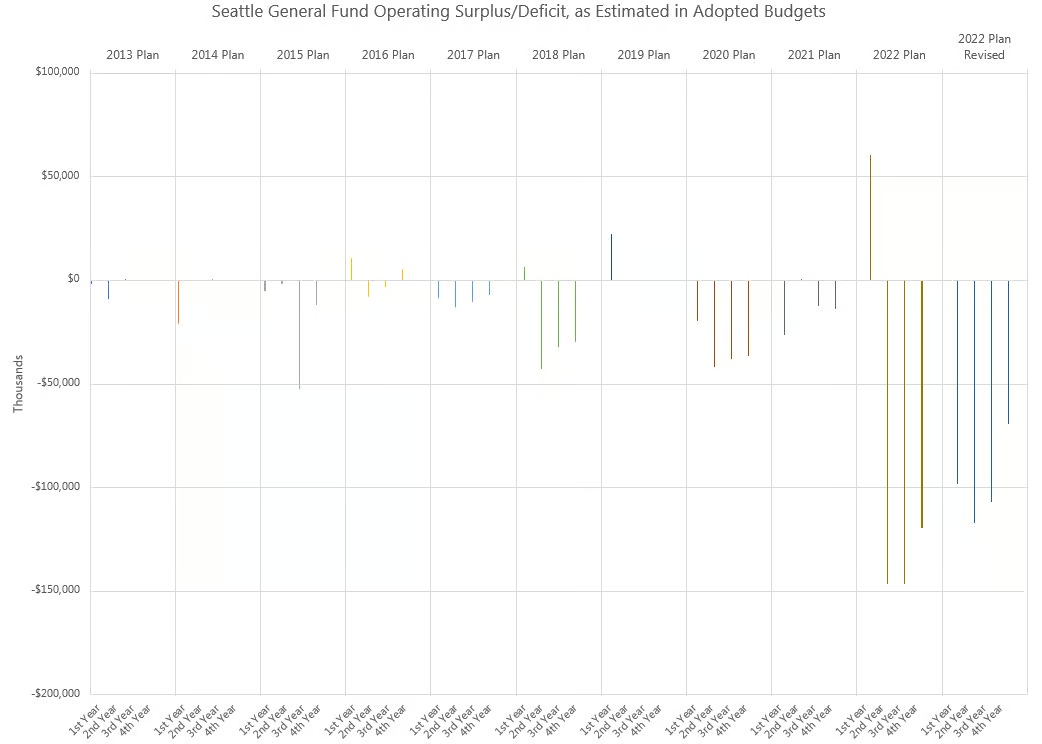
The presentation to the Finance and Housing Committee this week updates the 2022 GF financial plan to include the improved April revenue forecast, updated inflation estimates, and one-time carryforward spending and reserve replenishments. With these updates, GF operating deficits are expected in each year: $98.2 million in 2022, $117.2 million in 2023, $107.1 million in 2024, $69.3 million in 2025, and $37.7 million in 2026. The combined operating deficit for years 2023 through 2025 was originally $412.4 million and is now $293.6 million.
According to the staff memo, “While it is encouraging that these adjustments result in an improvement in the underlying financial condition of the GF, assuming the previously discussed economic assumptions are accurate, some combination of corrective measures will be required.” The memo notes some potential options, including cutting appropriations, assuming the optimistic revenue forecast instead of the baseline forecast, changing restricted fund policies to direct more revenue to the GF, and increasing revenues.
No decisions were made at the meeting—as Councilmember Mosqueda said, this exercise was to provide context for the committee as the city’s budget process begins (and the revised plans will change as the process proceeds). However, Councilmember Mosqueda also said,
We talked a lot about looking at existing revenue streams, but I think that there is still the situation, even with the passage of JumpStart, that we are in a very regressive tax state, and looking at potential progressive options as a longer-term solution is going to be important.
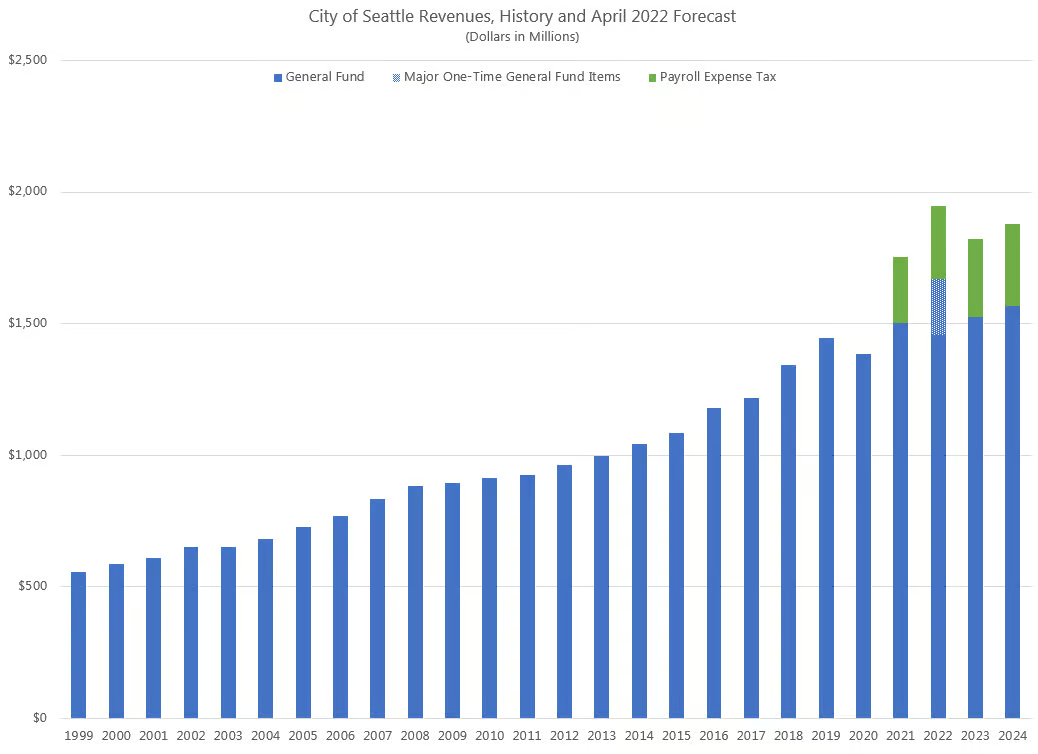
“JumpStart” refers to the payroll expense tax, which was adopted in 2020. In 2021, collections went to the GF, but beginning in 2022 they are deposited in a separate dedicated fund. Actual 2021 payroll expense tax revenues totaled $248.1 million, making it the fourth-largest tax source for the city. (If payroll expense tax revenues were kept in the general fund going forward, operating surpluses would be expected.)
As the chart below shows, even without the payroll expense tax, GF revenues are above pre-pandemic levels and are expected to continue to grow going forward (albeit at a slower pace than in 2018 or 2019).
Finally, the chart below shows how GF revenues and expenditures have grown over time. From 2010 to 2022, GF revenues grew by 86.6% while GF spending grew by 97.0%. (The figures for 2022–2026 are the revised estimates in the staff memo.)
