9:49 am
August 27, 2025
As I’ve written, the historically large tax increases that were enacted this year will effectively fund the new spending in the operating budget. The tax increases were not needed to maintain existing services.
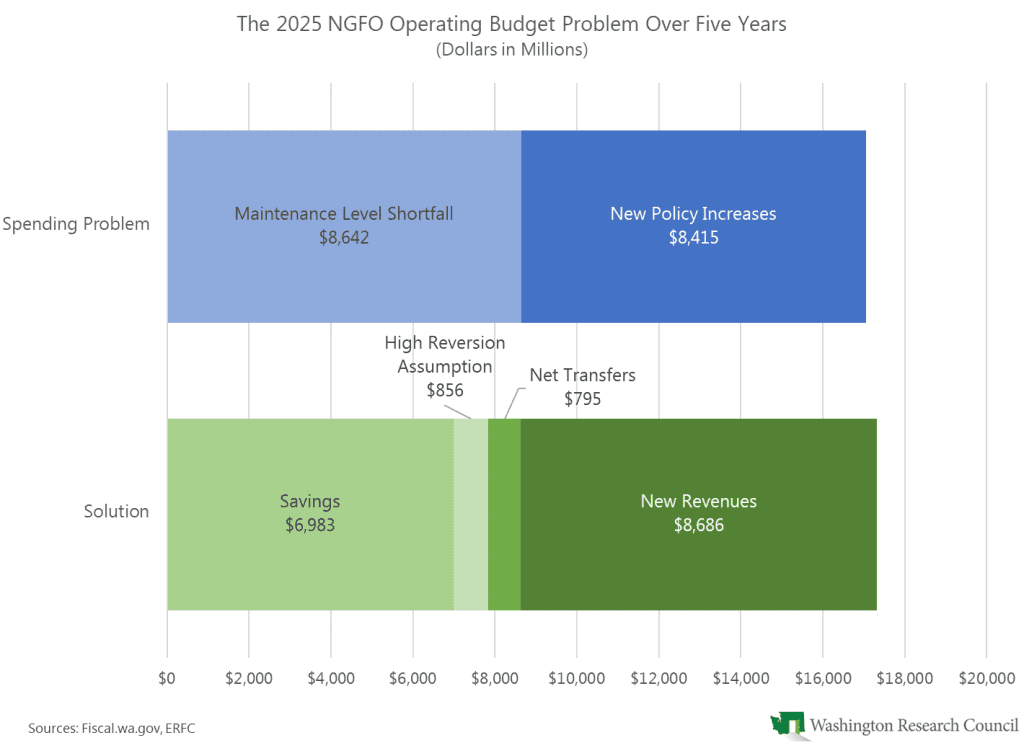
The chart below shows how the Legislature addressed the spending problem this year. First, the Legislature found $6.983 billion in savings from funds subject to the outlook (NGFO) over the five-year outlook period. (I detailed these savings items here.) Second, the Legislature assumed an unusually high level of reversions, which are appropriations that are not ultimately spent. This allowed the Legislature to increase appropriations by about $856 million while still balancing the budget. Third, transfers to the NGFO added $795 million in resources. (For example, the budget transfers $288 million from the public works assistance account to the NGFO and $110 million from the state treasurer’s service account to the NGFO.)
Those three items generated enough room in the budget to cover the maintenance level shortfall (the difference between forecasted revenues and the projected cost of continuing current services). However, the Legislature chose to add $8.415 billion in new policy spending. Thus, the new taxes will effectively fund the new policies.
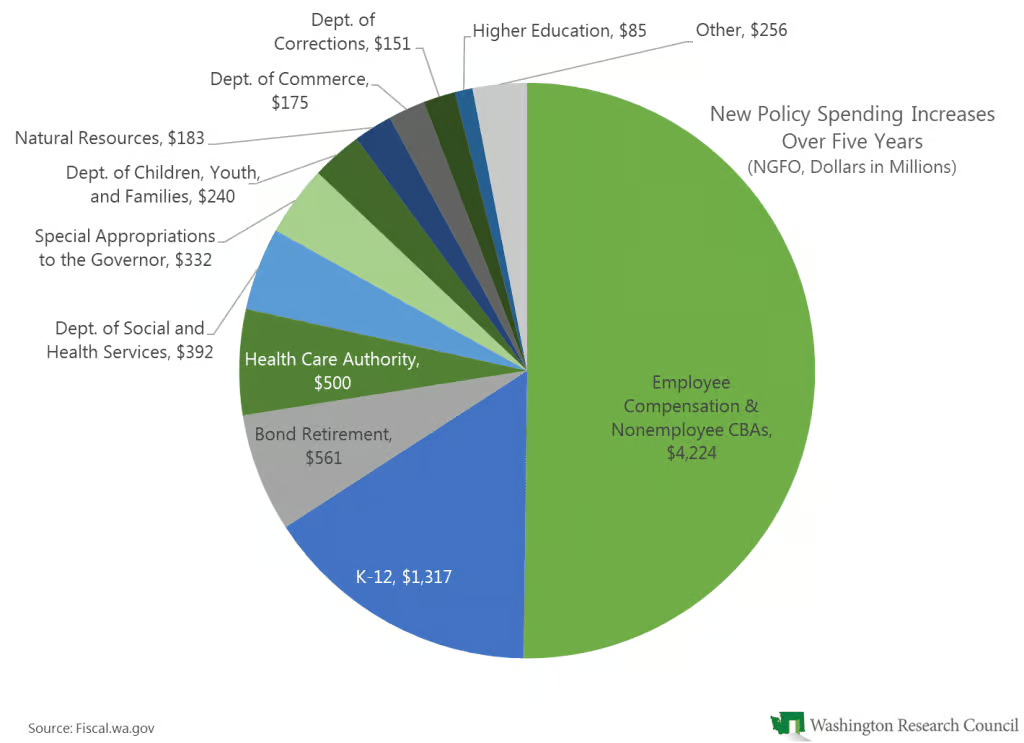
As the chart below shows, over half of the appropriations for new policy items are for collective bargaining agreements with employees and non-employees and other employee compensation increases.
About 16% of the total new policy items increase appropriations for public schools, including $759.2 million for special education; $213.8 million for materials, supplies, and operating costs; $202.1 million for local effort assistance; and $52.0 million for a one-time per-pupil enhancement.
Other major new policy items include:
- $560.5 million for bond retirement,
- $171.0 million for service provider rate increases,
- $168.1 million for community behavioral support services,
- $117.6 million for local housing programs,
- $100.8 million for the community reinvestment account,
- $100.0 million for local law enforcement grants,
- $93.3 million for emergency food assistance, and
- $84.8 million for the health care affordability account (which funds Cascade Care premium assistance).
(See our policy brief on the budget for more details about what was included.)