
11:06 am
August 22, 2025
The operating budgets enacted this year include $7 billion in savings to funds subject to the outlook over the five-year outlook period. (The outlook period includes revised appropriations for the final year of 2023–25, biennial appropriations for 2025–27, and the estimated cost of continuing those appropriations into 2027–29.)
The savings are more than offset by spending increases on other programs. For example, for 2025–27, the Legislature found $3.072 billion billion in savings but increased spending for other programs by $4.096 billion. The net increase compared to the 2024 supplemental is $1.024 billion. That said, the spending cuts are unusually large this year, as the Legislature needed to address an $8.6 billion maintenance level shortfall that was the result of its own prior spending choices. In addition to the savings, the Legislature adopted historically large tax increases.
Given the magnitude of the cuts, they are bound to contain many programs that some—even most—people would consider to be valuable and efficient uses of public funds. Indeed, since the end of the legislative session, many news stories have highlighted various programs that were cut in the state operating budget. For example, the budget cuts all K–12 grant programs. These include grants to Treehouse, which helps youth in foster care, as reported by the Seattle Times and Cascade PBS. The budget cuts also funding for diaper banks and eliminates funding for the Meaningful Day program for residents in adult family homes.
Some advocates have claimed that the $7 billion in savings (or some portion thereof) could have been prevented if only the state had enacted more new taxes. For example, in a June op-ed for the Washington State Standard, four organizations regretted the failure of proposed wealth and payroll expense taxes this session:
These policies would have raised the most revenue, made our tax code more equitable, and prevented cuts to vital services. . . .
In the end, legislators were forced to slash some services because they knew the governor would only approve a limited scope of revenue bills. They eliminated a program to support foster youth and delayed implementation of several programs, including early learning for kids from low-income households.
In fact, the wealth tax and the payroll tax would not have prevented spending cuts. As I wrote in May, the Senate operating budget proposal (which included a wealth tax and a payroll expense tax) and the House proposal (which included a wealth tax) also included virtually the same amount of savings as the budget that was ultimately passed by the Legislature. The enacted budget increased taxes by $9.0 billion over five years and cut $7 billion in spending items. The Senate budget would have increased taxes by $20.7 billion and still would have cut $7 billion in spending items.
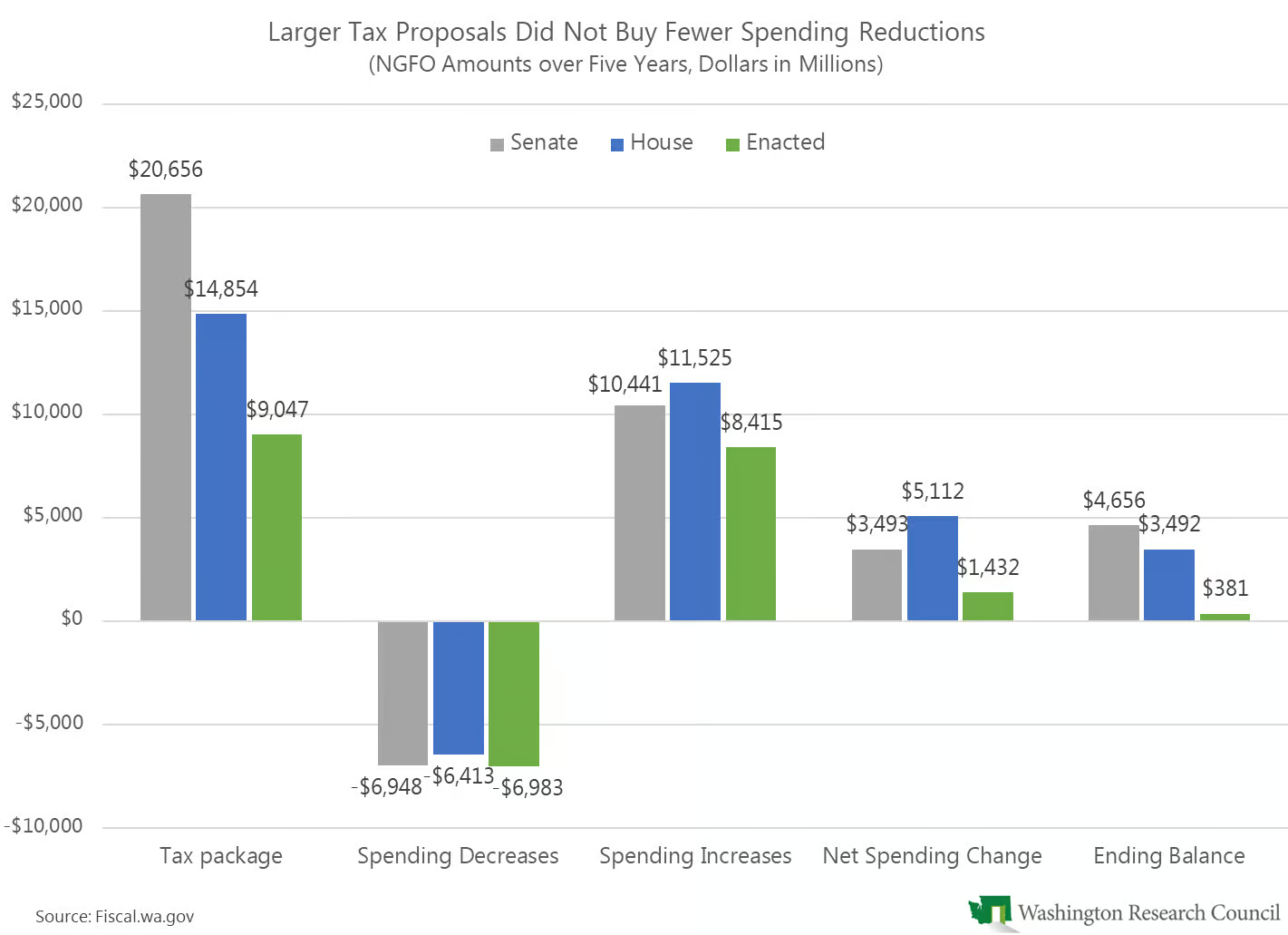
Not only do all three budgets include about the same level of savings, there is considerable overlap among individual savings items. For example, all three budgets included the elimination of all K–12 grant programs (including the grants for Treehouse), reduced funding for diaper banks, the elimination of the Meaningful Day program, and delays to expansions of early learning programs for low-income households. These, and many other programs, were simply not priorities for the Legislature—no matter how much new revenue they assumed.


Compare for yourself the savings items assumed in the three proposals—the data dashboard below shows every savings item in the enacted operating budget (as signed by the governor May 20), the Senate operating budget (as passed by the Senate March 29), and the House operating budget (as passed by the House March 31). Explore the data by time period, broad category of reduction, and state agency. Hovering your cursor over an amount will show you all the details about the item, including the state’s description.
For example, over the five-year outlook period, reductions for the Health Care Authority (HCA) total $630.9 million in the enacted budget, compared to $681.2 million in the House-passed budget and $989.1 million in the Senate-passed budget. Of the HCA reductions in the enacted budget, $204.6 million is to provider rates.
Some notes on the data:
- It is all in terms of the NGFO (funds subject to the outlook).
- The data comes from the interactive data reports and budget proposal agency detail documents at fiscal.wa.gov.
- The numbers are only the policy reductions; they are not the net impact to each program over the outlook period. (In some cases, a policy is reduced in one biennium, then added back in the next. The data here shows only the amount reduced.)
- I have loosely categorized the savings items as being program eliminations, program reductions, program delays, efficiencies and general reductions, underspends, shifts to other funds, shifts to user fees, compensation and rates, or other. These categorizations are subjective and are based on the policy descriptions provided by the Legislature in the agency detail documents. (In some cases, it is unclear from the state’s descriptions if a program is truly being eliminated, or if spending for the program is just being reduced.)

Tags: 2025-27