1:41 pm
June 11, 2025
The Legislature estimated that its 2025–27 operating budget balanced in 2025–27 and over four years, leaving an unrestricted ending balance in funds subject to the outlook (NGFO) of $225 million in 2025–27 and $673 million in 2027–29.
Yesterday, the Economic and Revenue Forecast Council (ERFC) adopted an official budget outlook based on the enacted 2025–27 budget. This outlook includes the impact of Gov. Ferguson’s vetoes and it makes other adjustments to the preliminary outlook that was prepared for the budget conference report in April.
As adopted, the official outlook (see page 19) estimates that the unrestricted NGFO ending balance is just $80 million in 2025–27 and $381 million in 2027–29.
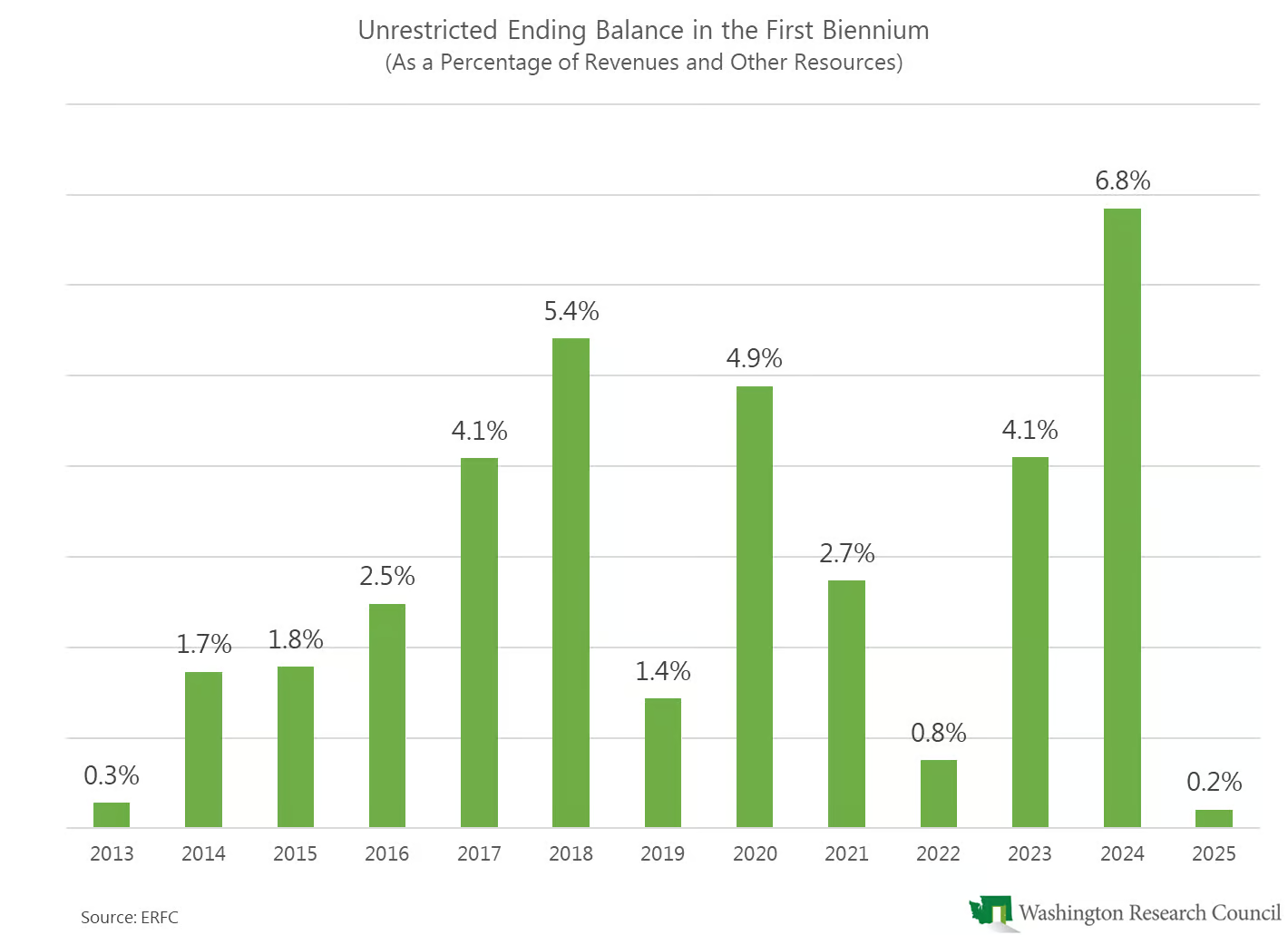
An ending balance of $80 million in the first biennium of an outlook is very low. It is the lowest ending balance in the first biennium since the very first outlook in 2013, which was $48 million. However, the NGFO budget is much larger now. The ending balance as a percentage of revenues and other resources is just 0.2% this year (in 2013, it was 0.3%).
The ERFC chose to follow the Legislature’s good example and adopt an outlook that does not assume 4.5% revenue growth in the second biennium. (The outlook statute allows the state to balance the maintenance level in the second biennium within the greater of the revenue forecast or an adjusted forecast that assumes annual revenue growth of 4.5%. Assuming 4.5% revenue growth when it exceeds the actual forecast is one of the causes of the maintenance level shortfall this year.)
The ERFC also chose to match the Legislature’s iffy reversion assumptions. Reversions are appropriations that are not ultimately spent. Thus, higher reversion assumptions mean that the state can appropriate more while still balancing the budget. The outlook this year assumes a higher than usual level of reversions. Although this is consistent with experience since the pandemic, it will not necessarily hold through the outlook period. (Reversions have been higher because of increased federal funding and the state hiring freeze.) For example, estimated reversions for 2025–27 are $764 million, significantly higher than the projected ending balance. If agencies spend up to their appropriation levels, the budget will be out of balance.
Why did the projected ending balance decline in the official outlook (compared to the preliminary legislative outlook)?
First, the governor vetoed some spending and revenue items. Together, the vetoes reduce the projected ending fund balances by $47 million in 2023–25, $85 million in 2025–27, and $142 million in 2027–29.
Second, as I’ve noted, the fiscal notes for the tax bills do not take into account the interactions between the bills. (For example, the fiscal note for ESSB 5794 assumes that the service and other activities business and occupation tax rate consists of two tiers: 1.5% and 1.75%. But ESHB 2081 would add a third tier.) The conference report outlook assumed the revenue impacts as estimated in the individual fiscal notes. The adopted outlook estimates that the interactions between the B&O bills will reduce their overall revenue impact by $35 million in 2025–27 and $47 million in 2027–29.
Third, the conference report outlook assumed that there would be increasing reductions to state funding for the operating costs of The Evergreen State College each year (for total savings over the outlook period of $14.3 million). The adopted budget instead assumes the same amount of reductions each year (for total savings over the outlook period of $8.1 million) because increasing the amounts would require a policy decision in 2027–29.
Fourth, the adopted outlook makes different assumptions about Health Care Authority gain share payments than the conference report outlook did.
The low $80 million ending balance for 2025–27 presages another tough budget next year. (For example, the state could need much more than that just to backfill the liability account.)
Categories: Budget.