11:43 am
October 2, 2026
Following the revenue forecast last week, Sen. Robinson and Rep. Ormsby talked about the state having just a “short-term” budget problem. Similarly, Gov. Ferguson said, “Our state continues to face significant short-term budget challenges.” Whether or not the problem is “short-term” will depend on legislative action.
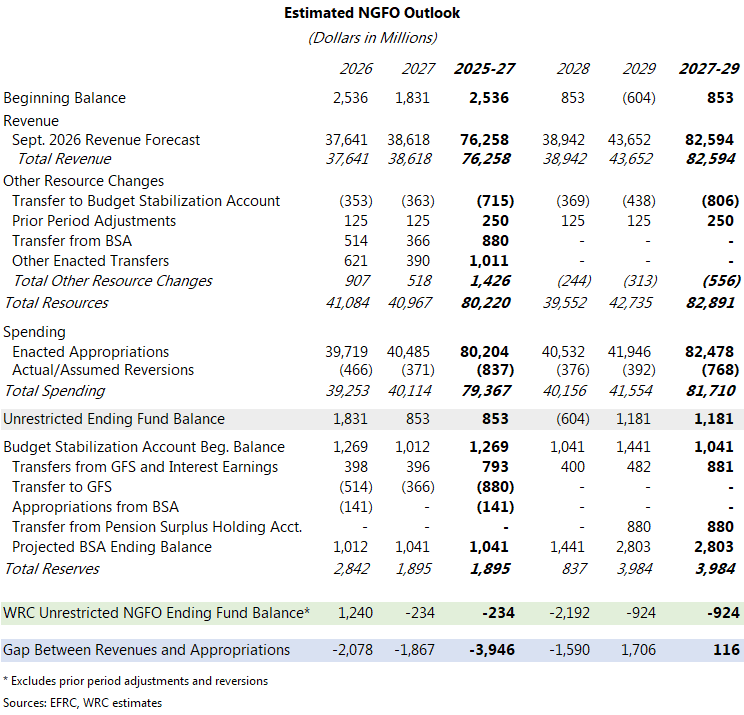
The comments made by Sen. Robinson and Rep. Ormsby during the Economic and Revenue Forecast Council (ERFC) meeting seemed to be focused on the estimated unrestricted ending balance in funds subject to the outlook (NGFO) in FY 2028 compared to FY 2029. Indeed, the official outlook for the 2026 supplemental estimated that the unrestricted NGFO ending balance would be -$802 million in FY 2028 and $653 million in FY 2029 (the first year of income tax collections).
I estimate that the combined impacts of the June and September revenue forecasts improve the unrestricted NGFO ending balances in both years, but there would still be a shortfall of about -$604 million in FY 2028 (all else equal). (See the row shaded gray in the outlook below.) The ending balance calculation makes use of both ongoing revenues and one-time funds (including the beginning balance and transfers from other accounts).
Note that the estimated ending balances assume that appropriations will only increase by 2.8% in 2027–29. The last time biennial spending increased by less than 7.7% was in 2011–13, when the state was dealing with revenue losses in the Great Recession.
Additionally, the estimated ending balance includes some dubious accounting assumptions. Excluding those, I estimate that the NGFO ending balance is about -$234 million at the end of 2025–27 and -$924 million at the end of 2027–29. (See the row shaded green in the outlook below.)
At the ERFC meeting, Jerry Cornfield of the Washington State Standard asked Sen. Robinson if she expects to make spending cuts next year, and she said, “I think we need to find ways to reduce current spending so that we can balance fiscal year 28.”
It is important to understand that the Legislature doesn’t just need to close a $604 million shortfall in FY 2028 (given the spending assumed in the outlook, based on enacted 2026 appropriations). They need to close a $1.59 billion shortfall that year in order to bring appropriations back in line with ongoing revenues. (See the row shaded blue in the outlook above.) The gap between the two was created by the Legislature in 2023–25 and is the cause of the budget shortfalls we have experienced since then.
The $1.59 billion estimate will change as the updated maintenance level (the cost of continuing current services and services planned in statute, adjusted for caseloads and inflation) for 2027–29 is developed. There are two caseload forecasts and two revenue forecasts before the Legislature writes the budget.
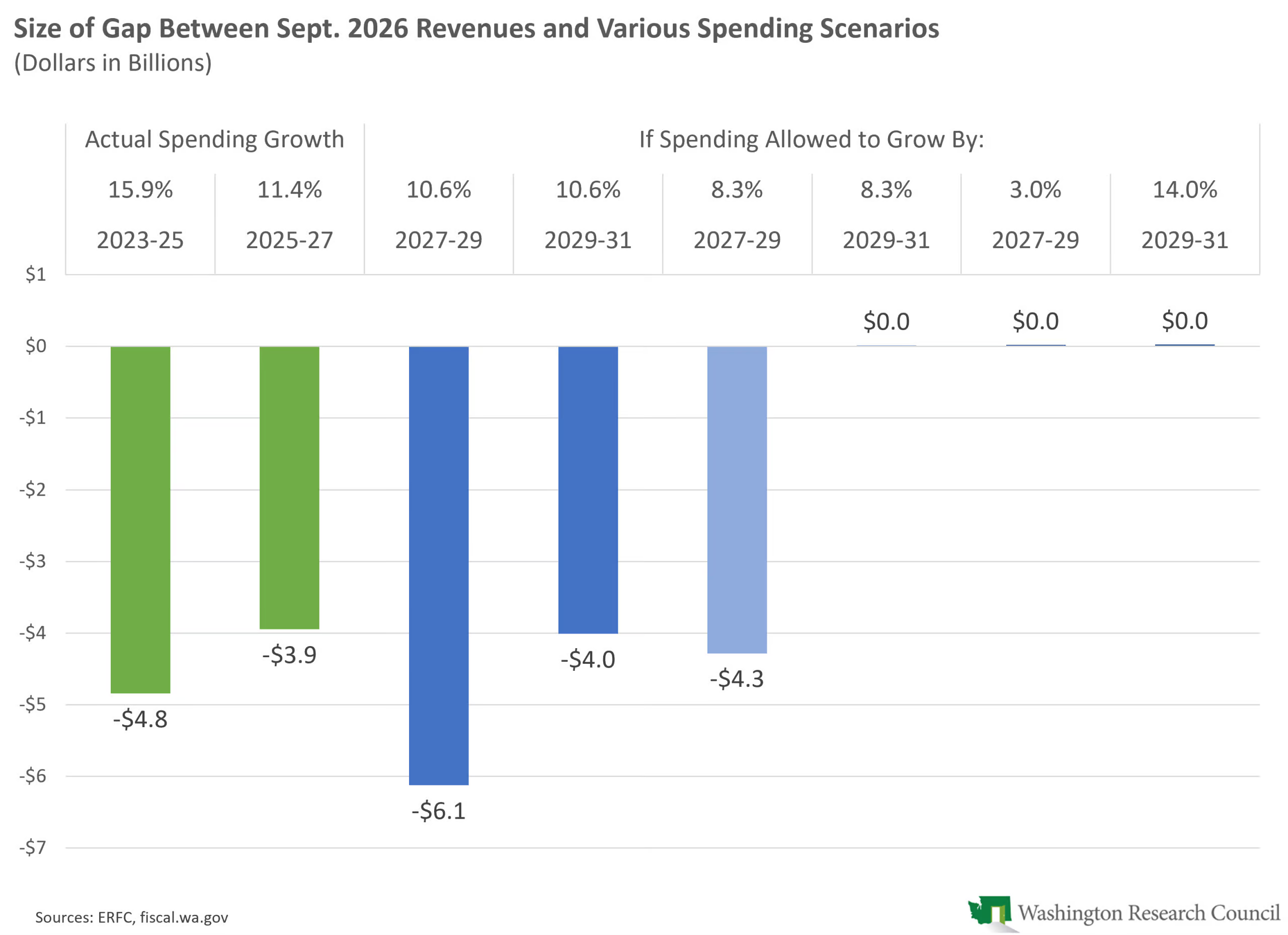
The chart below shows some hypothetical spending scenarios, assuming the September revenue forecast. The size of the gap between enacted 2025–27 appropriations and 2025–27 revenues, as forecasted in September, is $3.9 billion.
- Long-term average biennial spending growth is 10.6%. (This calculation includes growth going back to 2001–03; average growth since 2013–15 has been 15.6%.) If appropriations are allowed to grow by 10.6% in 2027–29 and 2029–31, the gap would increase to $6.1 billion in 2027–29 and $4.0 billion in 2029–31 (which includes two years of income tax collections).
- The Legislature could close the gap over two biennia if they hold appropriations growth to 8.3% in each biennium.
- The Legislature could close the gap in 2027–29 by holding appropriations growth to 3.0%. Then, appropriations could grow 14.0% in 2029–31 (the estimated revenue growth that biennium).
This exercise shows that income tax revenues do not solve the problem in the absence of spending restraint. Further, if the Legislature continues to balance the budget on paper by using one-time resources and making questionable accounting assumptions, the underlying problem will persist. Earlier this year, two of the credit rating agencies reduced Washington’s credit outlook to negative. Moody’s wrote that it could downgrade Washington’s credit rating if the Legislature relies on reserves and other one-time solutions to balance the budget.
To maintain our good credit and bring normalcy back to the budget process, the Legislature should restrain appropriations so they do not exceed ongoing revenues in the next budget.