

Given the economic downturn, Gov. Inslee vetoed some provisions in the transportation budget
Gov. Inslee signed the supplemental transportation budget yesterday, but he vetoed several sections. As passed by the Legislature, the budget appropriated $10.373 billion. (That’s an increase of $538.0 million over original 2019–21 appropriations.) Transportation budget writers were working under constraints imposed by the passage of I-976 last year. The Seattle Times reported, The $10.4 billion […]
November 26 , 2019 - Emily Makings
The transportation revenue forecast and I-976
Both the Senate and House Transportation committees held work sessions last week that included discussions of the impacts of I-976. (TVW has video of the Senate and House committee meetings.) A Senate staff presentation showed balance sheets for each affected account. Given the 2019–21 appropriations made earlier this year and the revenue reductions under the […]
November 14 , 2019 - Emily Makings
Tax policy after the election
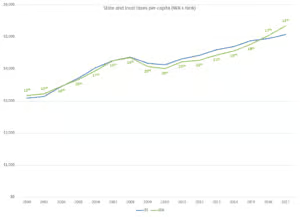
In the wake of the passage of I-976 and the results of some local races, tax policy is an emerging theme. For example, King County Executive Dow Constantine used the occasion to call for comprehensive state tax reform: Our state’s tax system is inefficient, unfair, volatile, inadequate, and bad for business. Local governments have few […]
November 07 , 2019 - Emily Makings
How to respond to I-976?
There is a lot of talk today about how state and local governments will respond to the passage of I-976. In the Seattle Times, Heidi Groover and Mike Lindblom have a thorough story on the issue. The fiscal impact statement for the initiative estimated that it would reduce state revenue by $478.1 million in the […]
October 30 , 2019 - Emily Makings
The budget implications of I-976
Heidi Groover has a story in the Seattle Times today that considers what might happen with the state budget if I-976 is approved. (I-976 would reduce vehicle fees and revoke local governments’ authority to levy certain transportation fees and taxes.) The initiative would significantly reduce state and local funding for transportation. As we wrote in […]
October 23 , 2019 - Emily Makings
More on the proposed new tax on Uber and Lyft in Seattle
Kevin Schofield of SCC Insight provides a rundown of some of the issues the Seattle City Council is debating as part of the 2020 budget. One of these is Mayor Durkan’s proposal to levy a new tax on transportation network companies (TNC; i.e., Uber and Lyft). The Council’s staff memo on the proposal includes some […]
October 16 , 2019 - Emily Makings
Washington cities largely fund transportation from local revenue sources
According to a study commissioned by the Joint Transportation Committee (JTC), Washington cities collectively face an annual gap of about $1 billion between their available funding for transportation and their transportation preservation and maintenance needs. As Lens reports, the study was presented to the Washington State Transportation Commission yesterday. (The $1 billion figure does not […]
October 09 , 2019 - WRC
New brief: I-976: Reversing Transportation Taxes and Fees
I-976 would limit annual state and local vehicle license fees to $30, revoke the authority for transportation benefit districts to impose vehicle fees, repeal the state motor vehicle sales tax, revoke Sound Transit’s authority to impose a motor vehicle excise tax (if possible to do so under the terms of its bonds), and specify that […]
September 27 , 2019 - Emily Makings
As part of her 2020 budget proposal, Seattle mayor would add a new tax on Uber, Lyft
Earlier this week Seattle Mayor Jenny Durkan proposed a city budget for 2020. The Seattle Times reports, “The mayor’s proposed budget calls for $6.5 billion in total spending in 2020, including infrastructure projects and $1.5 billion in general-fund allocations for basic services such as parks maintenance and policing.” The mayor does not propose major spending […]
July 26 , 2019 - Emily Makings
The costs of fixing culverts
Under an injunction issued by the U.S. District Court in 2013, the state of Washington must fix fish passage barriers in Western Washington by 2030. The state has begun this work, but there is a lot left to do. In the 2019–21 transportation budget enacted this year, the Legislature appropriated $100 million to replace culverts […]