
11:53 am
November 26, 2019
Both the Senate and House Transportation committees held work sessions last week that included discussions of the impacts of I-976. (TVW has video of the Senate and House committee meetings.) A Senate staff presentation showed balance sheets for each affected account. Given the 2019–21 appropriations made earlier this year and the revenue reductions under the initiative, the following accounts are estimated to have negative ending balances in 2019–21:
- Multimodal Account, -$344.1 million
- Motor Vehicle Account, -$65.9 million
- State Patrol Highway Account, -$21.6 million
- Transportation Partnership Account, -$12.2 million
- Transportation Improvement Account, -$495,000
Additionally, the Transportation Revenue Forecast Council adopted its November 2019 forecast last week. From the summary: “In the 2017-19 biennium, transportation revenues came in at $6.42 billion and 2019-21 biennium is anticipated to be $6.26 billion which is $0.16 million or 2.5% lower than the prior biennium. This decrease from the prior biennium was due mainly to the passage of Initiative I-976 which caused a significant reduction in certain transportation revenues beginning FY 2020.”
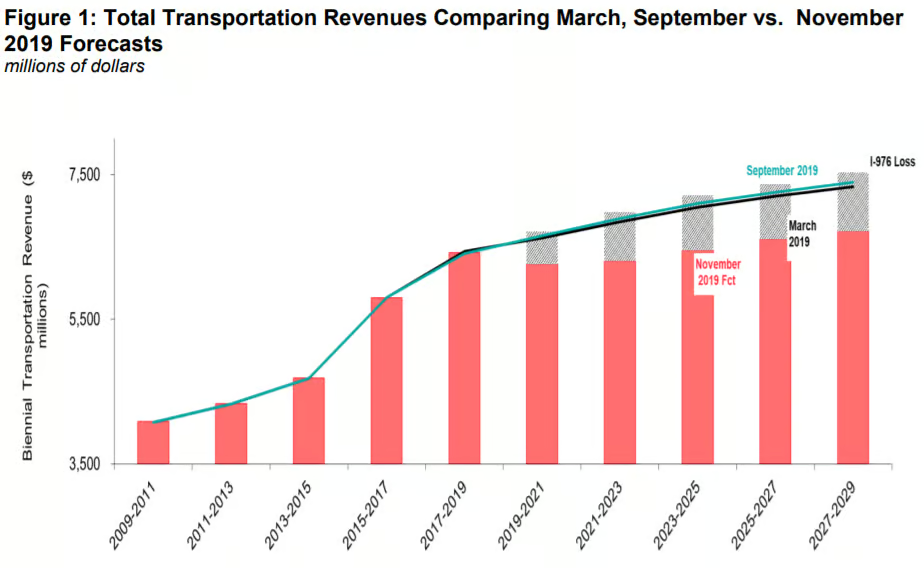
An alternative state transportation revenue forecast was prepared to show what the revenue forecast would have been but for the passage of I-976 (beginning on page 22 of the pdf). The chart below shows the impact of I-976 by biennium. For 2019–21, state transportation revenues are now expected to be $453.6 million lower than they would have been if I-976 had not passed.

The chart below (from the forecast summary) shows the March, September, and November transportation revenue forecasts and the impact of I-976.
Although the initiative has been challenged in court (a hearing is being held in King County Superior Court today on plaintiffs’ request for a preliminary injunction), the chairs of the transportation committees, Sen. Steve Hobbs and Rep. Jake Fey, both suggested last week that the transportation budgets would be cut.
Chair Hobbs said, “My intention is to do the cuts regardless of what happens because you don’t know what’s going to happen. I’d rather just get ahead of the game on this one.” Chair Fey said,
We can’t assume that we’re going to win the case, right? Because if we spent the money . . . and we were basically $478 million out of budget, we can’t responsibly do that. So we cannot assume that the initiative will be overturned. Unless we get some different guidance from the court when they make their preliminary injunction decision, maybe that will change things, I kinda doubt it, or if it’s overturned at some point in time, then we’ll have to decide if we’ll make adjustments at that point in time. . . . The voters get to do their thing, and we’re the ones that are ultimately accountable here. We have to make the hard decisions that need to be made in this particular case.
Bill Lucia has a story in Route Fifty that discusses the issue: “The situation in Washington illustrates how even in a state with relatively healthy finances and a thriving economy, policymakers can face challenges in figuring out how to pay for transportation programs—especially when unexpected drops in revenue occur.” (The story includes a number of interesting quotes from legislators as to what is to be done.)
Categories: Budget , Categories , Transportation.