11:20 am
October 2, 2024
On Friday, the new Transportation Economic and Revenue Forecast Council (TERFC) approved its first transportation revenue forecast. This is great news for the public because it’s a huge improvement in transparency. It’s good news for the Legislature because the transportation revenue forecast is no longer on autopilot. But it’s also bad news because revenues are now expected to be significantly lower than previously estimated.
The transportation revenue forecast includes revenues from motor vehicle fuel taxes; vehicle and driver fees; ferries; tolls; the 0.3% vehicle sales and use tax; the rental car tax; and various other transportation-related sources. It does not include revenues from the carbon emission allowance auctions.
The September forecast estimates that transportation revenues will be $6.881 billion in 2023–25, $7.081 billion in 2025–27, and $7.209 billion in 2027–29. These numbers are lower than had been estimated for the biennia in the Feb. 2024 forecast (on which the current budget was based): by $109.8 million (1.6%) for 2023–25, by $259.1 million (3.5%) for 2025–27, and by $368.9 million (4.9%) for 2027–29. (Forecast summaries and details are available here.)
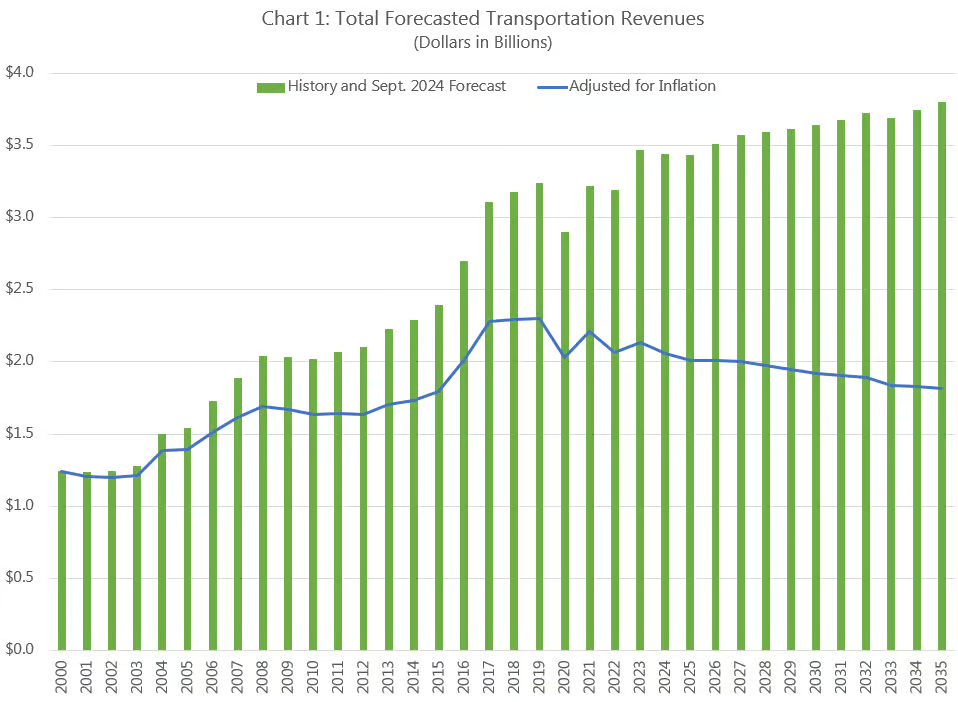
Chart 1 shows total forecasted revenues over time. In our report last year on transportation funding challenges, we noted that forecasted transportation revenues were expected to decline by 6.7% from 2023 to 2033 when adjusted for inflation. Now, they are expected to decrease by 13.8% over the same period.
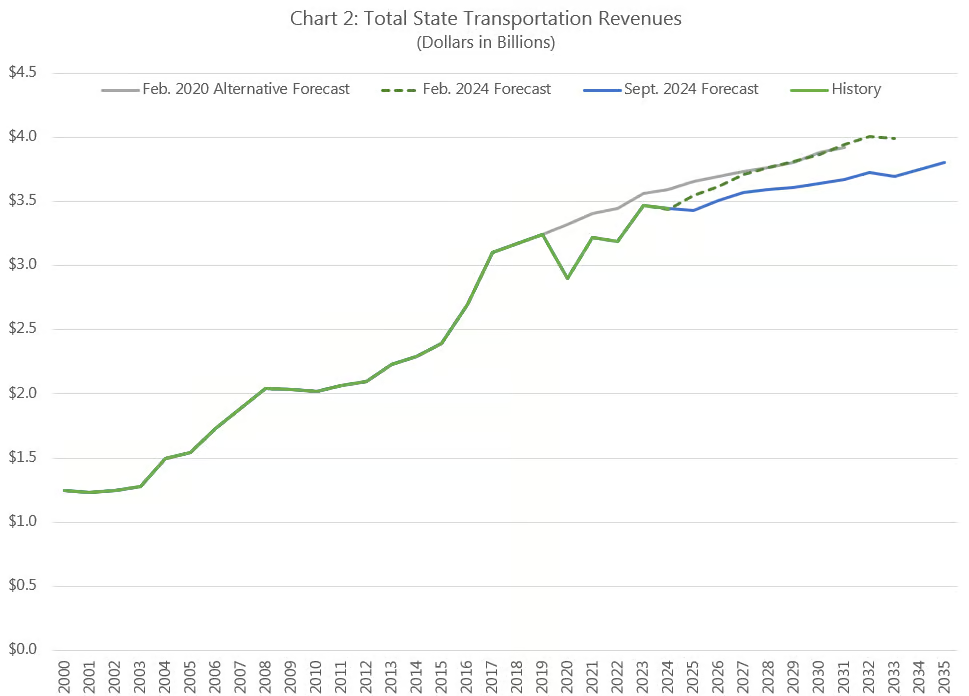
The decline in revenues compared to prior forecasts is so substantial because the forecast for motor vehicle fuel taxes—which are the largest source of transportation revenues—had not been meaningfully updated since June 2023. In preparation for the new forecast, the Economic and Revenue Forecast Council (ERFC) and Department of Transportation (WSDOT) worked with economists at Western Washington University to create a new model that would allow them to update the motor vehicle fuel tax forecast. Charts 2 and 3 compare revenues by forecast. (Note that these are not adjusted for inflation.)
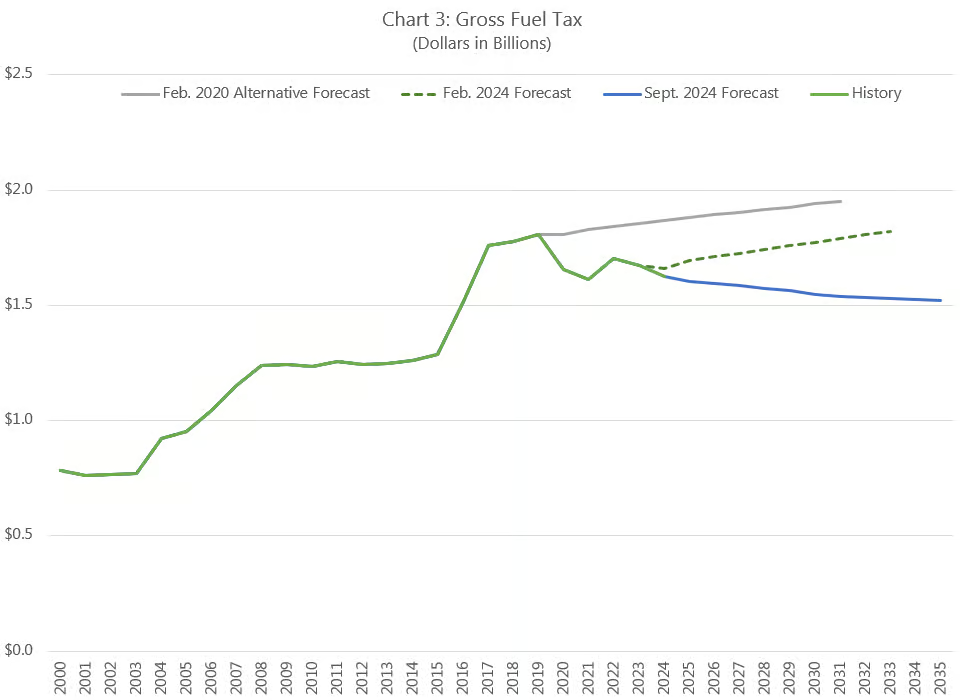
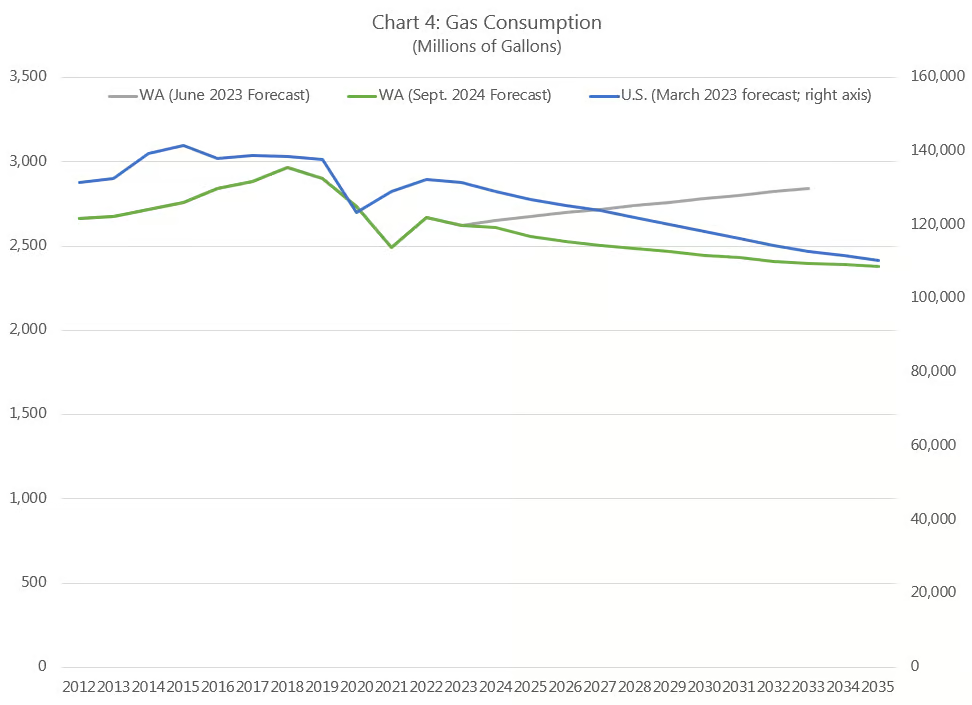
Underlying the new gas tax forecast is a new forecast of gasoline consumption. Previously, WSDOT had estimated that consumption would increase by 8.5% from 2023 to 2033. Now, over the same period, consumption is expected to decrease by 8.4%. This new trajectory is more in line with what is expected at the national level by the U.S. Energy Information Administration.
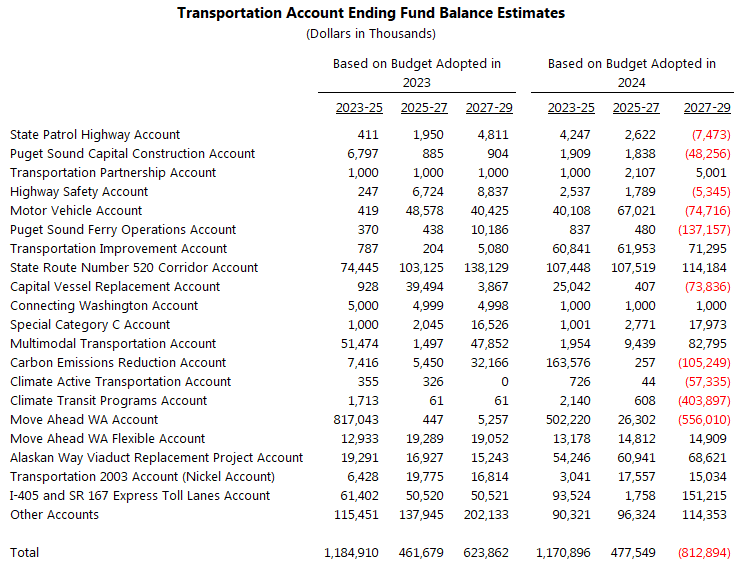
The September revenue forecast reductions worsen an already bad outlook for transportation funding. As I wrote this spring, the original 2023–25 transportation budget had balanced over six years (i.e., through 2027–29). However, the 2024 supplemental balanced only through 2025–27. At the time the 2024 supplemental was adopted, many transportation accounts were already facing shortfalls beginning in 2027–29. (The table is a point-in-time estimate of ending balances; it does not incorporate the new revenue forecast.)
Back to the great news: Previously, the transportation revenue forecast was prepared by WSDOT (along with various other agencies). Now the ERFC is responsible for producing the forecast, and the forecast is officially approved by the TERFC (made up of four legislators, the state treasurer, the director of the Office of Financial Management, and the director of the Department of Licensing).
The Friday presentation to the TERFC and accompanying summary tables were much more informative and useful than the presentations used to be. Further, the presentation was covered by TVW—a vast improvement over the prior process, in which meetings weren’t even publicly announced. (Unfortunately, in a reminder of the old days, the forecast documents were not posted until yesterday morning. I hope that, going forward, the ERFC will make the documents publicly available at the same time the forecast is approved.)
Categories: Budget , Tax Policy , Transportation.