
9:08 am
July 2, 2024
The June transportation revenue forecast was presented last Wednesday and published yesterday, but I won’t report the total numbers. They are dubious and irrelevant.
The June forecast is suspect because the estimates for gross fuel tax revenues haven’t been updated since September 2023 (and in September, the change was very small—only $1 million over ten years). Effectively, Washington hasn’t had a gross fuel tax revenue forecast since June 2023. This calls the whole transportation revenue forecast into question because the gross fuel tax is its largest revenue source (50.6% of 2021–23 transportation revenues).
I flagged this issue when the February 2024 forecast was published. As I noted then, the state has been working with economists from Western Washington University on a new fuel tax revenue model. During a May meeting to discuss the assumptions for the June revenue forecast, they said that the new model would not be ready in time for the June forecast. In the meantime, state agency staff suggested that they did not have enough confidence in the old model to even just update it with new collections information.
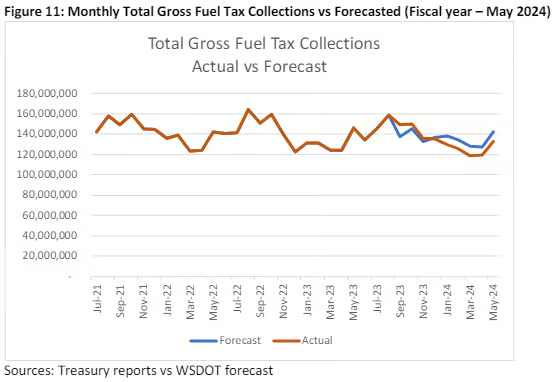
Hence the unchanged revenue forecast, even as the state knows that FY 2024 fuel tax collections have been coming in lower than the forecast. The forecast documents include the chart below that shows how gross fuel tax collections have been tracking. Apparently, FY 2024 gross fuel tax collections through May have come in $24.3 million below the forecast for the year (-1.6%).
That said, the June forecast does include a new motor fuel price forecast methodology; thus, it presents new estimates of gas prices for the first time since Sept. 2023. According to the forecast, it “indicates a leveling off between $4 and $4.7 per gallon for retail gasoline and diesel in 2024 and 2025.”
The good news is that the June forecast is fairly irrelevant for budget-writing purposes. There will be three more forecasts before the Legislature writes the 2025–27 transportation budget. Additionally, the responsibility for the forecast will shift soon to the Economic and Revenue Forecast Council (ERFC), which will produce the September transportation revenue forecast.
In a positive sign for transparency, the ERFC has already added the transportation revenue forecast adoption to its public meetings calendar. (The current process is very opaque.) I hope the ERFC will also overhaul how the forecast is presented. The current format makes it needlessly difficult to compare total revenues from one forecast to the next or to historical collections. It makes a lot of detailed forecast components available, but the overall effect is to bury the numbers that are important for budget writers and the public.
Categories: Budget , Transportation.