1:03 pm
June 29, 2021
Constitutionally required deposits to Washington’s rainy day fund (the budget stabilization account, or BSA) are based on “general state revenues.” General state revenues (GSR) are defined in Art. VIII, sec. 1 of the state constitution. Essentially, they are funds deposited in the general fund–state (with some exceptions). Under Art. VII, sec. 12, 1% of GSR must be transferred to the BSA annually. Additionally, three-quarters of any extraordinary GSR growth must be transferred to the BSA each biennium. (General state revenues are also used to calculate the state debt limit.)
The Office of Financial Management (OFM) estimates that, based on the June 2021 revenue forecast, GSR will be $50.754 billion in 2019–21, $55.486 billion in 2021–23, and $58.847 billion in 2023–25. These estimates would mean higher transfers to the BSA than were assumed in the official June budget outlook (which was based on the March revenue forecast). I estimate that, given these GSR figures, the BSA ending balance will be $9 million in 2019–21, $565 million in 2021–23, and $1.158 billion in 2023–25.
However, the transfers to the BSA are lower than they would be if capital gains tax collections were not directed to a dedicated account. If the capital gains tax remains on the books, the first $500 million a year will go to the education legacy trust account (ELTA) and any collections on top of that will go to the common school construction account. Thus, collections will not be included in GSR and will not feed into the required transfers to the BSA. This is particularly a problem for the capital gains tax because it is volatile; if it at least fed into the BSA, it would help build reserves in good years that could be used to offset lower than expected revenue in bad years.
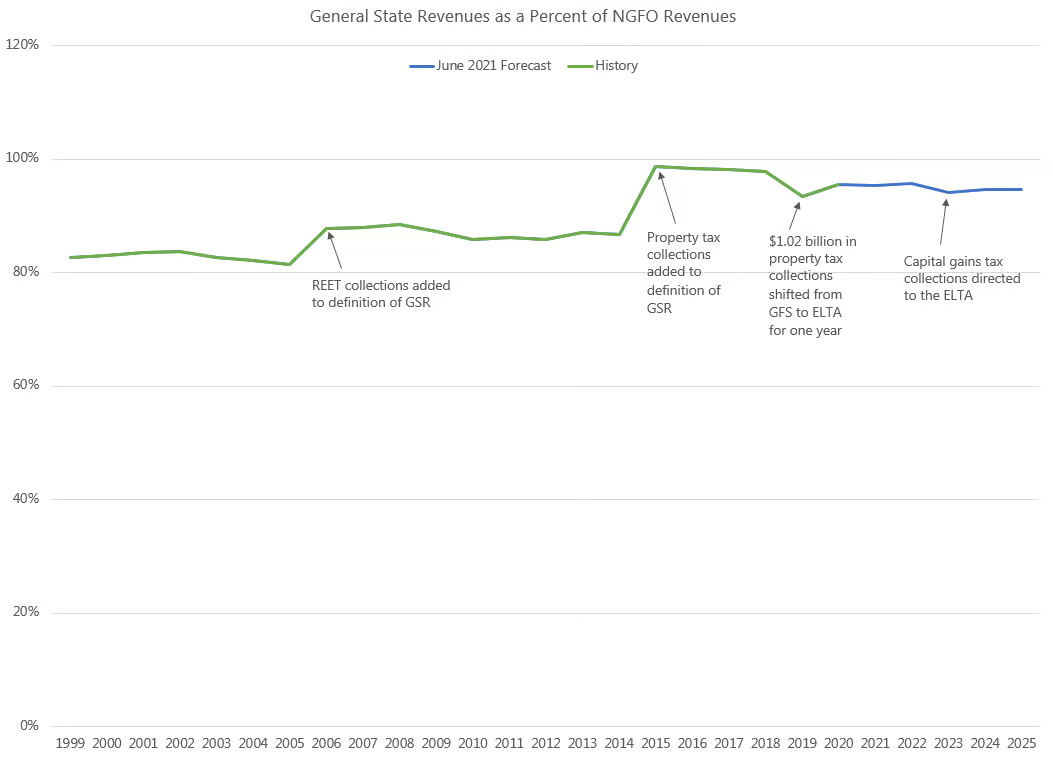
Generally, GSR as a share of funds subject to the outlook (NGFO) should be as high as possible to help ensure adequate reserves. The operating budget is required to balance over four years; the accounts subject to this requirement (collectively the NGFO) are the general fund–state (GFS), ELTA, opportunity pathways account, and workforce education investment account (WEIA). (As of July 25, 2021, the fair start for kids account will also be included.)
As the chart shows, GSR as a percent of NGFO reached a high of 98.8% in 2015 (when the property tax was added to the definition of GSR). Based on the June revenue forecast, GSR is estimated to be 94.2% of NGFO in FY 2023, when capital gains taxes will first be collected.