1:50 pm
September 9, 2025
Last week the Office of Financial Management (OFM) released a report on the impact of tariffs on Washington state. The report provides estimates of how federal tariff policy could affect prices, jobs, state revenues, and economic growth. Meanwhile, the preliminary September economic forecast from the Economic and Revenue Forecast Council (ERFC) cites the tariffs and related uncertainty as “major risks” to the state economy.
OFM’s analysis appears to be based on a May estimate from the Washington Council on International Trade that the federal tariffs imposed under the International Emergency Economic Powers Act (IEEPA) “could cost Washington companies between $18 billion and $21 billion in extra tariffs” a year. OFM assumes that these tariffs will “remain in place until 2029.” However, the reliance on the IEEPA for this purpose has been ruled illegal by a federal appeals court. The Trump administration has asked the U.S. Supreme Court to take the case. Thus, the OFM report may soon be moot.
Still, it is important to consider the potential effects of tariffs on our state. In general, tariffs are bad tax policy, as they are much more distortionary than other taxes. (Walt Whitman put it best: “Of all robbers I think the tariff is the meanest robber. It has such sneaky, sneaking ways: it hits you in the back—hits you when you ain’t lookin’: gives you no sort of chance to protect yourself.”)
The OFM report includes an estimate of the potential effects of the tariffs on state revenues. Aside from the fact that the estimates may be moot, OFM specifies, “The report does not present a comprehensive revenue forecast because the goal is to isolate tariff-induced changes in economic activity. It is not intended to account for broader fiscal or macroeconomic shifts that may also affect state revenues.”
Indeed, as today’s preliminary economic forecast from the ERFC shows, the federal tariffs paid by Washingtonians are not the only negative economic factor we face. There is also considerable uncertainty for businesses related to tariff policy, inflation continues to be an issue, and the state itself adopted historically large taxes earlier this year. The ERFC writes, “The major risks to the U.S. and Washington economies continue to be the impacts of trade policy and changes to federal government spending, employment and services, along with high interest rates and geopolitical conflict.” According to the ERFC, the economic forecast would improve if “tariffs are avoided or lower or just more certain.”
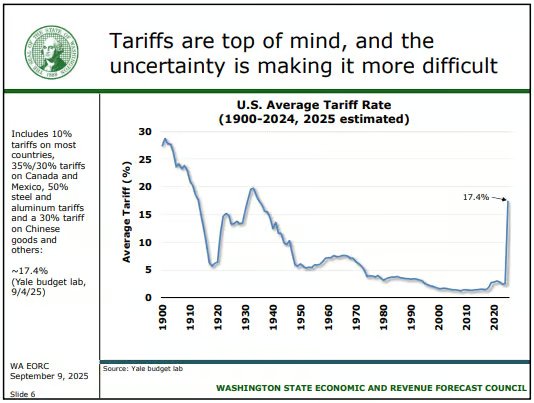
The economic forecast will underpin the Sept. 23 revenue forecast. Until then, it’s not clear how these economic factors will affect state revenues. The ERFC notes, “Overall, the changes to the economic forecast are very small” compared to June. At the same time, though, “There is a significant amount of uncertainty in the forecast due to trade and federal/fiscal policy.”
If the state revenue forecast is reduced, it will deepen the already-expected operating budget shortfall. The budget enacted this year was not sustainable and left a very small ending balance. That small ending balance declined even more due to economic changes in the June revenue forecast.
Categories: Budget , Economy , Tax Policy.