2:08 pm
September 7, 2023
The state Supreme Court has ruled that “school capital construction costs are not a component of the ‘education’ that the State, alone, must amply fund” under the state constitution.
Wahkiakum School District had sued the state in 2021. The district argued that the state wasn’t amply funding school construction and instead relied on local levies, which are dependent on local voters. However, as I noted when the Wahkiakum suit was filed, the Court had said in 2017 that full state funding of school construction is not part of the program of constitutionally-required basic education.
The Court’s opinion today notes, “The historical context shows that the constitution, the legislature, and the people have historically treated capital construction costs differently from other education costs. And the burden of funding those costs has always been shared between the State and the locality.”
But what is the appropriate split? According to the opinion, because Wahkiakum argued that the state bears full responsibility for school construction, it
did not address how much responsibility the State might bear for school capital construction costs if it were less than 100 percent of those costs. We therefore do not address whether there are constitutional parameters to this shared responsibility. We hold only that the article IX, section 1 “education” for which the State, alone, must provide ample funding does not include school capital construction costs.
A concurring opinion agrees that school construction is not part of basic education, but it would ask parties, on remand, to
discuss how much responsibility the State may bear for school capital construction costs if it is less than 100 percent of those costs, and whether article IX, section 3 creates an obligation that the common school construction fund be distributed in a manner that is accessible to the low-income, rural districts.
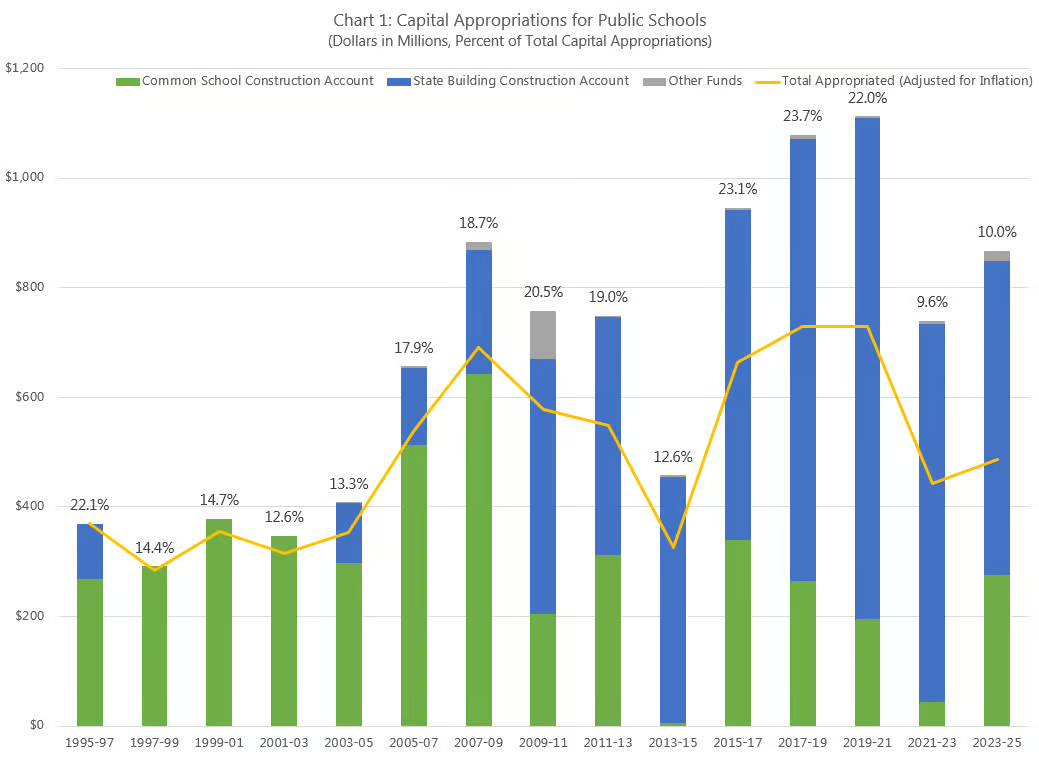
The common school construction account (CSCA) has not been the primary source of state funding for school construction since before the Great Recession. The enacted 2023–25 capital budget appropriates $867.6 million for public schools, which is 10.0% of the total capital budget. As Chart 1 shows, in the state capital budget for the current biennium, about two-thirds of funding for school construction comes from the state building construction account (state bond proceeds) and almost one-third comes from the CSCA.
That said, under the state’s capital gains tax, any collections over $500 million (adjusted for inflation) will go to the CSCA. The March 2023 revenue forecast (on which the state’s current budgets were based) estimated that the CSCA would not receive any capital gains tax revenue in 2021–23 and would get $197 million in 2023–25. However, collections have come in higher than expected. The June 2023 forecast estimates that the CSCA will receive about $340 million for 2021–23 and $398 million for 2023–25. Capital gains taxes are highly volatile, and it is especially hard to forecast a brand new tax. But if these figures stand, it means the state may be able to fund more school construction projects than expected. Whether the capital gains funding will be additive or supplant funding from the state building construction account remains to be seen.
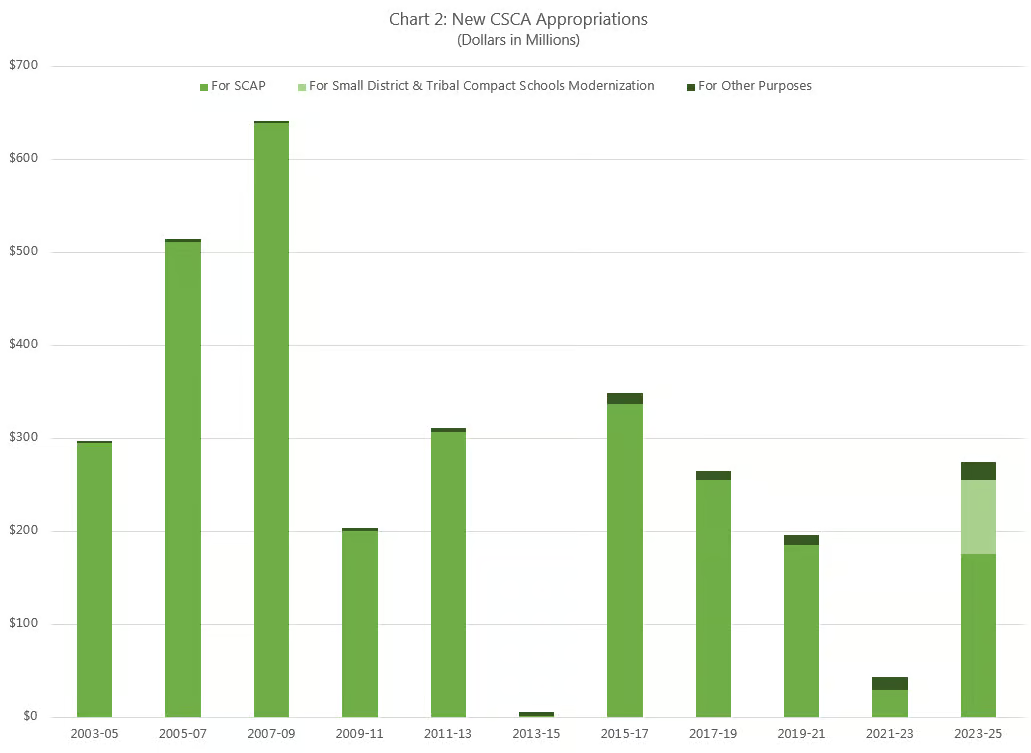
Also, regarding the concurring opinion’s point about whether the CSCA must be accessible to low-income districts, Chart 2 shows how funding from the CSCA has been appropriated by the state. The CSCA has mostly been used to fund the school construction assistance program (SCAP). To receive state SCAP funds, a school district must provide local matching funding. These local funds often come from bonds (which typically have a life of 15–30 years and require a three-fifths vote), but they can also come from capital project levies (which are authorized by the constitution for up to six years and require only a simple majority to pass) or other sources. The state funds are then provided based on district property values—those with lower values receive a higher state match. One of the reasons Wahkiakum sued was that they couldn’t pass a bond to qualify them for the SCAP. (Note that although most of the CSCA appropriations are used for SCAP, most of SCAP’s funding comes from the state building construction account.)
In the 2023–25 capital budget, 29% of CSCA appropriations is directed to the small district & tribal compact schools modernization program (which does not require local matching funds).