10:12 am
December 12, 2025
Lieutenant Governor Denny Heck was the keynote speaker at the Washington Observer’s Re-Wire Conference on Tuesday. During his talk, he brought up the estimated $4.3 billion budget shortfall and noted that there are three ways the Legislature could solve the problem (or a combination of the three): “Raise taxes, cut spending, or get creative with accounting.”
Importantly, he went on to explain how creative accounting, which seems easy in the short run, would be “less responsible, at least riskier, in the long run.” As examples, he cited removing the four-year balanced budget requirement and tapping the budget stabilization account (BSA, the constitutional rainy day fund).
As we’ve written, the four-year balanced budget requirement and the BSA are important budget sustainability tools. The four-year balanced budget requirement was adopted in 2012, after many sessions dealing with budget shortfalls during the Great Recession. The requirement forces the Legislature to consider the long-term effects of legislation. It helps to limit gimmicks and to prevent unsustainable bow wave spending (which occurs when a program is not fully implemented in the current biennium and inflates to full cost in a subsequent biennium).
The BSA was established by constitutional amendment in 2007. Annual contributions are required, and withdrawals are restricted. The idea is to ensure that reserves are available when they are truly needed.
Lt. Gov. Heck said that removing the four-year balanced budget requirement “would wipe out the out-year deficits that they had to balance to. But only on paper, right? All they’re doing is deferring the pain of those tax increase, budget cut, additional creative accounting decisions.”
Indeed, ignoring the problem will not solve anything. Further, Lt. Gov. Heck said, removing the requirement “would also jeopardize our state’s financial position.” The credit rating agencies consistently cite our four-year balanced budget requirement as a contributor to our strong credit ratings.
Additionally, Lt. Gov. Heck noted that Washington has the lowest level of reserves in the country and tapping reserves would also “have negative effects on our financial standing and our credit rating.” All three rating agencies say that drawing down reserves to address structural budget problems could lead to rating downgrades.
As Lt. Gov. Heck explained,
If the purpose of the budget stabilization account is to have a break-glass reserve—I’ve heard that term—isn’t it time to break the glass, given the deficit? After all, in some ways, the economy has been performing well. Isn’t it likely that we can grow our way out of the problem? Here, right now, precisely right now, is where we need some long-term perspective. . . . We may not have had a bona fide recession in 15 years, but that doesn’t mean we’re never going to have another one. . . . A recession inevitably results in a plummeting of revenues—that’s an example of a break-glass circumstance.
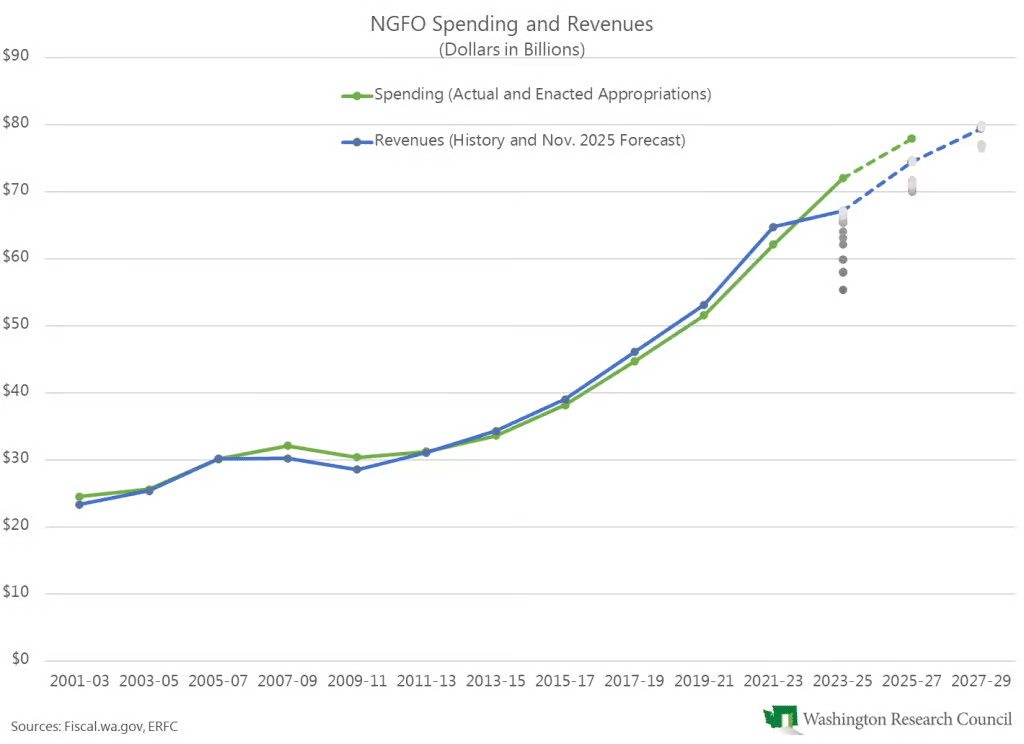
Indeed, the Great Recession was a break-glass circumstance. Consider the chart below. Nominal revenues declined in 2009–11. Unfortunately, the BSA was brand new at the time and there had not been enough time to amass sufficient reserves to bridge the revenue gap. Since then, the BSA balance grew, but the Legislature drained the BSA in 2021—at a time when revenues were growing (certainly not a break-glass situation). The funds were used to increase ongoing spending.
Revenues have still not declined. In 2023–25, legislators knew that revenue growth would slow, yet they approved a much higher level of spending. The gray points in the chart indicate the revenues estimated in each forecast for the biennium. Revenues were never expected to reach the appropriations level. The substantial difference between spending and revenues in 2023–25 was not the result of an unexpected revenue decline, and neither is the estimated shortfall for 2026. Thus, 2026 is also not a break-glass situation.
The four-year balanced budget requirement is not perfect. The Legislature can still delay full implementation of programs beyond the four-year window (as it did with the Fair Start for Kids Act, twice). Additionally, the statute allows the state to assume that revenue will grow by 4.5% a year in the second biennium—even if the official forecast is lower. Budgets in 2023–25 assumed this phantom revenue, which gave legislators an additional $1 billion to spend and contributed to the 2025 shortfall. That sort of thing would be much more common without the four-year balanced budget requirement. It’s easier to enact new programs if you don’t have to account for their full costs until later.
Later in the Re-Wire conference, an audience member asked a panel of legislators, “Why don’t we ditch the four-year budgeting requirement, which no other jurisdiction on earth uses? This would reduce the immediate budget problem as well as the corresponding desire/need for revenue.” (The relevant portion of the panel is here.)
Sen. Trudeau said, “I agree with the four-year requirement . . . . I think it pushes us to look out farther ahead and make good choices. So I think that’s going to stay on the table.” Rep. Fitzgibbon said,
I think we all want to have a sustainable budget and I don’t think the four-year budget requirement is going anywhere. I do think that whenever you have 49 states that have said this is not a good way to do things and one state that says that it is, and you’re the one, you should ask, you know, hard questions about if you want to be the only one.
Those questions have been answered by the credit rating agencies—the four-year requirement is a positive differentiator for Washington. It is heartening that there seems to be agreement that the requirement is not at risk. It makes budgets more sustainable and thereby reduces the likelihood of shortfalls and the ensuing hard choices about spending cuts and tax increases.
Categories: Budget.