
9:26 am
August 27, 2021
According to the Seattle City Budget Office last week, the city’s revenue forecast has improved since the city budget was adopted last year. That is the case even before factoring in federal relief funds or revenues from the new payroll expense tax.
The city’s 2021 budget was based on revenue forecasts from last November. Since then, the general fund revenue forecast has increased by $63.2 million for 2021 and $59.7 million for 2022 (not including the payroll expense tax).
Chart 1 shows how the revenue picture has improved, by forecast. The chart does not include revenues from the payroll expense tax in order to better illustrate the economic changes to the forecast. As passed in July 2020, the payroll tax was imposed as of Jan. 1, 2021. The August revenue forecast estimates that payroll expense tax revenues will be $217.7 million in 2021 and $234.6 million in 2022, making it the fourth-largest general tax source for the city, after property taxes, sales taxes, and business and occupation (B&O) taxes.
Last month, the City Council created a new “JumpStart Payroll Expense Tax Fund.” Beginning Jan. 1, 2022, payroll expense tax collections will go to the new fund rather than the general fund. But, a portion of the payroll tax collections may be transferred to the general fund going forward to replace lost revenues due to the pandemic.
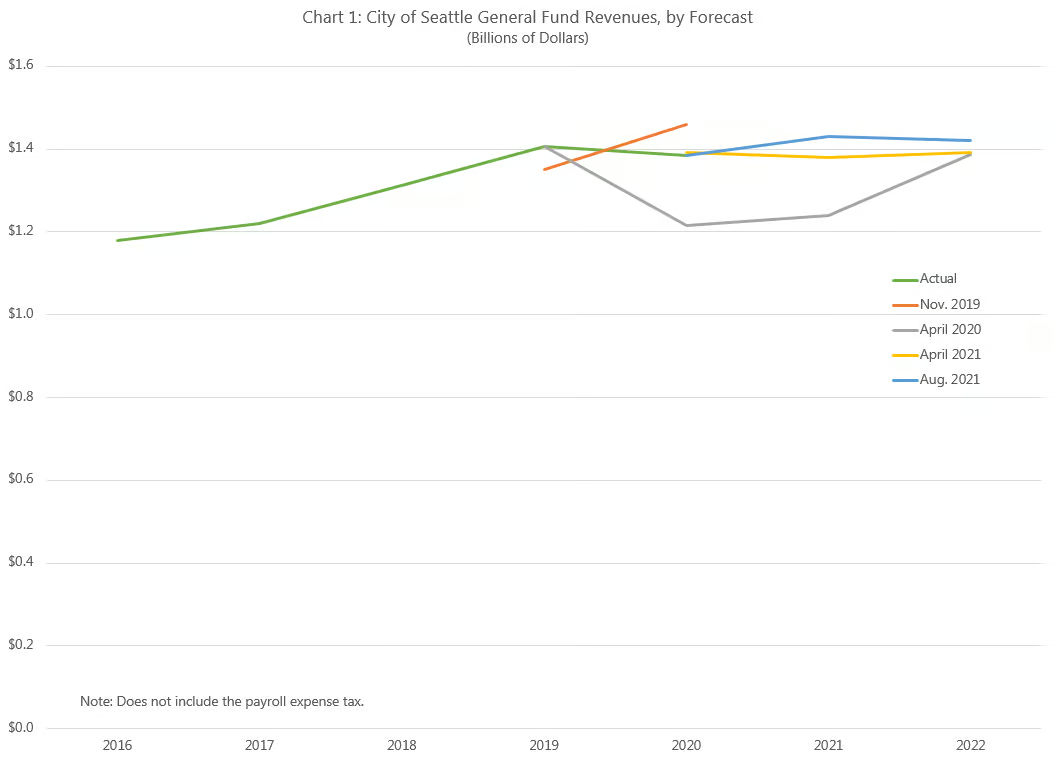
As the forecasts show, general fund revenues dipped a bit in 2020, but for 2021 and 2022 they are expected to be above 2019 (pre-pandemic) revenues. City financial data collected by the State Auditor’s Office provide a richer picture of how the pandemic and recession affected Seattle’s revenues last year. General fund revenues for calendar year 2020 were $1.364 billion, a decline of 6.1% over 2019. (Revenues for all governmental funds—which include the general fund, special revenue funds, debt service funds, capital project funds, and permanent funds—increased by 1.9%.)
Chart 2 shows the history of general fund revenues (as reported to the auditor), along with the current City Budget Office forecast for 2021 and 2022.
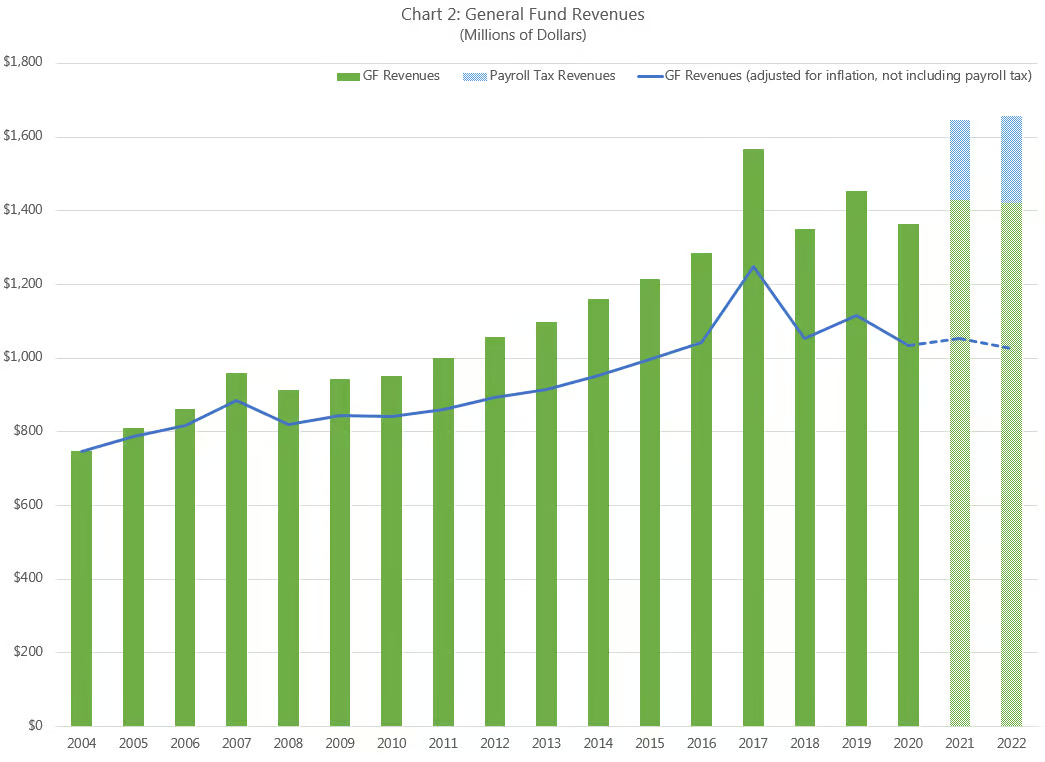
Chart 3 shows how the components of Seattle’s general fund revenues changed from CY 2019 to CY 2020. Of general fund revenues, taxes decreased by 9.3% ($109.4 million). The decline in B&O tax revenues was the largest by dollar amount.

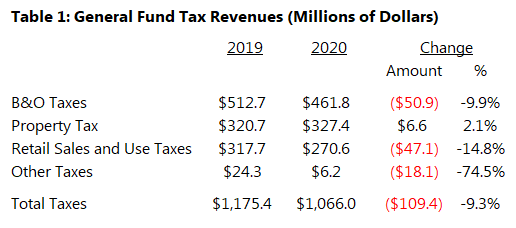
Meanwhile, intergovernmental revenues jumped by 259.1% in 2020. Of that category, direct grants from the federal government increased from $7.0 million in 2019 to $89.3 million in 2020. This amount includes some funding that the city receives regularly from the federal government and a fraction of the federal COVID relief funding that is meant for Seattle. Table 2 shows known amounts of federal relief allocated for Seattle (it will be spent over several years).

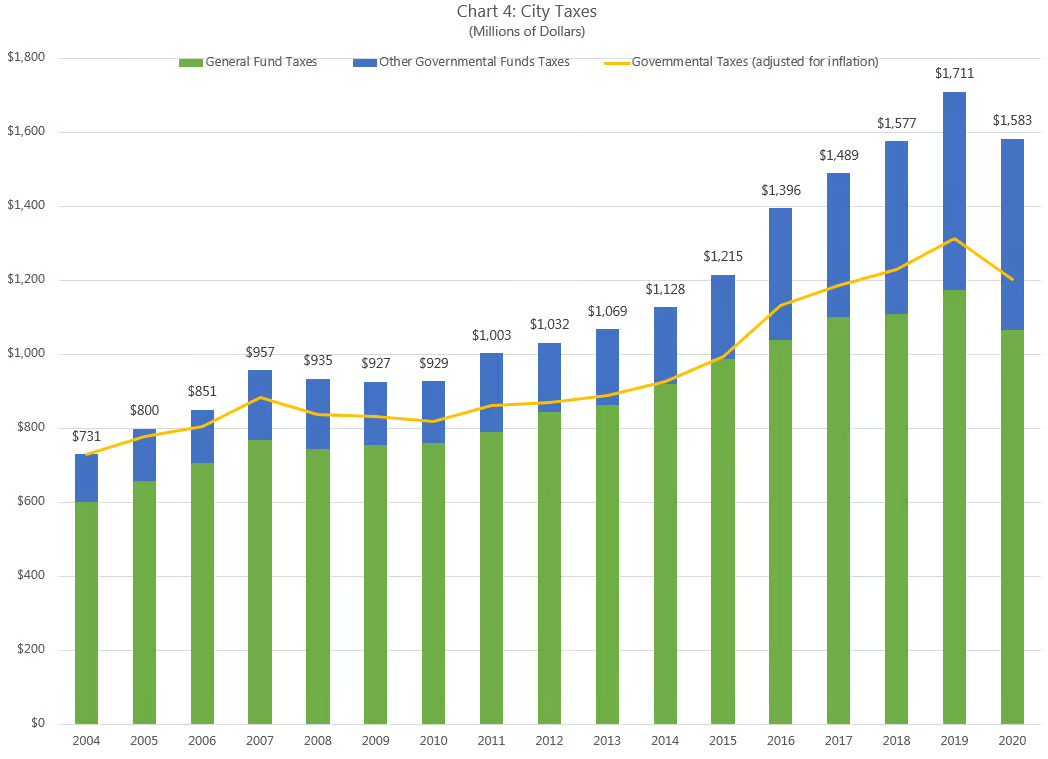
This post has focused on general fund revenues, because that is the most easily comparable data between the City Budget Office forecasts and the auditor’s historical data. But that doesn’t directly illustrate the tax burden in the city. To do that, it’s important to look at taxes (a component of revenues) for the general fund and other funds. Many of Seattle’s tax increases in recent years have gone to dedicated funds. For example, the 2019 library levy was estimated (in the 2021 budget) to collect $30.7 million in property taxes in 2021, for the “2019 Library Levy Fund.” The 2018 families, education, preschool, and promise levy was estimated to collect $87.2 million in property taxes in 2021, for its own fund. The 2015 Move Seattle levy was estimated to collect $103.2 million in 2021, for its own fund.
As noted above, general fund taxes decreased by 9.3% from 2019 to 2020. Taxes for all governmental funds decreased by 7.5%, to $1.583 billion in 2020. Adjusted for inflation, taxes are up 36.0% from the pre-Great Recession peak. Based on the general fund revenue forecast, city taxes should rebound in 2021. On top of that expected economic growth, the payroll tax will step tax revenues up substantially.
Tags: COVID & local revenues