1:16 pm
January 4, 2024
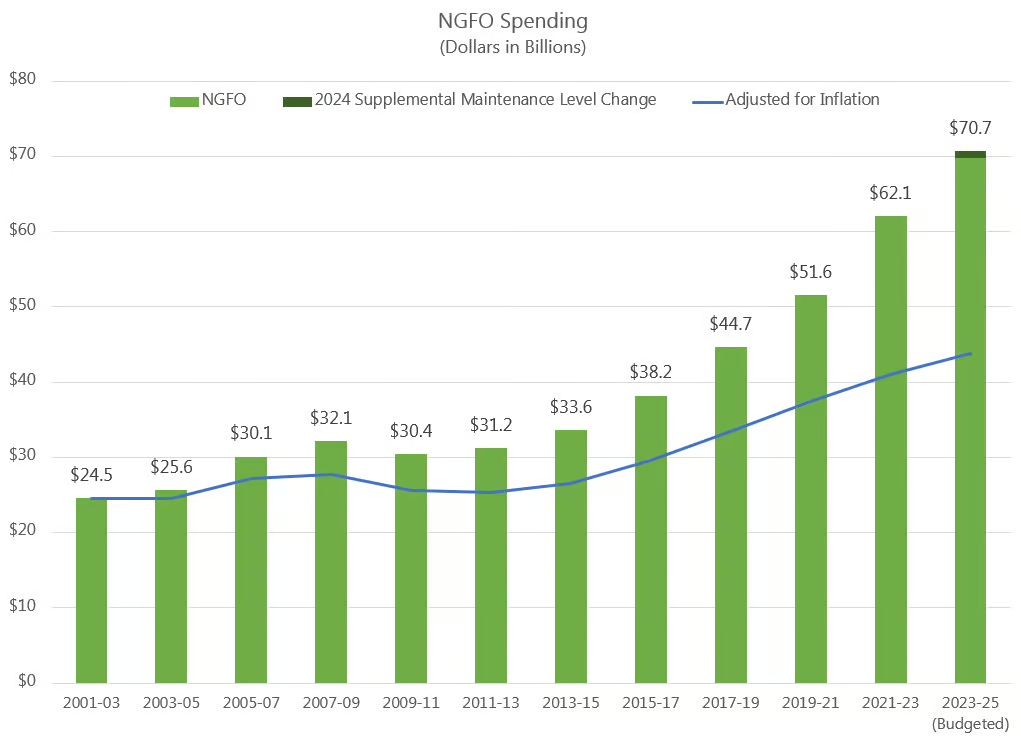
The good news heading into the legislative session on Monday is that the state is not facing an operating budget shortfall. Enacted 2023–25 appropriations from funds subject to the outlook (NGFO) are $69.804 billion. Gov. Inslee’s supplemental operating budget proposal estimates that the maintenance level for the operating budget has increased by $870.4 million, meaning that the total NGFO cost of continuing services funded in the enacted budget (adjusted for enrollment and inflation) is $70.675 billion, which is 13.8% higher than actual 2021–23 spending. (The maintenance level figure is an estimate and will be revised based on the Feb. 16 caseload forecast.)
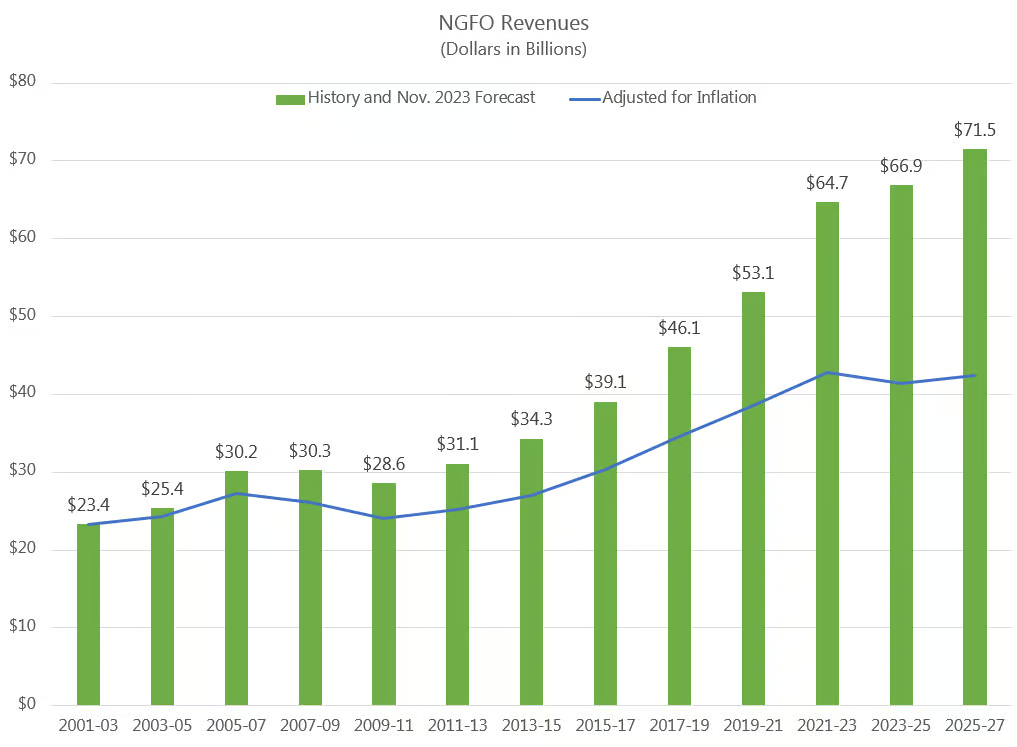
As I showed in this post, the state has sufficient current resources (including the revenue forecast, beginning fund balance, and enacted resource changes) to cover current spending policies and add some new spending in the operating budget. (The legislative budget proposals will be based on the Feb. 14 revenue forecast, so it’s possible that could change.)
The bad news is that the transportation budget and long-term transportation funding plans will likely need to be reworked. As we’ve outlined, transportation revenues are declining as costs are increasing. The recent doubling of the cost estimate for removing fish passage barriers (which is required by a federal injunction)—not to mention cost increases on other major projects—means that the Legislature may have to reconsider current plans for transportation spending.
Gov. Inslee’s supplemental transportation budget proposal did not provide much of a blueprint for the Legislature in responding to these challenges. It would add $150 million for fish passage barrier removal, but the money would come from the Move Ahead WA revenue package, which means that planned spending would not occur. Additionally, although all transportation accounts would balance under the governor’s proposal in 2023–25, they would not all balance over six years (which is the transportation budget practice).
Meanwhile, I’ll be watching for any legislative discussion of some of the fiscal policy choices in Gov. Inslee’s supplemental budget proposals.
First, the governor would take a big gamble on school construction funding. In the enacted 2023–25 capital budget, the state appropriated $573.4 million from the state building construction account (state bonds) for public schools. It also appropriated $274.9 million from the common school construction account (trust land revenues and capital gains tax revenues). Gov. Inslee’s proposal would reduce the public schools appropriations from the state building construction account and increase their appropriations from the common school construction account (CSCA). Revised appropriations for public schools would be $122.6 million from the state building construction account and $837.7 million from the CSCA.
Effectively, the governor would replace a dependable source of funding for school construction with a very uncertain source. (He would use the freed-up state building construction account funding to increase capital appropriations elsewhere, including the shift of $251 million from the operating to the capital budget.)
The CSCA is an uncertain source because of the capital gains tax. Any capital gains tax collections exceeding $500 million in a year go to the CSCA. Capital gains tax collections exceeded that threshold last year, so $347.5 million was deposited in the account. According to the Office of Superintendent of Public Instruction last month, CSCA resources for 2023–25 are estimated to total $1.177 billion. However, that includes $668.9 million in estimated capital gains tax revenues. If capital gains tax revenues are zero, the account would have just $508.4 million for the biennium. In that case, if the governor’s proposal is adopted, school construction spending would have to be cut unless another source of funding is found.
Capital gains taxes are generally volatile sources of revenue. The Legislature should consider them to be particularly vulnerable this year. We have only one year of collections data, so the revenue estimates are highly uncertain. (I would not be surprised if 2024 collections do not exceed the $500 million threshold.) Meanwhile, an initiative to repeal the tax could be on the ballot this Fall. If Legislators place a high priority on school construction, they should use capital gains revenues to supplement existing sources for school construction funding, not supplant them.
Second, the governor would increase appropriations from the carbon emission allowance auction proceeds by $915.2 million (appropriations are made in the operating, transportation, and capital budgets). If the governor’s plan for these revenues is adopted, revised 2023–25 spending from the auction proceeds would total $3.045 billion. (The auction revenues are not included in either the operating or transportation revenue forecasts.) Another initiative could be on the ballot this Fall that would repeal the climate commitment act. Nevertheless, the distribution of these funds will likely be a focus of the budgets this session.
Finally, even though there is not an operating budget shortfall, the governor proposes using reserves to fund new spending. He would use $798 million from the Washington rescue plan transition account (the shadow reserve fund) and $19.4 million from the budget stabilization account (the constitutional rainy day fund). He would not increase taxes, and it seems unlikely that the Legislature will increase operating budget taxes.
(Prior posts on the governor’s proposals are here.)
Categories: Budget.