
1:28 pm
December 6, 2023
During a House Appropriations Committee work session on Monday, committee staff provided a budget preview. There are three significant changes since the Legislature enacted the 2023–25 budget: the new revenue forecast, actual FY 2023 reversions (appropriations that were not spent), and a preliminary estimate of the maintenance level (the cost of continuing current services, adjusted for inflation and enrollment).
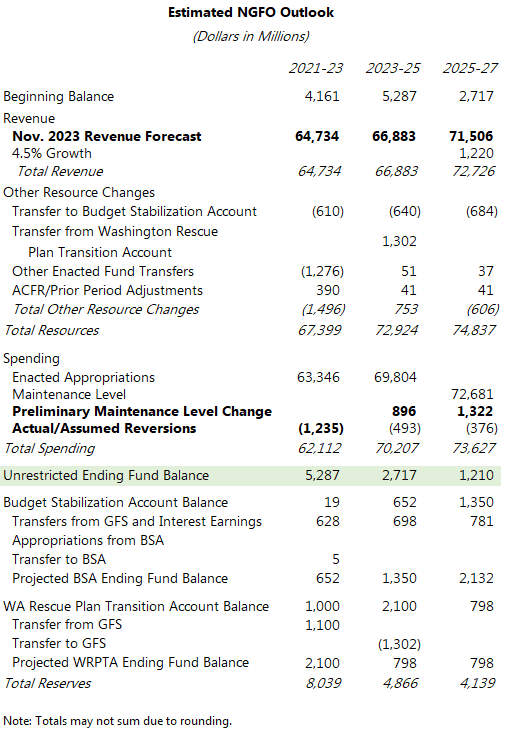
When the budget was adopted earlier this year, the official outlook estimated that the unrestricted ending balance in funds subject to the outlook (NGFO) would be $1.362 billion in 2023–25 and $23 million in 2025–27. Now, accounting for the increased resources and increased maintenance level costs, Appropriations staff estimates that the unrestricted NGFO ending balance is $2.717 billion in 2023–25 and $1.210 billion in 2025–27.
Note that those figures do not include any new policies the Legislature will decide to adopt. (The agency budget requests, which I’ve been writing about here, provide some ideas of new policy items that the Legislature may consider.) Additionally, the new figures rely on the November revenue and caseload forecasts. The Legislature’s budget will be based on the February 2024 revenue and caseload forecasts, so a lot could change.
The estimated outlook below begins with the official June outlook and adds in the new information. Following the outlook is additional information on the changes.
Revenue Forecast
As Kriss and I have written, the November revenue forecast increased the amount available compared to the March forecast (on which the budget was based). For purposes of the outlook, Appropriations staff adjusted the revenue increase to include economic changes only and to include the change to the amount added to the second biennium pursuant to the 4.5% growth assumption. Thus, over the period from 2021–23 through 2025–27, staff estimates that revenues increased by $2.887 billion from March to November.
Additionally, Appropriations staff estimates that if the pessimistic alternative revenue forecast (for which the Economic and Revenue Forecast Council assigns a 30% probability) comes to pass, the unrestricted ending balance would be $1.221 billion in 2023–25 and negative $6.443 billion in 2025–27.
Reversions
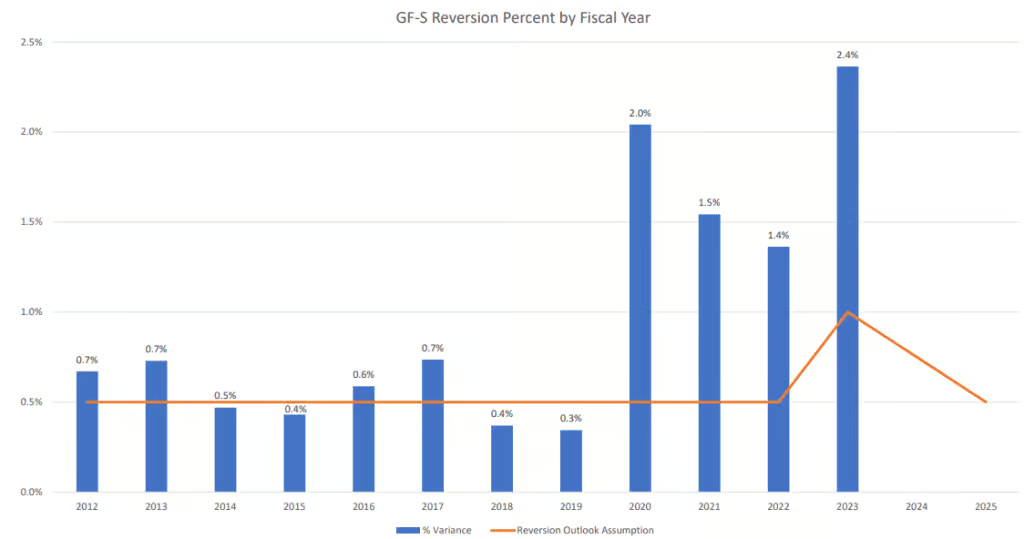
Reversions are appropriations that are not ultimately spent. In every outlook, the state assumes that there will be some level of underspending. Typically, the assumption has been 0.5% of spending. However, beginning in 2020, the state has experienced a much higher level of reversions. The chart below (showing historical reversion data) is from a staff presentation in a Ways & Means Committee work session last week.
The budget adopted this year assumed that FY 2023 reversions would be $253 million. The final figure was $760 million. That means that the extra $507 million that was not spent reverts to the state treasury and increases the beginning balance for 2023–25.
According to Appropriations staff, the high FY 2023 reversions were mainly due to:
- K–12: A correction in special education safety net amounts and timing of bus depreciation amounts.
- Department of Revenue (DOR): Actual remittances for the Working Families Tax Credit in FY 2023 were $117.0 million, but the state had appropriated $221.0 million (see this presentation from DOR to the Appropriations Committee.)
- Department of Commerce: Delays in implementing two new programs (electric vehicle charging and solar energy infrastructure).
- General labor shortages.
Maintenance Level
The revenue and reversion changes increase the resources available to budget writers. Meanwhile, the cost of continuing current services is estimated to increase, which will use up more of those resources so that they are not available for new policies.
Appropriations staff estimates that maintenance level changes will increase spending by $2.2 billion over the outlook period. According to staff, the maintenance level increases are driven by Medicaid caseloads, managed care rates, special education enrollment, K–12 salary inflation, per capita costs for long-term care clients, and Economic Services Administration caseloads. (I wrote about the November caseload forecast here.)
Categories: Budget.