
2:25 pm
March 12, 2025
The Senate Republican 2025–27 budget proposal would increase appropriations from funds subject to the outlook (NGFO) by $3.635 billion over enacted 2023–25 appropriations. That includes maintenance level increases (the cost of continuing current services, adjusted for inflation and caseloads) and net policy level decreases of $1.263 billion.
The net new policy proposals are comprised of $1.491 billion in increased spending and $2.753 billion in savings. The chart compares net policy changes in the Senate Republican proposal to those in former Gov. Inslee’s Book 1 (which balanced within existing resources) and Book 2 (which proposed new taxes) proposals. (Note that “Compensation” includes the collective bargaining agreements with state and nonstate employees, extension of those agreements to non-represented employees, other salary increases, and changes to retirement benefits and rates.)
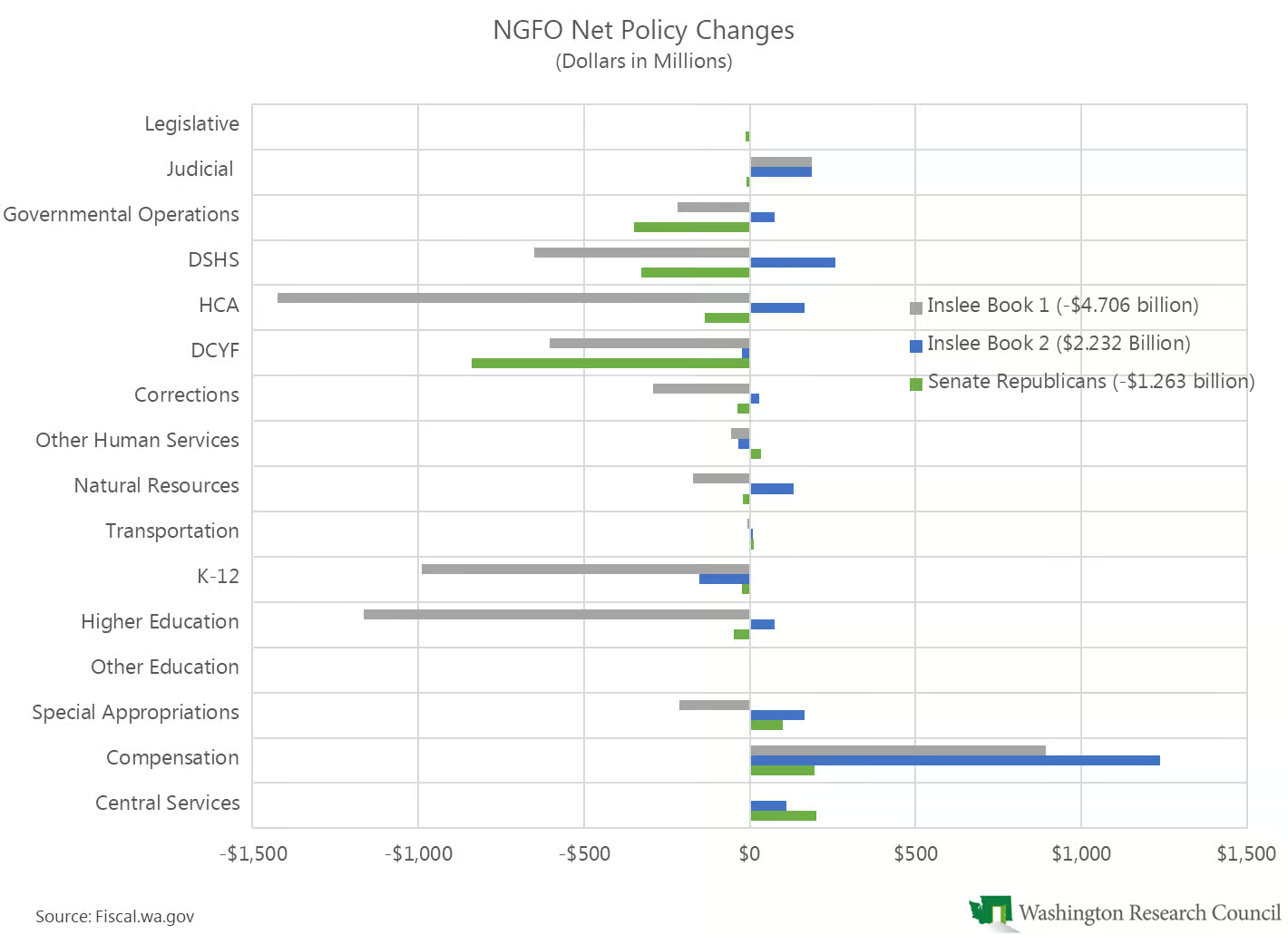
The Senate Republican proposal would make across-the-board reductions to many agencies. These total $110.9 million. Other notable policy changes for 2025–27 in the Senate Republican proposal include the following.
Governmental Operations. In the Department of Revenue, the proposal would shift $283.0 million in funding for the Working Families Tax Credit from the NGFO to the three Climate Commitment Act accounts. The NGFO would continue to fund the administration of the program and $215.0 million in remittances. Additional remittances would be paid from the climate investment account ($49.7 million), climate commitment account ($180.9 million), and the natural climate solutions account ($52.4 million). Statute already allows the climate commitment account to be used for this purpose.
Department of Social and Health Services (DSHS). The proposal would reduce net policy spending by $327.8 million, including:
- $81.5 million in savings by pausing food assistance program enrollment for one year.
- $66.3 million in savings from repealing a 2023 bill that eliminated garnishment of some Supplemental Security Income payments received by Aged, Blind, or Disabled program participants. (Under the enacted legislation, the elimination is not effective until Oct. 1, 2025.)
- $48.6 million in savings from delaying a statutory rebase of nursing home rates from FY 2027 to FY 2028.
- $35.0 million in savings by phasing in the opening of two Vancouver residential treatment facility units and indefinitely delaying the third unit.
- $26.1 million in savings by pausing state family assistance program enrollment for one year.
Policy increases would include:
- $70.9 million to maintain nursing home rates at their FY 2025 statewide average.
- $27.3 million to continue senior nutrition services.
- $24.6 million for the Transitional Care Center of Seattle.
Health Care Authority (HCA). The proposal would reduce net policy spending by $136.1 million, including:
- $134.4 million in savings from moving Aged, Blind, and Disabled services from a managed care service delivery model to fee-for-service.
- $44.5 million in savings from reducing physical health capitation rates for Medicaid managed care organizations by 1.5%.
- $18.2 million in savings from reducing behavioral health capitation rates for Medicaid managed care organizations by 1.5%.
- $39.5 million in savings for long-term civil commitment beds by removing funding for providers who decided not to contract, contractor delays in bed openings, and aligning federal matching rates to reflect actual expenditures.
Policy increases would include:
- $72.5 million for behavioral health personal care.
- $41.4 million for a statewide electronic health records solution.
Department of Children, Youth, and Families (DCYF). The proposal would reduce policy spending on net by $838.6 million, including:
- $445.8 million in savings from maintaining (instead of increasing) 2023–25 Working Connections Child Care (WCCC) subsidy rates in 2025–27.
- $167.2 million in savings from eliminating the expansion of WCCC to families with incomes up to 75% of state median income. (The expansion is currently scheduled to begin July 1, 2025.)
- $76.5 million in savings captured from an underspend in the child welfare program.
- $70.1 million in savings by eliminating the Early Childhood Education and Assistance Program (ECEAP) entitlement. (The entitlement has been delayed multiple times and is currently scheduled to begin in SY 2026–27.)
- $47.9 million in savings related to 12-month authorization of child care subsidies (payments end if the child did not attend in the previous month).
- $30.2 million in savings due to an increase in WCCC copayment rates.
Other Human Services. The proposal would appropriate $100.3 million to the Criminal Justice Training Center for law enforcement hiring grants (2SSB 5060).
K–12. The proposal would reduce policy spending on public schools by a net of $23.0 million. It would increase appropriations by $60.0 million for materials, supplies, and operating costs and by another $60.0 million for special education. It would also add $23.8 million for regional attendance, behavior, and credits early warning system coordinators at each educational service district.
The proposal would save $71.3 million by reducing grant program maintenance level funding by 50%. It would use the remaining $71.3 million for new achievement grants for low-income school districts.
The proposal would save $72.3 million by limiting funding for Transition to Kindergarten to the current funded enrollment for FY 2026, and then allowing 3% annual enrollment growth.
Higher Education. Of the statewide across-the-board reductions, $53.3 million applies to higher education institutions. Of that, $25.8 million applies to the four-year institutions; these savings are offset by new funding to increase resident undergraduate enrollment ($30.2 million). However, an additional reduction of $32.9 million applies to The Evergreen State College, so that the amount of its state funding per student matches the average state funding per student at the other regional institutions.
The proposal would save $32.3 million from eliminating the extension of eligibility for the Washington College Grant and other financial aid programs that was adopted in 2024 (SB 5904). It would add $40.0 million for the University of Washington’s behavioral health teaching facility.
Special Appropriations. The proposal would add $61.7 million for information technology projects.
Compensation. The proposal would reject the tentative collective bargaining agreements negotiated by the Office of Financial Management. Instead, it would appropriate $420 million for lump sum payments to state employees. All represented and non-represented state agency classified employees and executive, legislative, and judicial branch employees would receive $2,500 on July 1, 2025 and another $2,500 on July 1, 2026.
The proposal would save $98.0 million by reducing Washington management service staffing by 10% across all agencies. It would also save $127.0 million by changing pension rates (SSB 5357).
In 2023–25, the state contributed 85% of the health insurance premium for employees. The Senate Republican proposal specifies that the state would contribute 80% of t he premium in 2025–27. This would be in line with the private sector average.
Categories: Budget.Tags: 2025-27