
12:33 pm
March 11, 2025
Today Senate Republicans proposed an operating budget for 2025–27 and a 2025 supplemental to the 2023–25 operating budget. It is unusual for the minority party to propose a full budget; the last time was in 2022 (in the House). This proposal provides another set of options for closing the projected budget shortfall; as we wrote yesterday, there are many ways to do so.
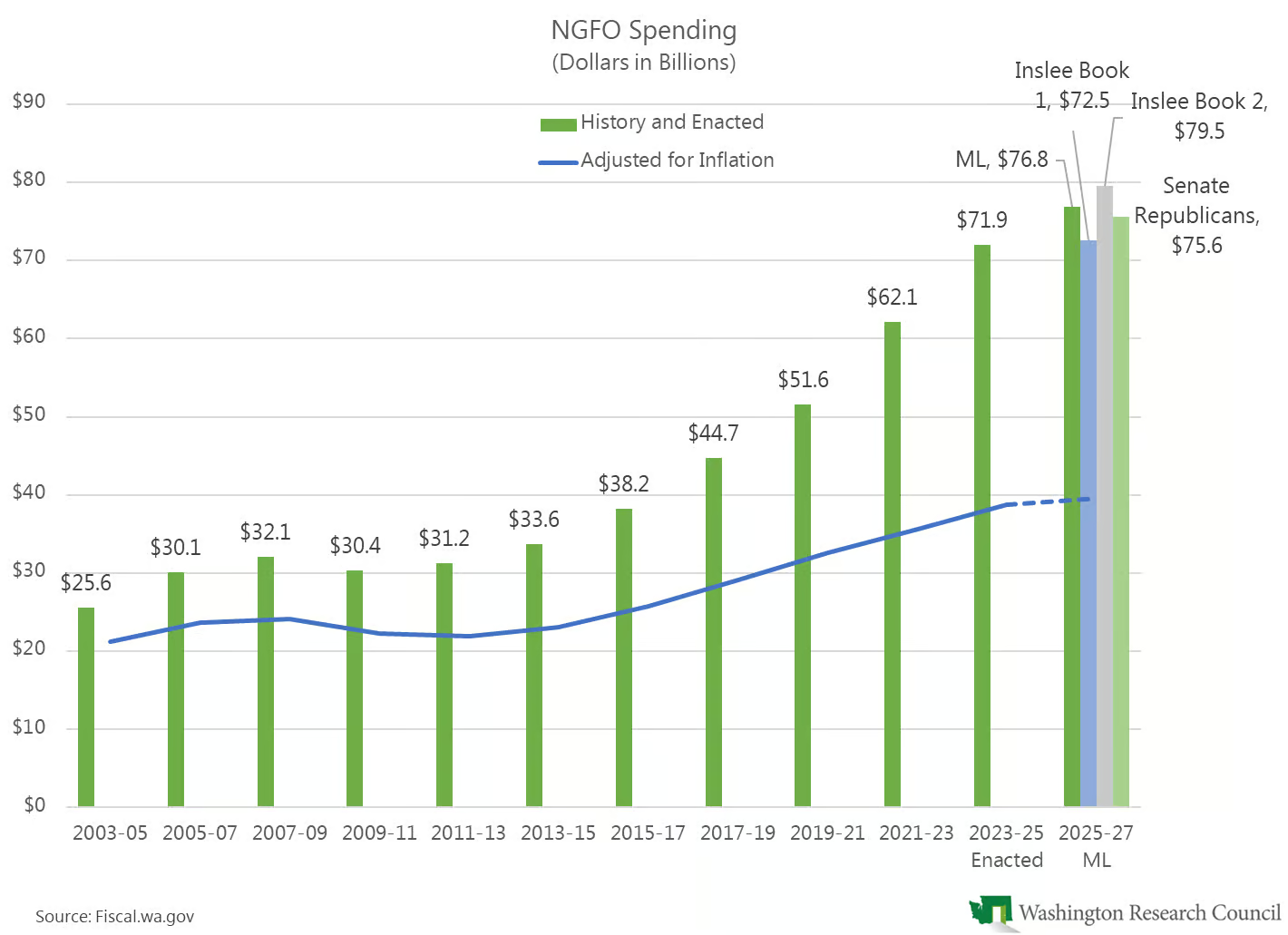
Compared to enacted 2023–25 appropriations, the Senate Republican proposal would increase appropriations from funds subject to the outlook (NGFO) by $805.9 million (1.1%) in 2023–25 and by $3.635 billion (5.1%) in 2025–27.
Those numbers are net of maintenance level (the cost of continuing current services, adjusted for caseloads and inflation) changes and new policy spending. According to the estimated outlook, maintenance level changes would increase spending by $876 million in 2025, $4.418 billion in 2025–27, and $6.337 billion in 2027–29. These amounts are $145 million higher (over the five-year period) than the maintenance changes estimated by the Office of Program Research in December—presumably because the new figures incorporate the February caseload forecast. The Senate Republican maintenance level numbers are $996 million lower (over five years) than the maintenance level assumed in former Gov. Inslee’s budget proposal. The maintenance level is adjusted over the course of the budget process; this large difference suggests that Inslee included some items in his maintenance level estimate that the Legislature considers new policy.
Net policy level changes in the Senate Republican proposal would reduce spending by $70 million in 2025, $1.263 billion in 2025–27, and $1.824 billion in 2027–29. Notably, the Senate Republican proposal would not fund the collective bargaining agreements with employees. It would apply across-the-board spending reductions to many agencies: 6% for the Legislature, 3% for agencies that don’t provide direct services, and 1.5% for higher education. It also makes some spending increases, including increased funding for K–12 materials, supplies, and operating costs; $100 million to hire more law enforcement officers; and $5,000 bonuses for state employees. (I’ll write more about the spending choices in another post.)
The proposal would not increase taxes or use reserves from the budget stabilization account. It would use $362.7 million from settling diligent enforcement disputes with tobacco companies. (Gov. Ferguson previously proposed using $315 million from this settlement to help close the shortfall.) The Senate Republican proposal would also transfer a net of $3.267 billion from other funds to the NGFO over the five-year period (mainly in 2025–27), including:
- $2.500 billion from the Law Enforcement Officers and Firefighters’ (LEOFF) System Plan 1 retirement account (Inslee proposed using $1.0 billion from the account, which he estimated had a surplus of about $2 billion)
- $200 million from the public works assistance account
- $110 million from the state treasurer’s service account
- $110 million from the model toxics control capital account
- $80 million from the Washington student loan account
- $69 million from the electric vehicle incentive account
- $53 million from the enterprise services account
- $41 million from the salmon recovery account
The proposal would leave an unrestricted NGFO ending balance of $170 million in 2027–29.
Importantly, for 2027–29, the proposal assumes forecasted revenues, not the 4.5% growth that is allowed by statute. This means that it does not assume $1.049 billion in phantom revenues. However, the proposal assumes a higher level of reversions (appropriations that are not spent) than was assumed in Inslee’s proposal. While reversions have been higher than normal in recent years, it is not certain the trend will continue. If the Senate Republican proposal assumed the same level of reversions as Inslee’s proposal, it would not balance over four years. (Note that Inslee’s proposal would not balance in 2025–27 if his assumed reversions do not materialize.)
Altogether, this proposal provides an alternative to Inslee’s Book 2 proposal (which increased taxes) and Inslee’s Book 1 proposal (which balanced within existing resources but cut deeply in order to fund collective bargaining agreements and other new policy spending). The House and Senate majorities will make their budget proposals after next week’s revenue forecast.
Tags: 2025-27