
12:54 pm
October 29, 2026
The state’s self-insurance liability account (SILA) is funded by state agencies, and their premiums are based on a biennial actuarial study of agency liabilities. The actuarial reports are issued in the summer of even years, based on program data as of the end of the prior calendar year. Via a public records request, I obtained each actuarial report going back to 2018.
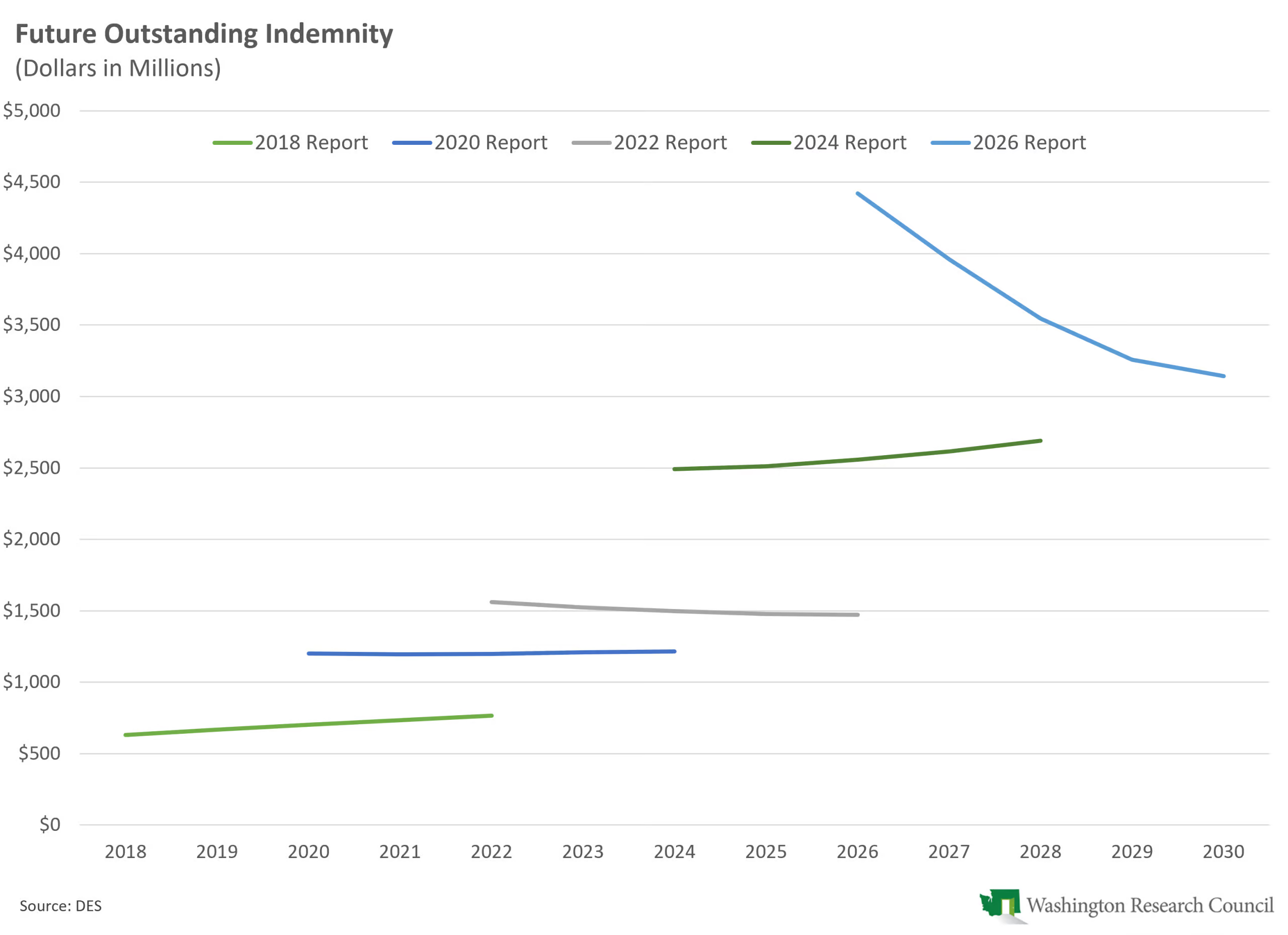
According to the 2026 actuarial report, Washington’s outstanding indemnity losses (including expenses) total $4.421 billion. That is a significant jump from the 2024 report, which estimated outstanding losses of $2.491 billion.
The 2026 report estimates that the biennial SILA premium need is $1.3 billion, up from $390 million in 2025–27. (Note that the 2026 supplemental budget included a significant backfill for the SILA. It’s not clear if this is factored into the 2026 actuarial report; I’m not sure how it would affect the indicated premiums.)
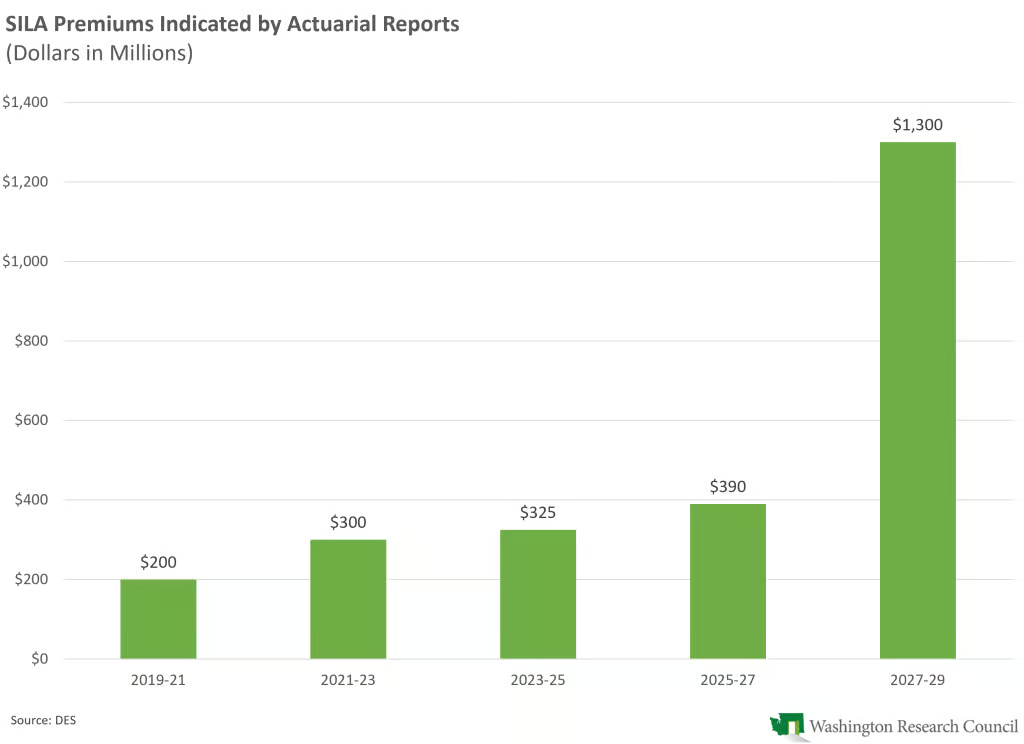
I’ve written extensively about the SILA solvency problem; previous posts are available here. As I wrote last month, the 2027–29 budget request from the Department of Enterprise Services (DES) notes that there will be a cash deficit in the account at the end of 2025–27 that will require a $335 million backfill. According to the DES request, the carryforward funding for SILA in 2027–29 is $360.2 million, far short of the total premium need of $1.3 billion.
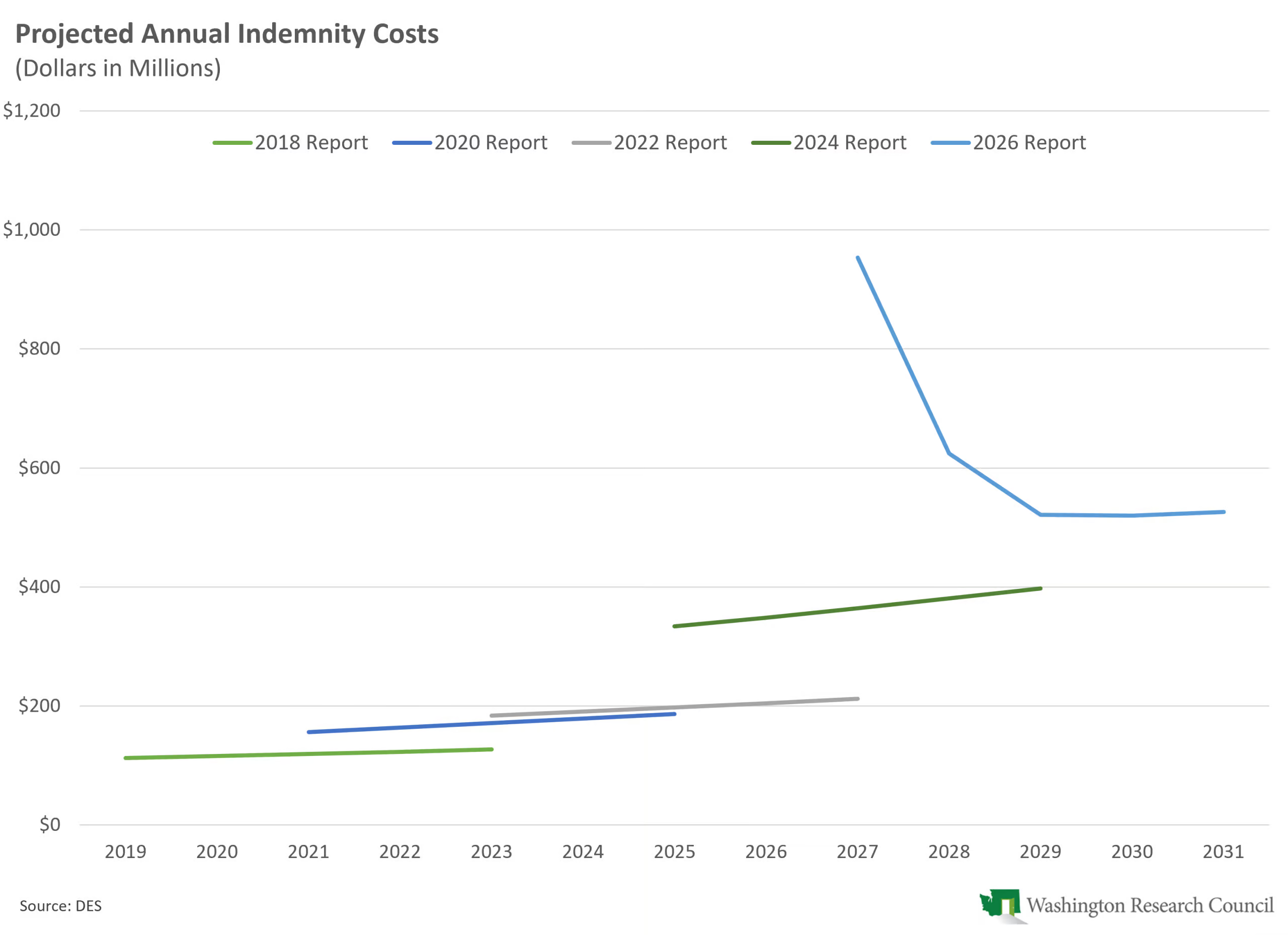
This summer, legislative staff told the Joint Legislative-Executive Committee on Budget Transparency and Fiscal Sustainability that the outlook for 2027–29 (based on the 2026 supplemental budget) had included $278 million from funds subject to the outlook (NGFO) for SILA premiums. The total premiums assumed from all funds was $390 million, which was based on the premium need from the 2024 actuarial report. (See pages 17–19 here.) Staff didn’t provide an estimate of how much of the $1.3 billion that is needed for 2027–29 would come from the NGFO. Based on the split in the outlook, the NGFO share will probably be about 70% of the total premium cost. This means that the current outlook underestimates NGFO spending on SILA premiums by about $632 million. Adding a $335 million backfill for the SILA (which would come from the NGFO), the new NGFO costs get up to about $967 million.
The increasing liabilities are first addressed in the 2020 actuarial report. The 2020 report states,
Total [Self Insurance Liability Program] liabilities have increased significantly due to recently reported claims and commensurate case reserves attributable to the Children, Youth, and Family (CYF) agency. This increase, along with the unique nature of general liability claims associated with the CYF agency and the change in State statutes surrounding these claims warrant a separate evaluation of liabilities associated with this particular risk.
Further, regarding the Department of Children, Youth, and Families, “a significant number of claims are now reporting upwards of 40 years after the occurrence of a claim event, requiring a different approach to modeling outstanding liabilities.”
Identical statements were included in the 2022 and 2024 reports. Then, in 2026, the report states,
Consistent with the prior analysis, the largest driver of the outstanding liability is the general liability exposure association with . . . the Department of Children, Youth, and Families. A material increase in monthly reported claims began in May 2024. Before May 2024, the average monthly reported claim count was approximately 20; beginning in May 2024, that level increased to roughly 100 claims per month. As a result, claim frequency increased materially in the latter part of reporting period 7/1/2023–24 and continued through the valuation date of December 31, 2025. Accordingly, paid and incurred amounts increased materially relative to the prior analysis as of December 31, 2023.
The 2026 report notes recent court cases and changes to statutes of limitation and adds,
Consistent with our understanding of these legal changes, the newly reported claims are associated not only with recent accident periods but also with occurrences having loss dates as early as 1955/56. As a result, unlike standard lines of coverage, the outstanding liability estimates are not concentrated solely in the most recent accident periods.
For the tail liability estimate, we have made the important assumption that the unprecedented growth in claims reporting in the past three years is a temporary response to the change in State law and will not continue at this rate in perpetuity. Our analysis assumed that the elevated level of claim reporting would continue through the reporting period 7/1/2026–27 and then gradually decline to a stable pattern.
This sounds reassuring, until you read the previous actuarial reports. The “tail liability” refers to “claims which have already occurred, but have yet to be reported.” The 2020, 2022, and 2024 reports all include this statement:
For the tail liability estimate, we have made the important assumption that the unprecedented growth in claims reporting in the past three years is a temporary response to the change in State law and will not continue at this rate in the years ahead. Should claims continue to report as they have in the past three years, the tail liability could increase by a multiple of three to four.
(Emphasis in original.)
I hope the actuaries are correct that the elevated level of claims will gradually decline, but the prior reports also assumed that the growth would be temporary. Regardless, the 2026 report still estimates a much higher level of liabilities going forward than was estimated previously.
Tags: SILA