
12:28 pm
May 16, 2025
One of the major tax bills that is assumed in the operating budget is ESSB 5794, which—according to the bill—would eliminate “obsolete tax preferences.” (“Preference” is the state’s terminology for exemptions, exclusions, deductions, deferrals, credits, and preferential tax rates. Many of these are in place for important tax policy reasons.)
The bill would:
- Apply the business and occupation (B&O) tax to interest on investments or loans secured by first mortgages or deeds of trust on non-transient residential properties. (I expect the tax rate for these amounts would be the rate for service and other activities.)
- Apply the B&O tax to the sale of precious metal bullion and monetized bullion. (The retailing or wholesaling tax rate would apply.)
- Apply the B&O tax to credit unions that merge with or acquire a bank regulated by the Department of Financial Institutions. (The bill specifies that the tax rate would be 1.2%.)
- Apply the B&O service and other activities tax rate to the rental of individual storage space at self-service storage facilities.
- Repeal the public utility tax credit for certain billing discounts provided by light and power businesses and gas distribution businesses.
- Increase the B&O tax rate for title insurance agents. (Their rate is currently 0.484%; I expect they would instead be taxed at the service and other activities rate.)
- Repeal the B&O credit for new employment for international services in eligible areas.
- Repeal the B&O credit for the value of services and information related to standards and testing for public safety.
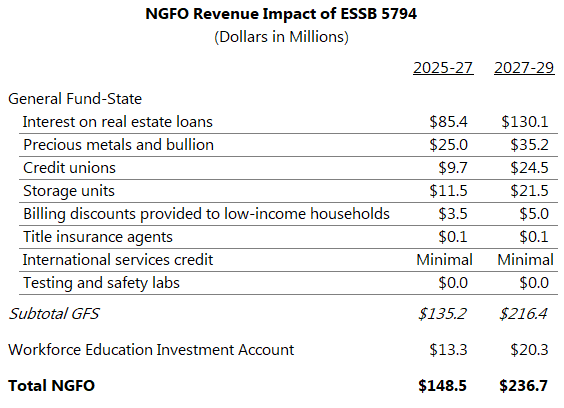
The budget assumes that the bill would increase revenues to funds subject to the outlook (NGFO) by $148.5 million in 2025–27 and $236.7 million in 2027–29. A fiscal note for the bill as passed by the Legislature is now available.
The fiscal note appropriately compares ESSB 5794 to current law. However, it is important to understand that there are many interactions between ESSB 5794 and ESHB 2081, which would broadly increase B&O taxes. The fiscal notes for these bills do not take those interactions into account, so determining the combined revenue impact of both bills is not simply a matter of adding up the fiscal notes. For example, the fiscal note for ESSB 5794 assumes that the service and other activities tax rate consists of two tiers (as under current law): 1.5% and 1.75%. But ESHB 2081 would add a third tier (2.1%). (My estimate of how B&O tax rates would change by industry under both bills is here.)
The following table shows the general fund–state (GFS) impact of each of the provisions in ESSB 5794, based on information from the Department of Revenue. (DOR could not provide the break-out in terms of the NGFO. Consequently, it’s not clear which provisions would generate the revenues to the workforce education investment account, which, like the GFS, is part of the NGFO.)
The table includes the NGFO impacts from changes to the B&O tax, public utility tax, and retail sales tax. Again, note that these estimates do not take into account the general B&O tax increases included in ESHB 2081.
Finally, in the fiscal note, DOR notes, “There is some litigation risk that the courts would invalidate this tax on the rental of storage units on the grounds that rental income from real property is subject to the state constitution’s uniformity clause.”
In 1959, the Legislature imposed a tax on rents exceeding $300 a month. The following year, the state Supreme Court said it was unconstitutional because the tax was a non-uniform property tax, not an excise tax. In 2023, the Supreme Court held that the capital gains tax is an excise tax and not an income tax. As DOR notes, that decision “was critical of” the 1960 case. DOR concludes,
Categories: Budget , Tax Policy.There is a good likelihood our Supreme Court will overrule Apartment Operators [the 1960 case] and uphold a clear legislative intent to impose a B&O tax on the activity of renting real property. This estimate assumes tax collection would not be delayed during any legal challenges, and the tax would ultimately survive any legal challenges.