
2:03 pm
March 24, 2023
The Senate Ways & Means Committee chair’s operating budget proposal would increase appropriations from funds subject to the outlook (NGFO) by $5.059 billion compared to the enacted 2022 supplemental. (That includes appropriations in other legislation.)
The maintenance level (the cost of continuing current services, adjusted for enrollment and inflation) is estimated to increase by $914.5 million. (Gov. Inslee’s proposal had assumed the maintenance level would increase by $1.519 billion.)
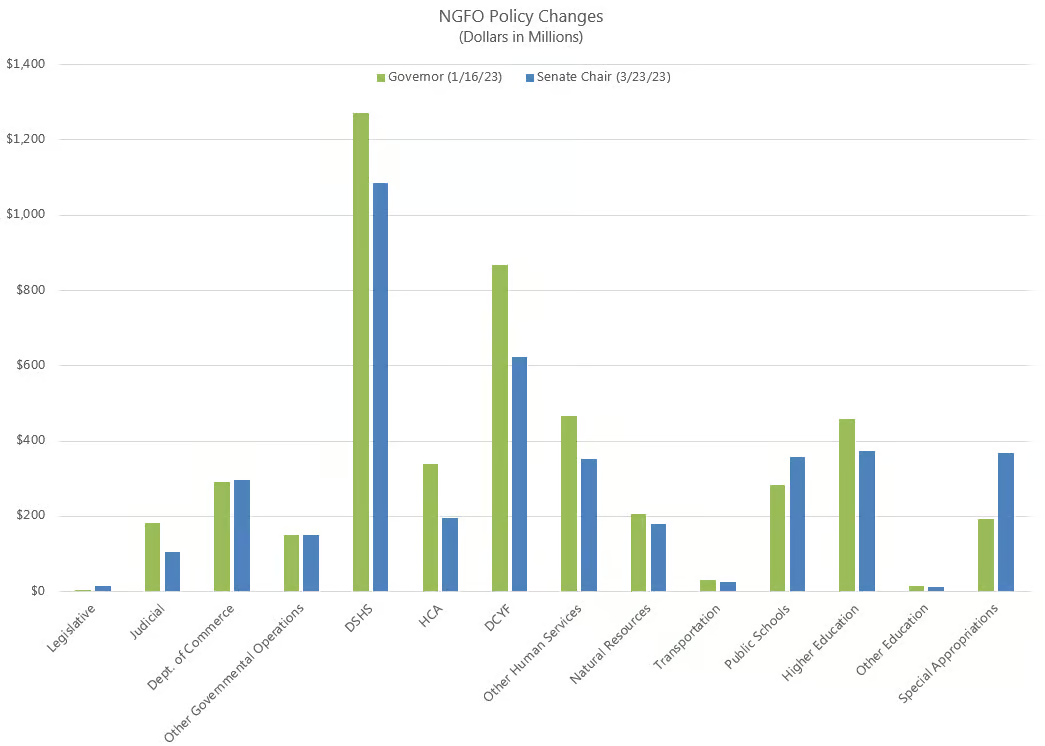
On top of the maintenance level, new policy spending would total $4.145 billion in the Senate chair’s proposal, which is $614.0 million less than Gov. Inslee had proposed. The chart below shows how the policy changes are distributed in each proposal.
The new NGFO policy spending in the Senate chair’s proposal includes:
- Department of Commerce: $56.0 million for the operations and maintenance costs of permanent supportive housing, $55.5 million for emergency housing and shelter capacity, $32.0 million for local housing programs, and $30.0 million for encampment response and outreach.
- Department of Social and Health Services (DSHS): $257.2 million to adjust consumer directed employer (individual provider) rates and $61.9 million for agency provider parity, $223.4 million to increase rates for other service providers, and $151.7 million for the adult family home collective bargaining agreement (CBA).
- Health Care Authority (HCA): $47.1 million to increase behavioral health provider rates and $54.3 million to increase rates for other service providers.
- Department of Children, Youth, and Families (DCYF): $215.2 million for the family childcare CBA, $56.4 million to increase Early Childhood Education and Assistance Program (ECEAP) rates, and $44.6 million to expand ECEAP.
- Public Schools: $264.0 million for K–12 salary inflation (ESB 5650), $100.6 million for pupil transportation (E2SSB 5174), $93.0 million to increase the special education enrollment cap (E2SSB 5311), $267.4 million to increase the special education excess cost multiplier (E2SSB 5311), and $11.5 million to lower the special education safety net threshold (E2SSB 5311).
- Special Appropriations: $51.9 million for foundational public health services and $47.7 million for information technology projects.
The costs of the CBAs with state employees are accounted for in each agency. Compensation for represented and non-represented employees would total almost $830 million for the biennium. Additionally, the proposal assumes a 3% rate increase for eligible members of the Public Employees’ Retirement System (PERS) Plan 1 and Teachers’ Retirement Systems (TRS) Plan 1, which would increase spending by $39.7 million. The proposal also assumes passage of ESSB 5294, which would result in lower required contributions to the unfunded actuarial accrued liability (UAAL) in PERS 1 and TRS 1. This would save $807.7 million in 2023–25.
By my count, funding for the CBAs with state and non-state employees, increased provider rates, and other compensation makes up 60.6% of the policy changes in the Senate chair’s proposal. (That excludes the savings from the PERS/TRS 1 UAAL changes. Net of those savings, compensation and rate increases make up 41.1% of total policy changes.) These items made up almost half of the governor’s proposed policy changes.
(For my earlier overview of the Senate chair’s proposal, see here.)
Tags: 2023-25 , Senate2023