3:53 pm
January 8, 2025
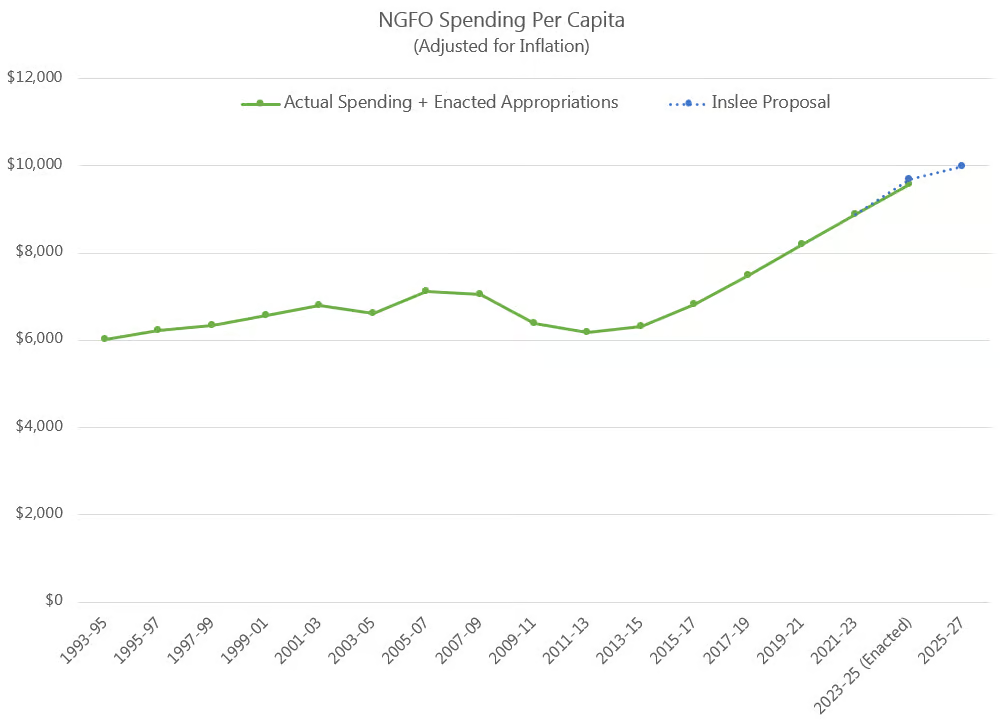
Washington’s spending has grown dramatically since the Great Recession, even after accounting for inflation and population growth. Under Gov. Inslee’s operating budget proposal, inflation-adjusted per capita spending from funds subject to the outlook (NGFO) would continue to increase.
From 1993–95 to 2005–07, inflation-adjusted NGFO spending per capita grew by 18.2% (biennial growth averaged 2.8% a year over this period). After the Great Recession, from 2013–15 to 2021–23, inflation-adjusted NGFO spending per capita grew by 40.6% (biennial growth over this period averaged 7.6%).
For 2023–25, enacted appropriations are 7.6% higher than inflation-adjusted per capita spending in 2021–23. Under Gov. Inslee’s 2025 supplemental proposal, revised inflation-adjusted per capita appropriations would be 8.9% higher than in 2021–23. Under Gov. Inslee’s 2025–27 proposal, these appropriations would increase by 4.4% compared to enacted 2023–25 appropriations.
All told, if Gov. Inslee’s proposals are adopted, inflation-adjusted per capita appropriations in 2025–27 would be 40.1% higher than the pre-Great Recession peak (and 57.9% higher than 2013–15).
State spending is clearly outpacing inflation and population growth; indeed, spending choices are the reason the state is facing a budget problem. Our analysis of how this shortfall came about is here.
It is not a revenue shortfall. Nevertheless, the governor’s budget proposal would substantially increase taxes. Note, though, that the governor is required to submit a budget that balances within current resources. (He may also submit a budget that uses new revenues, which is his preferred budget and the one we discuss above.) The governor’s current law (or Book 1) budget would reduce inflation-adjusted per capita spending by 4.7% compared to enacted 2023–25 appropriations. However, even that reduced per capita spending would still be 2.5% higher than actual 2021–23 per capita spending.