12:44 pm
December 17, 2024
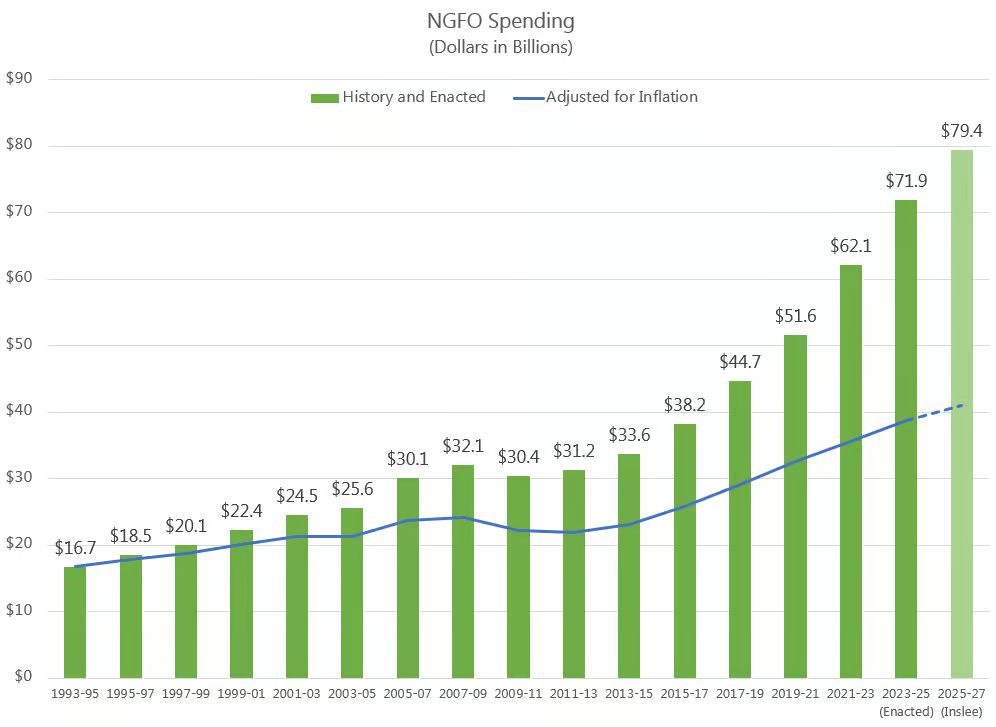
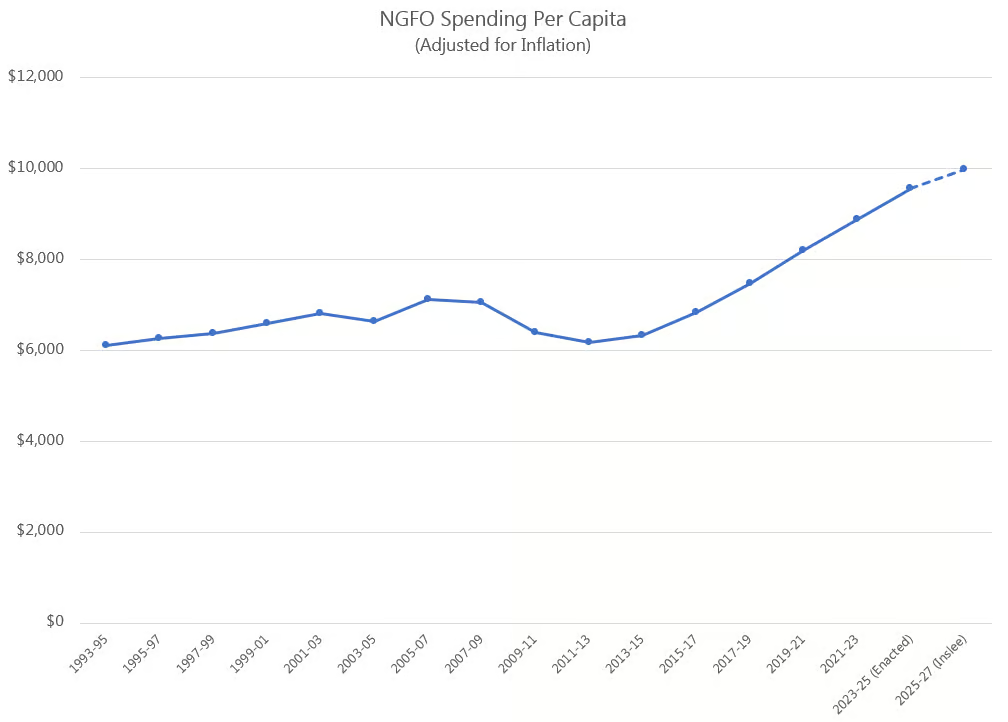
Gov. Inslee’s 2025–27 operating budget proposal would appropriate $79.446 billion from funds subject to the outlook (NGFO). That is $7.501 billion (10.4%) higher than enacted appropriations for 2023–25. Of the spending increase, $2.097 billion would be new policy.
The proposal would leave an unrestricted NGFO ending balance of $497 million in 2025–27 and $2.376 billion in 2027–29.
Given the estimated 2025–27 budget shortfall and the proposed new spending, how does the governor balance the budget?
- He would impose a wealth tax to increase revenues by an estimated $3.380 billion in 2025–27 and $6.911 billion in 2027–29. The rate would be 1% on worldwide wealth over $100 million.
- He would increase the business & occupation (B&O) tax to increase revenues by $1.045 billion in 2025–27 and $1.580 billion in 2027–29. First, from October 2025 until December 2026, the tax on businesses in the services and other activities category that make more than $1 million a year would increase by 20%. Then, beginning in January 2027, all B&O tax rates would increase by 10%.
- He would transfer the balance of the budget stabilization account (BSA, or the rainy day fund) to the NGFO in FY 2026. The transfer of $1.633 billion would then be returned to the BSA in 2027–29.
- He would also transfer a net of $1.071 billion from other funds to the NGFO in 2025–27. That includes $1.0 billion from the Washington Law Enforcement Officers & Firefighters’ (LEOFF) System Plan 1 retirement account. It also includes $100.0 million from the public works assistance account, $80.0 million from the treasurer’s service account, and $69.0 million from the electric vehicle incentive account.
Even with all of those new resources, the budget would still not balance in 2025–27 but for the assumption of an unusually high level of reversions (appropriations that are not spent). The Office of Program Research’s estimate of the budget shortfall assumed that reversions would be $604 million in 2023–25, $383 million in 2025–27, and $379 million in 2027–29. Gov. Inslee’s budget assumes reversions in those biennia of $870 million, $700 million, and $437 million.
If Gov. Inslee’s budget used the OPR reversion assumptions, the unrestricted NGFO ending balance for 2025–27 would be negative $86 million.
Additionally, Gov. Inslee assumes 4.5% annual revenue growth for 2027–29, consistent with the outlook statute. Although revenues are not currently forecasted to grow that much, his budget would still balance over four years if the additional resources from the 4.5% assumption were not included.
All of this is Gov. Inslee’s preferred (or “book 2”) budget. However, he is required by law to also present a “book 1” budget that is balanced within existing resources. It’s not clear when that will be available.
As we outlined in detail in our report, Anatomy of the Projected State Budget Shortfall, the budget problem in 2025–27 is not the result of a drop in revenues. It is the result of spending choices made by the Legislature in recent years. Meanwhile, the business tax burden in Washington is already above the national average.
Tags: 2025-27