
1:31 pm
November 4, 2026
As I wrote last month, the paid family and medical leave (PFML) program premium rate will increase to 1.2% in 2027. Nevertheless, the program is facing “a sustained deficit,” as the annual actuarial report (released Nov. 1) shows. Meanwhile, a report on program solvency, which was required by the 2026 supplemental budget, has also been released by the Employment Security Department (ESD). It offers some options for legislators that could improve solvency. The two reports should be read together.
Sustained Deficits Expected
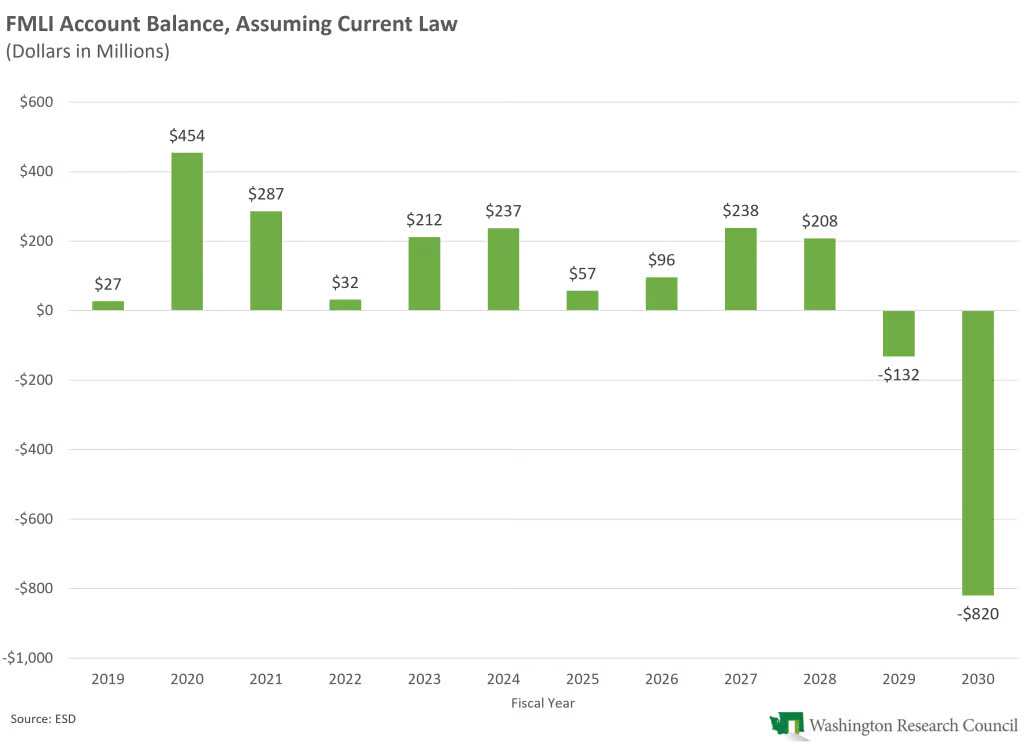
According to the actuarial report, the sustained deficit is expected beginning in 2029. Under current law, ESD estimates that the family and medical leave insurance (FMLI) account balance will be -$132 million at the end of FY 2029 and -$820 million at the end of FY 2030.
The report notes, “Premium rates for 2027 and later are truncated by” the statutory premium rate cap. If the rates were determined based on the actuarial rate method that will first be used for the 2029 rates, and if there were no rate cap, the 2027 rate would be 1.32% (assuming a three-month reserve level).
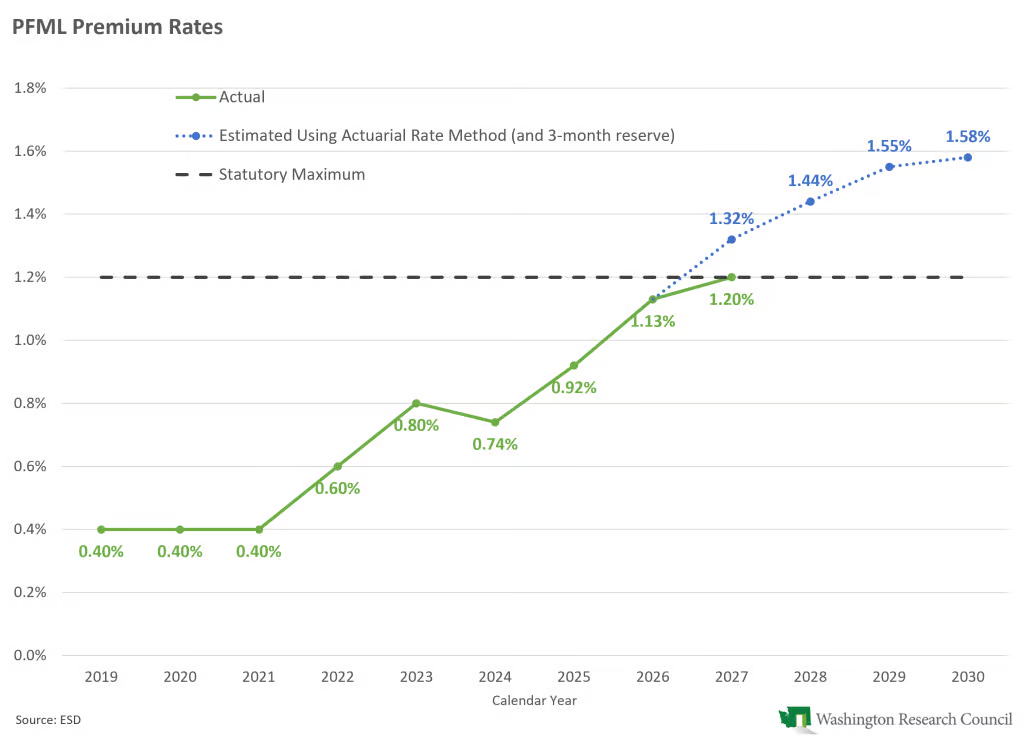
The solvency report includes a limited projection of the premium rate needed assuming a four-month reserve. The rate would need to be 1.67% in 2029, 1.77% in 2031, and 2.0% in 2036. ESD writes, “Without changes to premium revenue, benefit expenditures, or program design the premium rate would be projected to reach 2.0% by 2036, otherwise it would continue to experience financial insolvency.”
Causes of Insolvency
In the solvency report, ESD writes, “A lack of a financial reserve, limitations on the current and future rate models, and high usage are the primary drivers of expected short- and long-term periods of insolvency.” According to the actuarial report, the sustained deficit is due to the 1.2% cap on rates and “a continued increase in program benefit costs.”
This increase in costs is due to high utilization and increases in benefit amounts. ESD “continues to see higher growth in paid claims related to the newness of the program and programmatic changes over time.” (Note that benefits have been available since 2020; the report never explains when the program will be considered mature.) The actuarial report estimates that utilization growth will start to slow down, but “claims experience has continued to grow at double-digit rates.”
Additionally, “The increase in benefit payments is attributed to both the increase in the average weekly benefit amount and the escalated number of claims.” (The maximum weekly benefit amount is 90% of the state average wage, so it rises automatically.) According to the actuarial report, “The ultimate benefit per Family Leave claim was around $7,400 in 2023; it is now closer to $8,200. A similar increase was observed for Medical Leave claims, which went from an average cost of about $6,500 to $7,300. The increase per claim is mostly driven by the claimants’ weekly wages.”
PFML benefits have also been expanded. For example, the actuarial report references the 2025 passage of E2SHB 1213, which expanded access to job protection. The actuarial report repeatedly says this has contributed to increased costs. (The solvency report doesn’t discuss the role of benefit expansions at all.)
The solvency report includes comparisons to similar programs in other states. Colorado’s program appears to be quite similar to Washington’s. Nevertheless, ESD writes (regarding the current rate-setting method), “While California and Colorado have not experienced the same level of insolvency, Washington’s high levels of growth since benefits launched have outpaced the 40% adjustment of the prior year’s expenses.” The report never addresses what is different about Colorado that has kept it from experiencing Washington’s insolvency.
Policy Options for the Legislature
ESD presents several options that could help improve program solvency by increasing revenues, decreasing expenditures, or changing program design. These include, for example,
- Increasing the taxable wage base,
- Increasing the premium rate cap,
- Using the state average annual wage as the taxable wage base instead of the Social Security wage base,
- Changing the weekly benefit amount calculation to reduce wage replacement,
- Reducing the maximum weekly benefit amount,
- Reducing the amount of leave available,
- Reducing the threshold for the small business exemption, and
- Giving ESD flexibility to change aspects of the program to maintain solvency in the short run.
The report does not provide detailed cost estimates for the options, but it includes some examples of the annual percentage impact that some of the policy options would have on the account balance in 2036. To have a solvent program and a 1.2% premium rate, ESD estimates that revenues would need to increase by 73% or spending would need to decrease by 40% (or some combination thereof). Removing the taxable wage cap, for example, would have a 19% impact on the account balance, and reducing maximum leave duration by four weeks would have a 22% impact on the account balance.
ESD does not make any recommendations as to which options the Legislature should choose. But it does recommend that the actuarial rate setting method (which is scheduled to be used for 2029 rates) go into effect and that “a robust reserve” be established. Additionally, ESD highlights the consequences of delay:
If policy makers decide to delay taking legislative action, the program, the Governor’s Office and the Legislature have very few options available in the event of long-term, sustained deficits. Authorization from OFM for short-term deficits spending, per RCW 43.88.260, is allowed only if the program can resolve deficits through quarterly revenue collections. Should this not be the case it opens the program to significant legal risks if there are no funds in the Paid Leave account as there is no precedent for such a scenario.
The first thing the Legislature should do is stop expanding benefits. We have known about the program’s solvency issues since 2022, yet the Legislature has increased PFML benefits since then. Whatever other options the Legislature chooses, it should act quickly to get the program on a self-sustaining path.
Categories: Economy , Employment Policy.Tags: paid family leave