
11:20 am
February 27, 2026
Determining the size of a budget shortfall is more subjective than you might think. It involves numerous assumptions, and various parties don’t always agree on what those assumptions should be. On top of that, everyone has a different idea of how much new spending should be added.
In a supplemental budget year, shortfalls occur when revenues are lower than anticipated at the time the biennial budget was adopted or when the cost of continuing current services, adjusted for inflation and enrollment (the maintenance level) is expected to increase. This year, revenues are higher than anticipated in the adopted budget, but the Legislature estimates that maintenance level changes will increase costs by $1.734 billion in 2025–27 and $1.993 billion in 2027–29. (Further, the budget adopted last year did not set this Legislature up for success.)
The difference between the maintenance level and existing resources is the maintenance level shortfall.
Every budget outlook includes two sets of assumptions: prior period adjustments and reversions. Prior period adjustments occur on the resources side of the ledger. For example, they include corrections to errors found in the accounting of prior years. Typically, the outlooks have assumed $20 million in additional resources each fiscal year from prior period adjustments. However, the House proposal inexplicably assumes prior period adjustments of $157 million each year.
On the spending side of the ledger, the outlooks assume that some amount of appropriations will not ultimately be spent. These amounts would revert to the state for future appropriation. As I have written, the reversion assumption has been moving around quite a bit lately and is effectively a budget gimmick that allows the appropriations level to be artificially increased while still balancing on paper.
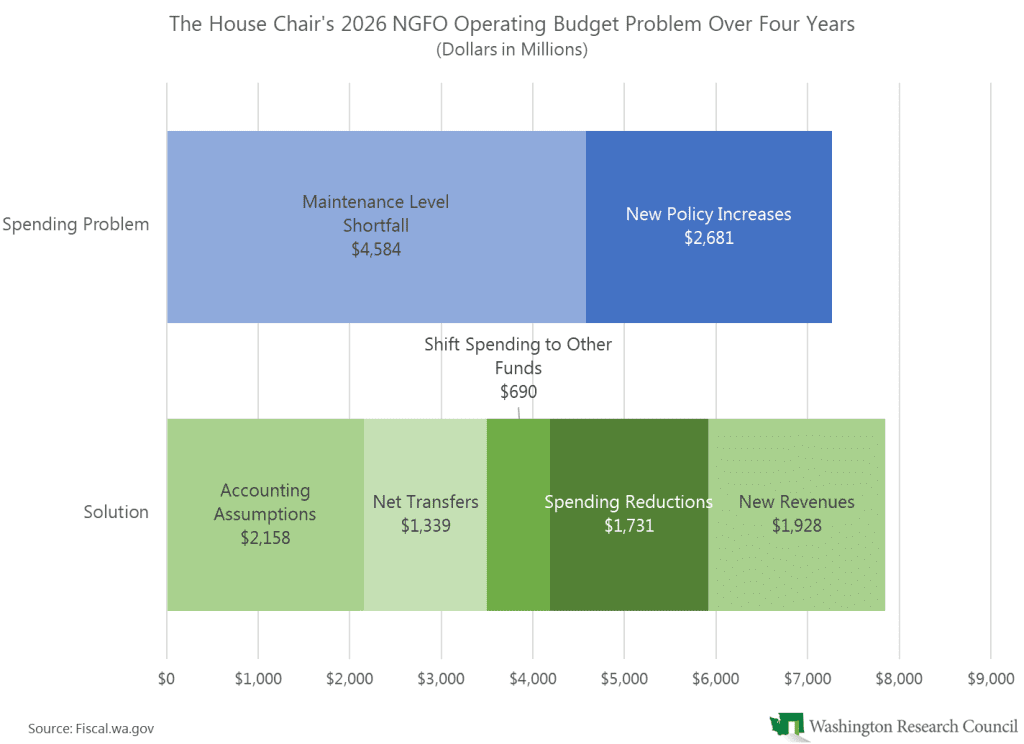
Consequently, to estimate the maintenance level shortfall for the 2026 supplemental, I am not including any assumptions regarding prior period adjustments or reversions. Given the enacted 2025–27 budget, the February 2026 revenue forecast, and estimated maintenance level increases, I estimate that the shortfall is $1.873 million in 2025–27 and $4.584 billion over four years. (This does not include any potential new spending.)
Given that estimated shortfall, how do the Senate and House operating budget proposals balance the budget? Both the Senate and House would also add new spending increases, which increases the size of the problem. Both would increase taxes and reduce some spending. But both also rely heavily on one-time resources and accounting gimmicks: they shift some spending to funds outside of the NGFO, they transfer funds into the NGFO, and they increase the use of reversion and prior period adjustment assumptions. (The charts below reflect the proposals as proposed by the Senate and House chairs.)
As I wrote yesterday, and as we showed in a 2024 report, this budget problem is the result of spending choices the Legislature has made in recent years.
(For more on the Senate and House supplemental proposals, see here.)

Tags: 2026 supplemental