12:27 pm
May 18, 2021
This year the Legislature passed (and Gov. Inslee signed) 2SHB 1168, which aims to reduce the risk of wildfire by improving “long-term forest health.”
The bill creates the wildfire response, forest restoration, and community resilience account. The account may be used for:
- “Fire preparedness activities consistent with the goals contained in the state’s wildland fire protection 10-year strategic plan.” (The strategic plan is here.)
- “Fire prevention activities to restore and improve forest health and reduce vulnerability to drought, insect infestation, disease, and other threats to healthy forests.” (The bill adds that priority for this funding will go to purposes consistent with the 20-year forest health strategic plan, the Washington state forest action plan, and the wildland fire protection 10-year strategic plan.)
- “Fire protection activities for homes, properties, communities, and values at risk.”
Each biennium, 25% of appropriations from the account must be for forest health activities and 15% must be for community resilience activities. The account may not be used for emergency fire costs or suppression costs.
Additionally, the bill specifies that inmate forest fire suppression and support crews will have to be paid at least the minimum wage when fighting fires. (Funding for this provision will not come out of the new account.)
Although a dedicated account is created, there is not a dedicated funding source. In 2019, the commissioner of public lands proposed an insurance premium surcharge to help fund wildfire response. That wasn’t approved, and this year the Legislature opted to fund the bill through the general fund–state (GFS).
To implement 2SHB 1168, DNR’s fiscal note (see the attachment beginning on page 52 of the pdf) estimates that it will need $131.3 million in 2021–23, $88.7 million in 2023–25, and $86.3 million in 2025–27.
2SHB 1168 notes that it is the intent of the Legislature to appropriate $125 million in each of the next four biennia for the purposes of the bill. Instead, the 2021–23 operating budget essentially funds the need identified in the fiscal note. As passed by the Legislature, the 2021–23 operating budget includes $130.5 million from the GFS to implement 2SHB 1168. The outlook assumes that GFS funding will be $95.1 million in 2023–25.
According to the bill,
Wildfires inflict huge costs to the state budget, the budgets of partner agencies, and our economy. From 2014-2019, agencies in Washington annually spent nearly $150 million fighting wildfires. In 2015, firefighting costs were more than $342 million. In 2019, firefighting costs were more than $172 million. And suppression costs are only a small portion of the full economic impact. According to a 2018 report by the nonprofit headwater’s economics, suppression costs account for only nine percent of the total cost of wildfires when factoring in disaster recovery, lost business, lost infrastructure, and timber damage, and public health impacts.
Suppression costs may be a small portion of the direct and indirect costs of wildfires, but they account for over half of the direct spending on the wildfire program by the Department of Natural Resources (DNR). For example, this report to the Legislature notes, “The Wildfire program’s 2021-23 biennium carry-forward level (CFL) funding totals $124,670,000, of which $53,076,000 is in Preparedness, $7,852,000 is in Prevention, and $63,743,000 is in Suppression.” (The carry-forward level essentially just carries forward current funding into the next biennium.)
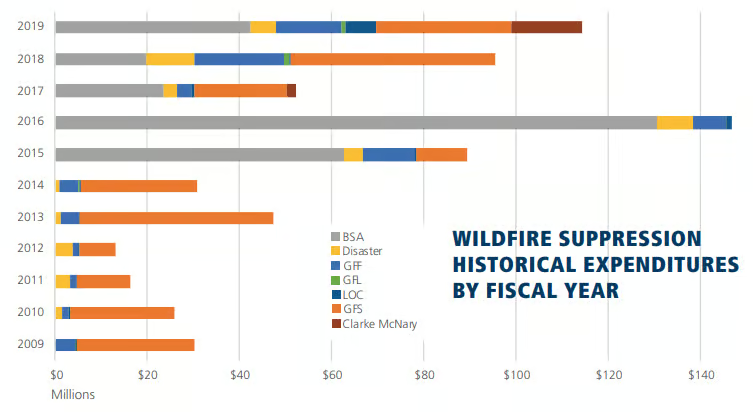
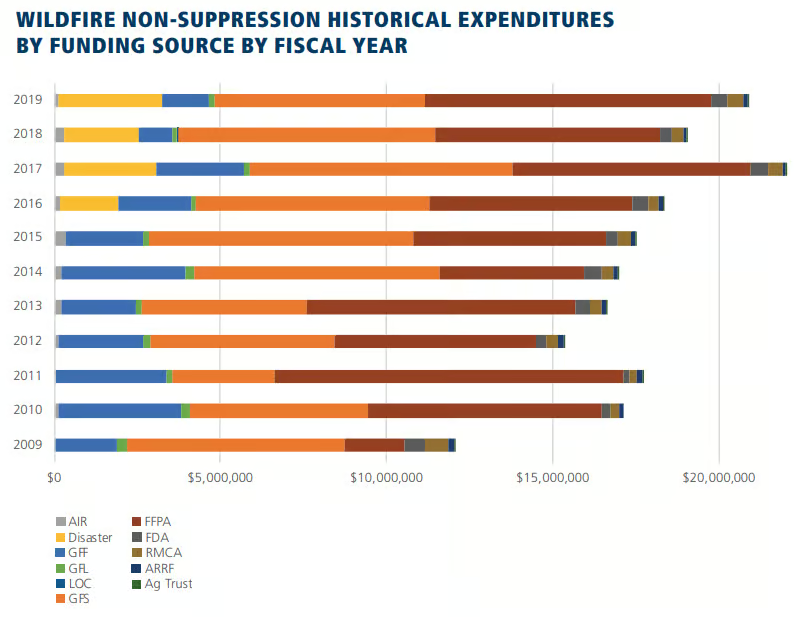
The two charts below show wildfire program suppression costs and non-suppression costs in each year, by fund source. (They come from this report. Note that the x-axis goes to $140 million in the first chart and to $20.0 million in the second.) As the first chart shows, the budget stabilization account (BSA, or the rainy day fund) was used for emergency fire suppression costs in each year from 2015–2019. The total amount appropriated from the BSA for this purpose over time is $369.6 million.
A Crosscut story about the bill notes,
For decades, money meant to go to prevent fires by improving forests has been shifted by necessity to firefighting. Going forward, Washington would build up a robust workforce trained to clear underbrush and thin forests either by hand or through controlled burns, a practice used only sparingly in Washington and most Western states.