
2:37 pm
December 5, 2019
Commissioner of Public Lands Hilary Franz has proposed an insurance premium surcharge to help fund wildfire response. The draft legislation would require property and casualty insurers (except medical professional liability businesses) to collect a “wildfire surcharge” of $5 per policy annually. Each property and casualty insurer would have to make a payment of at least $1,000 a year.
Under the draft, “Each property and casualty insurer may annually collect wildfire surcharges remitted in preceding years by means of a policyholder surcharge on premiums charged for property and casualty insurance. The recoupment is at a uniform rate reasonably calculated to collect the wildfire surcharge remitted by the insurer.” The draft would create a new “wildfire prevention and preparedness account,” to which receipts from the surcharge would be deposited.
The Department of Natural Resources (DNR) estimates this would increase revenues by $126 million a biennium. The press release states, “Revenue for the Wildfire Prevention and Preparedness Account will come from a surcharge of just a few cents on property and casualty insurance premiums. For the average household, the cost will be just over $1 per month.”
This may sound familiar. An increase to the tax on property and casualty insurance premiums to fund wildfire prevention and suppression was passed by the Senate earlier this year as part of its 2019–21 operating budget plan. The Senate Ways and Means Committee later amended the underlying bill (SSB 5996) to change the tax increase to a 0.52 percent surcharge on insurers’ receipts, with a minimum surcharge of $1,000. As amended, the bill was expected to increase revenues by $123.2 million a biennium. SB 5996 was not ultimately passed by the Legislature.
DNR’s 10-year strategic plan notes, “The cost to manage large wildland fire in Washington state averaged nearly $37 million per year between 2008 and 2012. Between the years of 2013 and 2018, the average annual expense quadrupled ($153 million).”
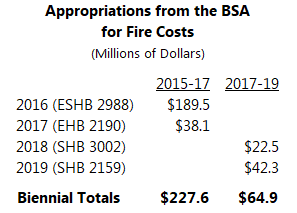
Indeed, in recent years, the Legislature has used the rainy day fund (the budget stabilization account, or BSA) to pay for a portion of wildfire costs.
Also this week, Sen. John Braun proposed dedicating the current state sales tax on motor vehicles to transportation. According to Sen. Braun, this would increase transportation funding by $30 billion over 20 years. He notes, “Car tabs were just slashed by voters, part of a twenty-year consistent message from the public on the issue. The gas tax, with increasing fuel-efficiency and the rise of hybrid/electric cars, is a declining long-term revenue source, absent increases in the tax rate.”
The proposal has been prefiled as SB 6041. Beginning in FY 2021, 10 percent of the revenues from the sales tax on motor vehicles would be deposited in the new “congestion relief and safety account.” The portion of revenues dedicated to the account would increase by 10 percent a year until reaching 100 percent in FY 2030. The deposits to the congestion relief and safety account would be suspended in any year in which employment growth is estimated to be less than 1 percent (thereby keeping the funds for use in the operating budget).
Appropriations from the account could be made for “transportation projects, programs, or activities based on the percentage of historical spending of eighteenth amendment restricted funds and noneighteenth amendment restricted funds.” Funds could not be used for new bond issues.
A fiscal estimate from Sen. Braun projects that under the bill, $120 million would be diverted from the operating budget in FY 2021, increasing to $1.701 billion in FY 2030, when the switch from operating to transportation would be complete.
Categories: Budget , Categories , Tax Policy.