12:26 pm
June 24, 2026
Jim Brunner of the Seattle Times reports that the Office of Financial Management (OFM) has authorized the state’s self-insurance liability account (SILA) “to be in a temporary cash deficiency of up to $1.7 billion” in 2025–27.
At this time last year, the state had authorized a temporary cash deficiency in the account of up to $1.01 billion for 2025–27. As part of the 2025 authorization, OFM stated, “prior to any future authorization of cash deficiency in this account, and before the next legislative session, DES must work with its actuarial services provider, OFM, legislative staff, and other appropriate agencies to review the rates, funding structure, and other potential solutions to address this fund’s insolvency.” It’s not clear how much of that work was done before the 2026 legislative session.
The 2026 supplemental appropriated $1.074 billion from all funds to backfill SILA, plus $29.5 million from all funds to increase agency premiums for self-insurance and tort liability costs on an ongoing basis. Of the appropriations, $956.1 million came from funds subject to the outlook. (This was the main driver of overall new spending in the 2026 supplemental budget.)
Agency premiums for tort liability costs are part of the central services model. According to OFM’s central service model report based on the 2026 supplemental, $715.8 million of the new funding is supposed to be paid to SILA in FY 2026 and $387.3 million will be paid to SILA in FY 2027. Most of this new money will come via premiums from the Department of Children, Youth, and Families (DCYF). According to OFM’s 2026 authorization letter, the backfill will not go to SILA before June 30, 2026. Apparently, because part of the backfill comes from federal funds, DCYF needs federal approval before it can pay the premium.
Although OFM’s new cash deficiency authorization letter suggests that the potential $1.7 billion deficiency might be partially a timing issue, it is concerning that it is so much higher than the $1.1 billion backfill provided in the 2026 supplemental. Especially since the Department of Enterprise Services, in its budget request for the 2026 supplemental, had said that the shortfall could grow to $1.403 billion in 2025–27, in the worst-case scenario.
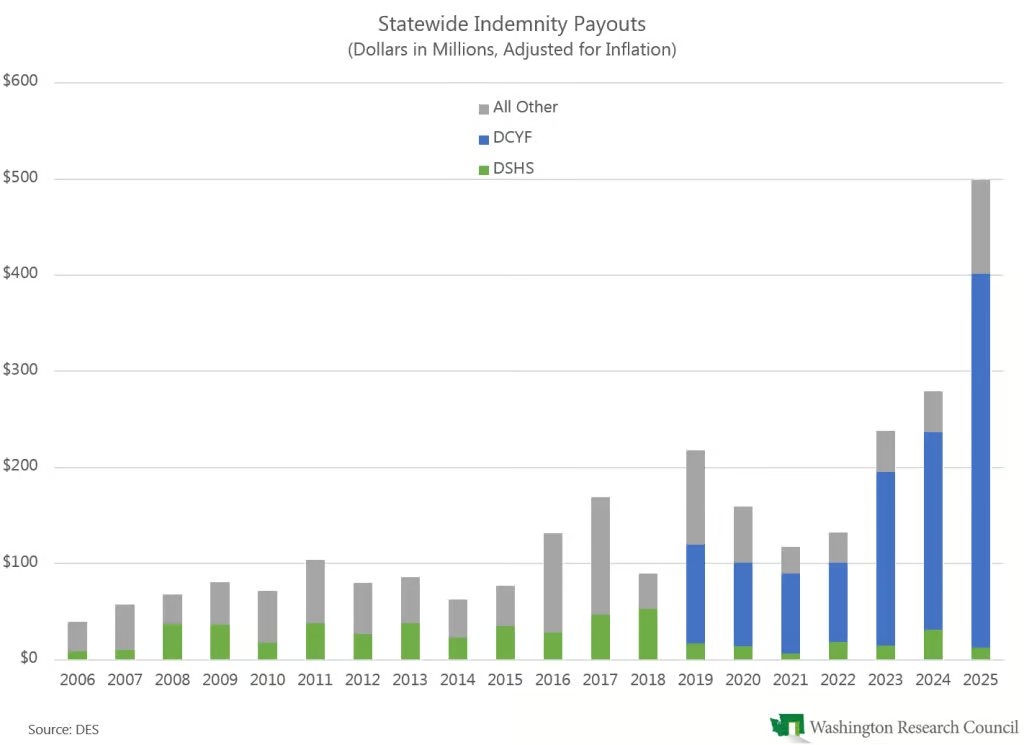
The liability account has had a shortfall at the end of each fiscal year since 2018. The 2022 supplemental provided $217 million from the NGFO to backfill the account, but the account was back in the red less than a year later. Since May 2023, the account’s ending balance has been negative every single month. According to OFM, the ending balance was -$839.1 million last month. As of today, the balance is -$952.3 million.

To the extent that the $1.1 billion backfill approved this year is not sufficient to close the shortfall by the end of 2025–27, the Legislature may need to appropriate additional funding. Unfortunately, the 2026 supplemental left a small ending balance of just $277 million at the end of 2025–27.
Additionally, the state must do something to more permanently address the increasing indemnity payouts, which have risen dramatically over the past several years. To that end, the 2026 supplemental (Sec. 135(6)) created the Tort Study Committee to recommend “changes to the current system and processes for claims against the state, or against its officers, employees, or volunteers, acting in such capacity, for damages arising out of tortious conduct.” The committee began meeting June 3 and must report to the Legislature by Nov. 1, 2026.