
12:26 pm
July 1, 2025
Today is the first day of fiscal year 2026 and the first day of the 2025–27 biennium.
Unfortunately, the Legislature did not set the year up for success. First, as we’ve shown, the Legislature’s spending choices over the past several years led to a four-year $8.6 billion maintenance level shortfall (the difference between the cost of continuing current services and expected resources) coming in to the 2025 session.
Second, although the enacted 2025–27 operating budget balanced over four years, the 2025 Legislature chose to leave a very low unrestricted ending balance in funds subject to the outlook (NGFO) for both 2025–27 and 2027–29. (And the ending balances were low even though the Legislature ignored the problem in the liability account.) The Legislature estimated that the ending balances of the budget as passed would be $225 million in 2025–27 and $673 million in 2027–29. The official budget outlook, which accounts for vetoes and makes some assumption changes, estimates that the enacted budget leaves ending balances of $80 million in 2025–27 and $381 million in 2027–29.
Comparing unrestricted ending balances in the first biennium of the outlook, going back to the first four-year outlook (produced in 2013), the unrestricted ending balance in 2025–27 (as enacted) is the lowest ever, as a percent of revenues and other resources. Even the $225 million ending balance in the budget as passed by the Legislature was the second lowest.
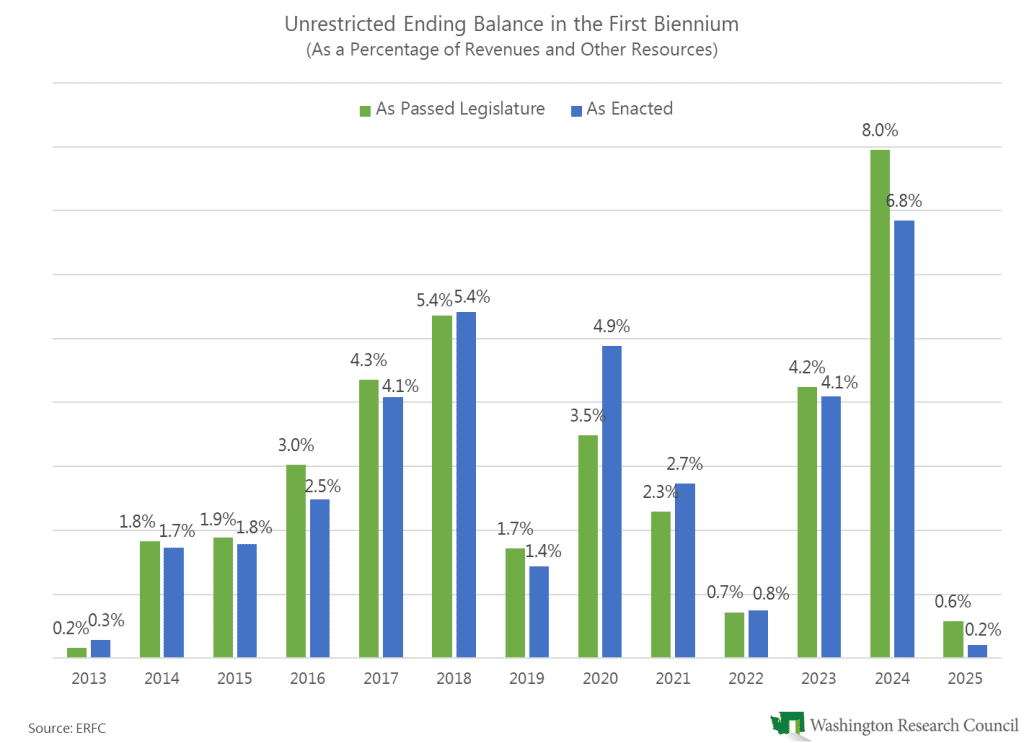
And now revenues are forecasted to be $721 million lower over the outlook period than assumed in the budget outlook. This means that the estimated ending balance for 2025–27 is just $2 million (0.005% of revenues and other resources) and the estimated ending balance for 2027–29 is negative $331 million.
The Legislature chose to spend down resources even though there were widespread expectations of both a slowing economy and less funding from the federal government. Indeed, in a story about the June revenue forecast, the Olympian reports:
State Sen. June Robinson of Everett, the Senate Democrats’ budget leader, said the forecast wasn’t as bad as she thought it might be.
“It’s not surprising, I guess,” she said. “I think we were all expecting revenue to be down for a lot of reasons, mostly things out of our control happening at the federal level.”
But the Legislature did have control of the spending level it adopted this year. The budget stabilization account (BSA, or the rainy day fund) is expected to hold $2.056 billion at the end of 2025–27. But had the Legislature left a higher unrestricted ending balance, it would be in a better position to address anticipated challenges.
Categories: Budget.