11:15 am
September 19, 2024
Superintendent of Public Instruction Reykdal claims, in his office’s 2025–27 budget request, that “No matter how you look at the numbers, Washington currently underfunds K–12 education by around $4 billion per year.” This is an opinion, and Reykdal does not show his work for the calculation.
Nevertheless, the Washington Observer slightly changes that wording and presents it as fact in an item yesterday about the superintendent’s request. Additionally, the Observer writes, “The state has failed to uphold its minimum constitutional requirements to pay for basic education, Reykdal says, and in the agency’s budget request, about $1.5B of the $3B requested by OSPI from 2025-27 would go toward basic education.” I think this is referring to this part of Reykdal’s letter:
Washington must fund basic education as it is currently defined and constitutionally required. That means fully funding special education and providing adequate funding for student transportation to and from school. It also means providing sufficient funding for the materials, supplies, and operating costs needed to provide instruction each day so that districts do not need to deplete other important educational programs to cover these basic and necessary expenses. Funding basic education means meeting state-outlined school staffing ratios and supporting living wages for those staff, particularly classified staff.
Under the McCleary decision, the state was required to fully implement its reforms to the program of basic education. The state Supreme Court ruled that it had done so in a 2018 order, even though “plaintiffs still dispute the constitutional adequacy of the funding formulas.”
Indeed, the state Supreme Court explicitly said (in a 2017 order) that the prototypical model “is not designed to dictate reimbursements to school districts for their actual expenditures on the components of basic education.” Instead, the prototypical model “is designed to calculate the amount of state funding necessary to provide for the program of basic education while maintaining the ability of individual school districts to decide how best to spend the allocations to meet local needs. Being only an allocation model, it is not prescriptive.” Further, “This court has never held that to meet its constitutional obligation, the State must precisely account for every school district’s actual expenditures in providing basic education.”
Apparently the Legislature isn’t funding basic education to the level that Reykdal would like. It doesn’t follow that the current funding level falls short of constitutional requirements.
The Observer also states, “The infusion would be an important step toward bridging the ever-widening money gap from the state’s peak investment in K-12 education in 2019-20 . . . to the gradual decline of dollars and arguably, priority, for K-12 education in subsequent budget cycles.”
In fact, there has not been a decline of dollars for K–12. Adjusted for inflation, state spending on K–12 has increased since SY 2019–20 (or FY 2020), both in absolute terms and per pupil. (The spending data in the charts are from the state’s fiscal website, and they reflect the 2024 supplemental budget.)
Chart 1 shows that K-12 appropriations from funds subject to the outlook (NGFO) in FY 2025 are higher than FY 2020 spending (adjusted for inflation). Although there was a decrease in inflation-adjusted NGFO spending on K–12 in 2021 and 2022, that was offset by increased federal funds.
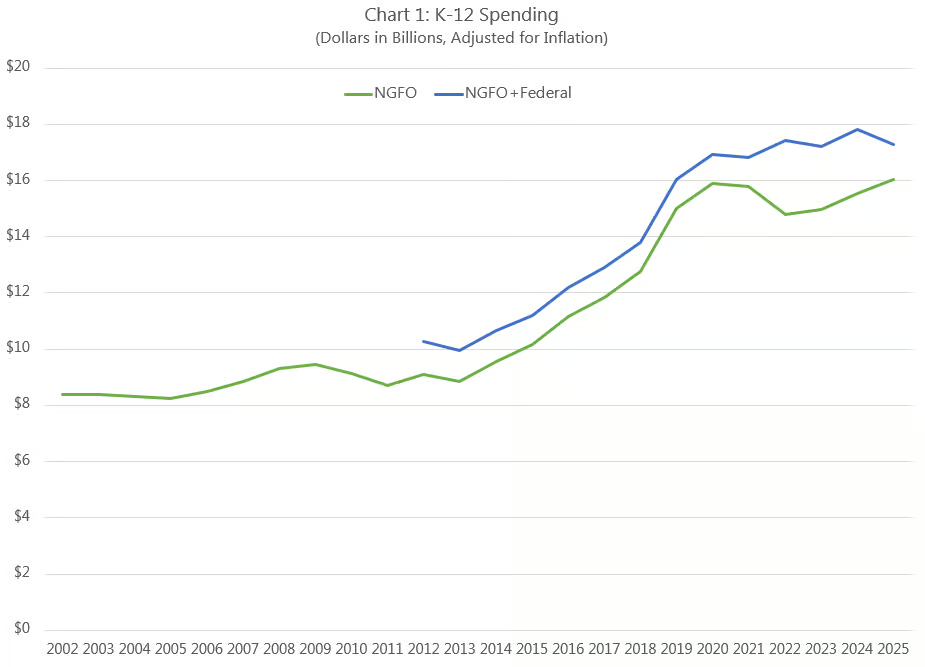
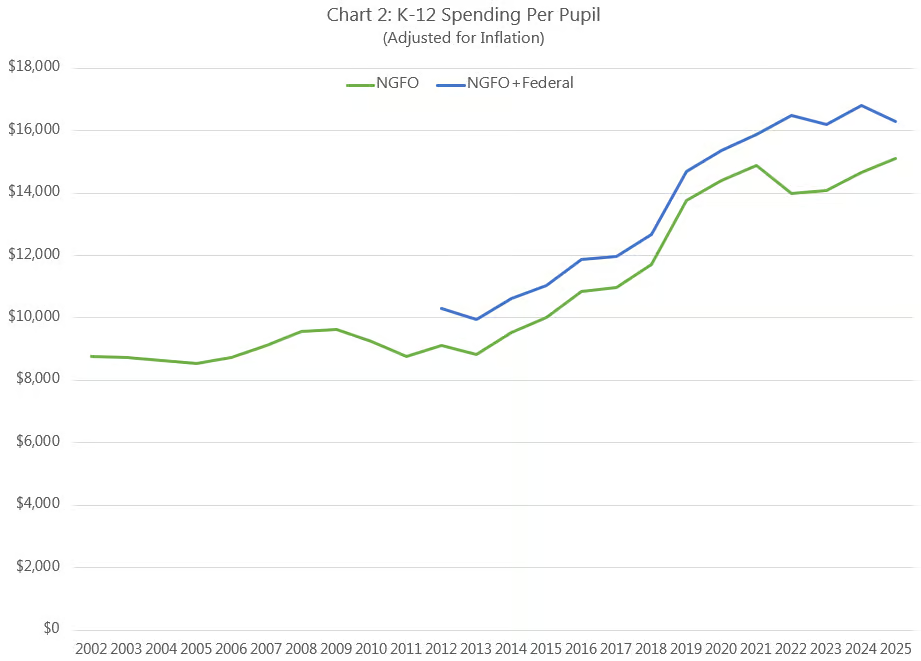
Chart 2 similarly shows how per pupil spending has increased over time. (Note that charts 1 and 2 do not include local funding for schools.)
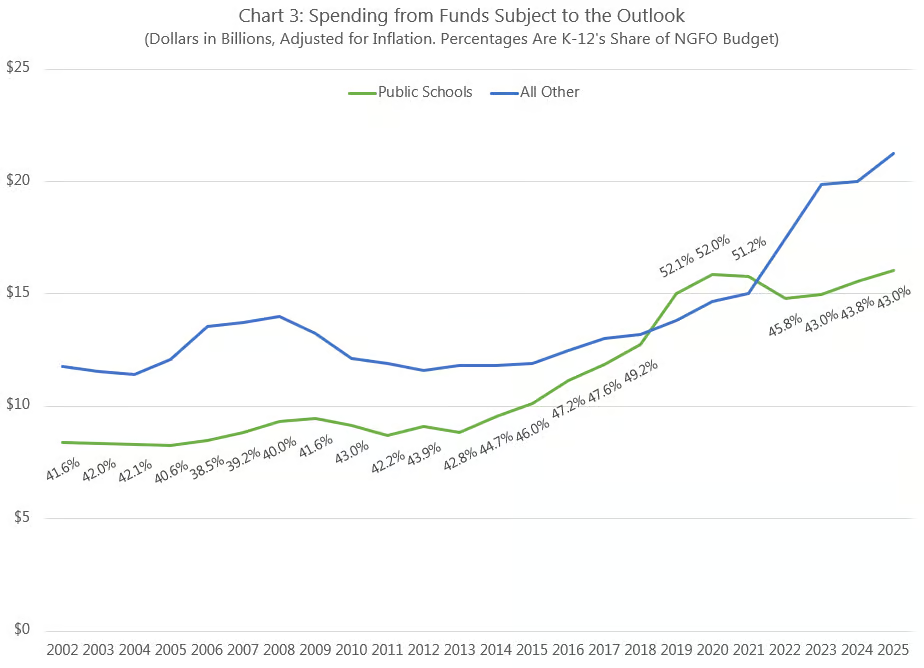
Reykdal writes, “The share of our Operating Budget dedicated to K–12 education has shrunk in recent years from its high-water mark of over 50% in 2019 to just 43% today.” That’s true. However, as shown above and in the chart below, it does not mean that K–12 spending has declined.
In July I wrote about this idea that the state should be spending 50% of the budget on K–12. There’s more there, but essentially it is an unworkable target given the varied needs of the state and changing demographics. More importantly, a 50% target has no connection to actual educational needs.
(For more on the state’s response to McCleary, see our 2020 report.)