
11:58 am
September 20, 2021
Washington state and its largest local governments have spent very little of their Coronavirus State and Local Fiscal Recovery Funds so far, according to performance reports filed at the end of August. Meanwhile, funding to address negative economic impacts accounts for nearly half of planned expenditures (across all reporting governments).
The American Rescue Plan Act included the Coronavirus State and Local Fiscal Recovery Funds (CSLFRF). These are fairly flexible funds that state and local governments may use in response to the pandemic and any revenue losses. The funds may be used for costs incurred by Dec. 31, 2024. Washington state and its local governments received the first half of their allocations this year and will receive the second half in 2022.
The federal government required governments with more than 250,000 residents to submit initial Recovery Plan Performance Reports by Aug. 31, 2021 (reports will also be due in each of the next six years). The reports cover the period from when funds were received by the entity to July 31, 2021. They include information on the planned and actual uses of the federal dollars (using categories defined by the U.S. Treasury Department). Because this first report only covers a few months of activity and jurisdictions have three more years to obligate funds, the funding plans could change and it should be expected that many governments report that only small portions of their awards have been allocated at this point. Additionally, jurisdictions may have adopted additional spending plans between July 31 and now.
In Washington, the governments that had to submit the report were the state; the City of Seattle; and King, Pierce, Snohomish, Spokane, Clark, Thurston, Kitsap, and Yakima counties.
The table shows the actual and planned expenditures reported to Treasury. Only the state, King County, Pierce County, and Clark County reported actual expenditures for the covered period. These expenditures are largely categorized as being for public health and negative economic impacts. For example:
- The state spent $35.0 million for the UW Medical Center and $14.4 million on food assistance.
- Pierce County spent $6.9 million on small business economic assistance and $3.0 million on COVID-19 testing.
- King County spent $2.8 million on payroll costs for public sector staff responding to COVID-19 and $1.2 million on prevention in congregate settings.
In total, $67.5 million had been spent by July 31—1.2% of the total awarded to the 10 governments.
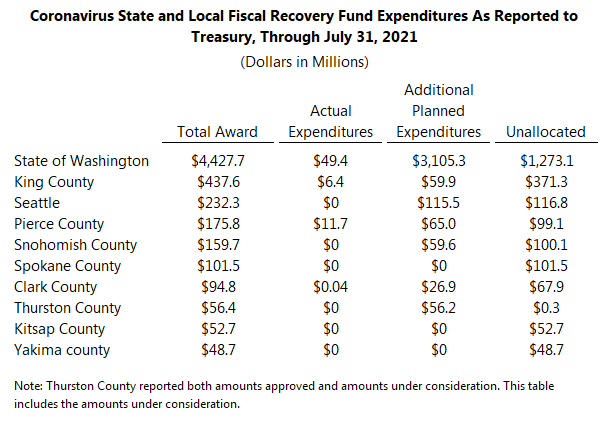
Although actual expenditures are low so far, seven of the reporting governments have plans for at least some of their awards going forward. However, Spokane, Kitsap, and Yakima counties reported that they have yet to develop their spending plans. (Here’s a Spokesman-Review story on the process in Spokane.)
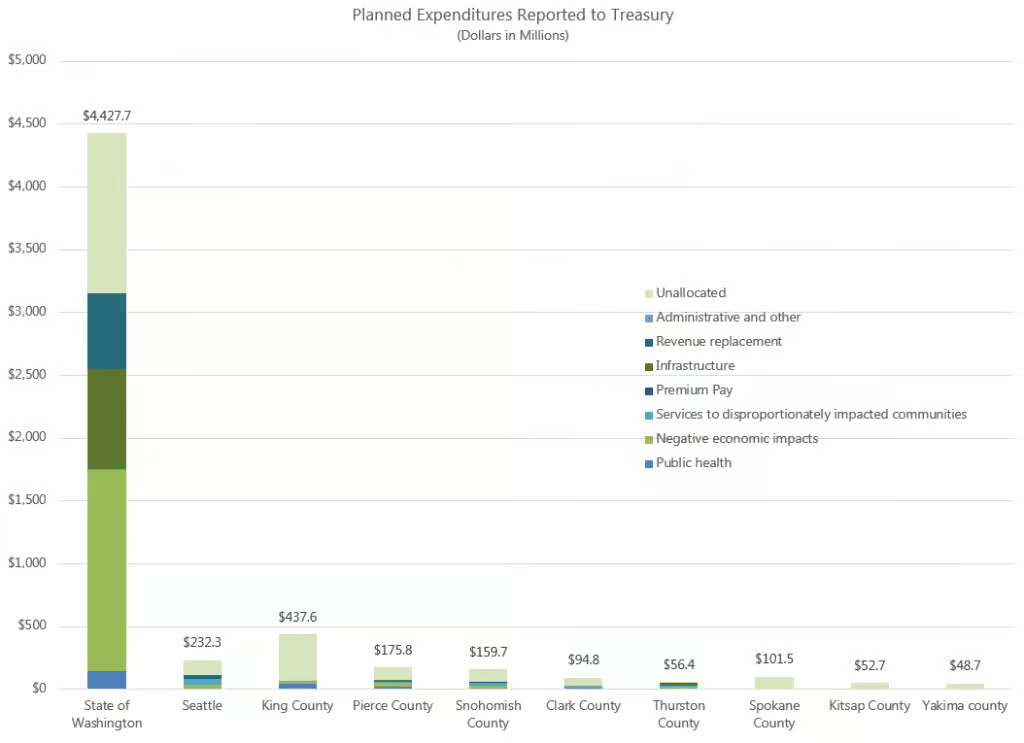
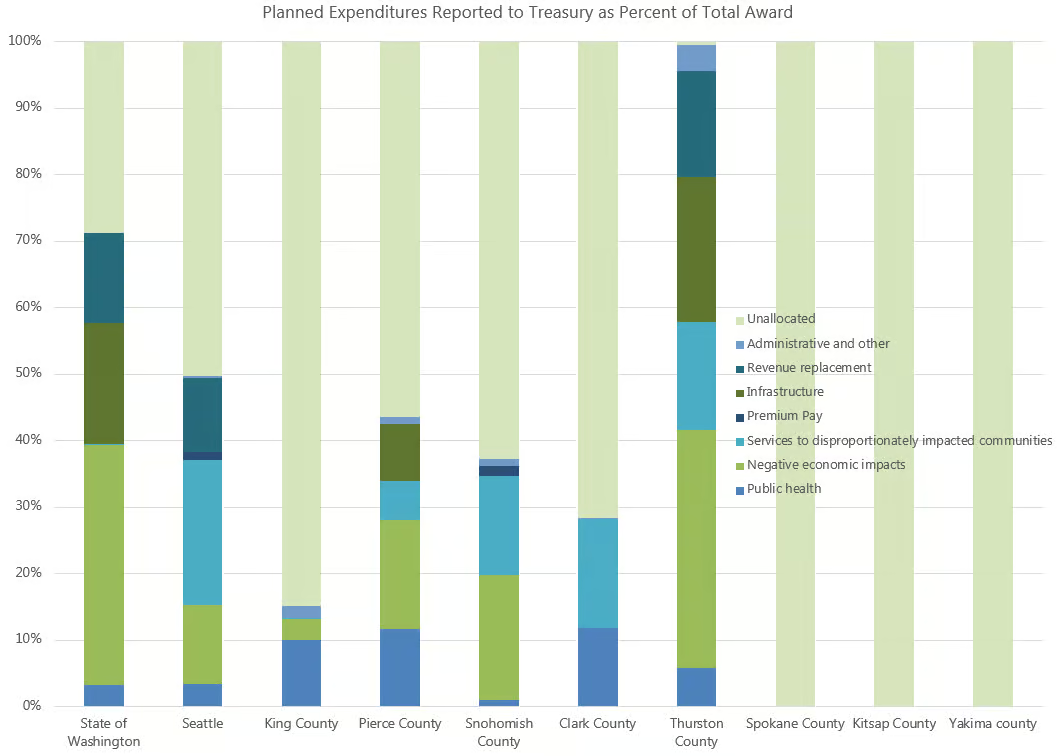
Including all reporting governments, 48.4% of the planned expenditures are for negative economic impacts (including, e.g., rental assistance and business assistance).
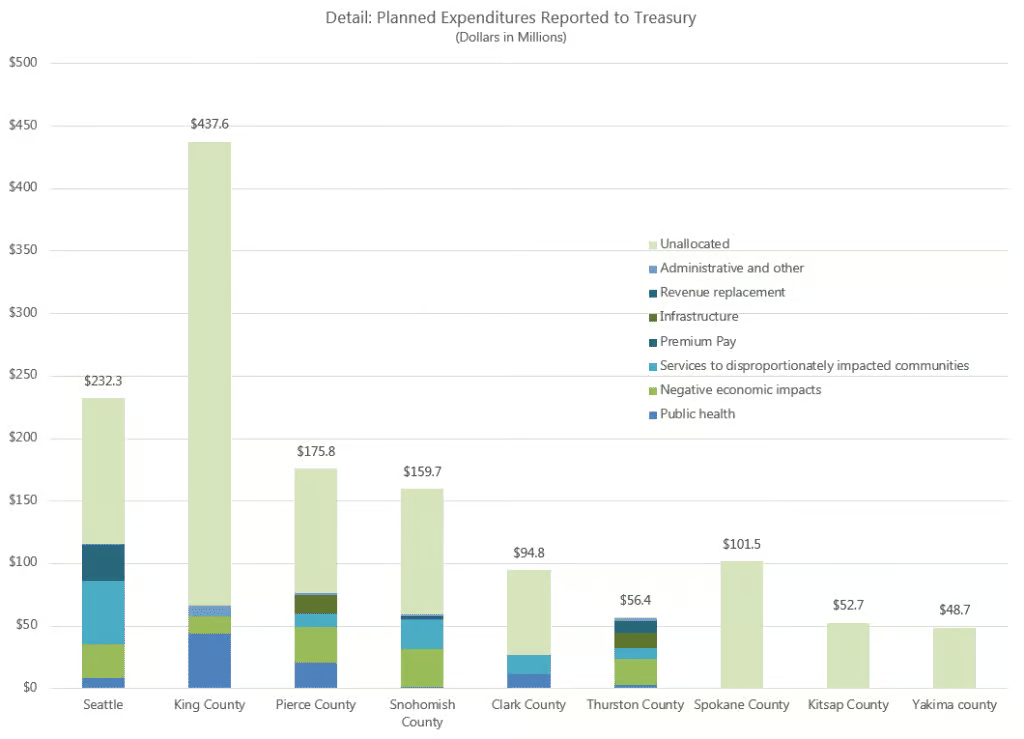
The charts break out the planned spending for each jurisdiction by category, as reported to Treasury. Thurston County included both funding approved ($11.5 million) and funding under consideration (another $44.7 million) in its report. The charts include the funding Thurston County is considering. On the other hand, the reports do not include some plans that have been adopted. For example, King County adopted a plan in May to spend $337 million of its award. (In its report, King County notes, “Given the urgency of needs in the community and the timelines needed to stand-up new programs to respond, the county’s appropriation process was initiated prior to issuance of the Interim Final Rule by US Treasury. An eligibility review process is underway to ensure that programs meet the eligibility requirements set out by Treasury.”)
The state’s report outlines appropriations made by the Legislature earlier this year. Detailed information on the Legislature’s appropriations of the CSLFRF and other federal relief are included in this spreadsheet. The state’s report notes that it is still reviewing whether certain appropriations are eligible uses of the CSLFRF. First, the 2021–23 operating budget appropriated $500.0 million from the CSLFRF for unemployment insurance relief, contingent on that being an allowable use of the federal relief dollars. (If it is determined not to be an allowable use, the policy will be funded from money transferred from the rainy day fund to the new shadow reserve account.)
Second, the 2021–23 transportation budget appropriated $400.0 million from the CSLFRF for culvert replacement. (The budget bill specified that if fish passage barrier removal is not an eligible use of the CSLFRF, the policy will be funded from the connecting Washington account.)
Third, the state’s report notes that it is reviewing $747,000 appropriated from the CSLFRF in the capital budget for two clean water projects to see if they “demonstrate a water quality benefit.” The two water projects are rate relief for the Belfair water reclamation facility and funding to “relieve the town of Malden from current loan burdens and allow the town to rebuild, without incurring debt, from damage caused by the September 2020 fire.”
Some notable planned funding items (on top of what has already been spent) that are included in the local governments’ reports:
- Seattle: $18.3 million for affordable housing, $10.7 million for other housing assistance, $8.0 million for services for unhoused persons, $17.4 million for small business assistance, $8.1 million for public health, $6.0 million for childcare, and $3.0 million for premium pay for childcare workers.
- King County: $22.3 million for payroll costs for public sector staff responding to COVID-19, $5.0 million for nonprofits, and $4.5 million for small business assistance.
- Pierce County: $15.0 million for broadband, $13.4 million for small business assistance, $5.4 million for public health capital investments, $5.2 million for affordable housing, and $5.0 million for COVID-19 testing.
- Snohomish County: $12.0 million for services for unhoused persons; $10.0 million for job training assistance; $7.9 million for small business assistance; $5.3 million for aid to tourism, travel, or hospitality; and $5.3 million for childcare.
- Clark County: $15.5 million for services for unhoused persons and $8.7 million for public health capital investments.
- Thurston County: $9.0 million for affordable housing, $5.5 million for small business assistance, $10.6 million for aid to impacted industries, and $5.0 million for broadband.
Revenue Loss Calculations
The CSLFRF money may be used to backfill revenue lost due to the pandemic. (I wrote about how such revenue losses are to be calculated here.) Some of the reporting governments note in their reports the extent of their revenue losses, but not all of them include backfilling those losses as planned expenditures.
- The state estimates that it experienced $2.18 billion in lost revenue. (As I noted here, the methodology is highly favorable to the state and allows the state to backfill revenues that were never expected in pre-pandemic revenue forecasts.) According to the state’s report, “The amount makes the state eligible to spend CSFRF on revenue replacement.” Thus, “Washington appropriated $600 million CSFRF to transportation accounts and operating expenses because travel-related revenue decreased during the pandemic.” The report includes a list of which transportation accounts will be backfilled. They include: $115.6 million for the multimodal account, $99.4 million for the motor vehicle account, $86.0 million for the Puget Sound ferry operations account, and $67.7 million for the connecting Washington account.
- Seattle includes $25.9 million in its expenditure plan for revenue replacement. The money will be used “to provide a new round of cash assistance through the Seattle Disaster Relief Fund.”
- Snohomish County estimates it experienced $18.4 million of revenue loss, but backfilling these revenues is not included in its planned expenditures.
- Clark County estimates that they will backfill $9.5 million. According to the report, $5.8 million of that will “be committed to specific revenue replacement categories as determined the County Council” and $4 million will be “available to support other government services.” (The $9.5 million is not included in their planned expenditures.)
- Thurston County reports that $9.0 million in revenue replacement (over multiple years) is under consideration. The county estimates that it lost $2.5 million in revenue in 2020.
Tags: ARP Act , COVID-19