9:53 am
October 12, 2026
In 2025, the federal government enacted H.R. 1, which made various changes to Medicaid and Supplemental Nutrition Assistance Program (SNAP) eligibility and funding. Many of these changes have not yet taken effect. Some result in direct costs for the state, but others would have only indirect impacts to the state budget, depending on legislative choices.
For example, under prior law, the federal government pays the full cost of SNAP benefits. Under H.R. 1, effective federal fiscal year 2028, states will have to fund a portion of SNAP benefits, based on their SNAP payment error rates. The higher the error rate, the higher the state match. This will be a direct cost for Washington, unless its payment error rate falls below 6%.
The new Medicaid work requirements in H.R. 1 could be an example of indirect costs. Effective CY 2027, to remain qualified for Medicaid, a Medicaid expansion client (i.e., someone with no children and income up to 138% of the federal poverty level) must work or perform community service for at least 80 hours a month or be enrolled in school part time. (Notably, the federal government has said that individuals can meet this monthly requirement by earning at least 80 times the federal hourly minimum wage, which is $580. Washington’s minimum wage is higher than the federal minimum, so a Washington minimum wage worker could effectively meet the Medicaid work requirement even if they only work 33 hours a month.) To the extent that this policy results in individuals losing Medicaid coverage, the state could make a policy choice to fund their health care using only state dollars. (Note, though, that the federal government currently funds 90% of Medicaid costs of the expansion population.)
On Sept. 3, by executive order, Gov. Ferguson created a “H.R. 1 Continuous Medicaid Response Committee” to “continue and strengthen Washington’s ongoing efforts to address federal health coverage changes associated with H.R. 1.” The order also directs the Health Care Authority (HCA) and the Department of Social and Health Services (DSHS) to “take actions to minimize unnecessary administrative burdens and support continuity of health coverage for eligible Washington residents as new federal requirements take effect.”
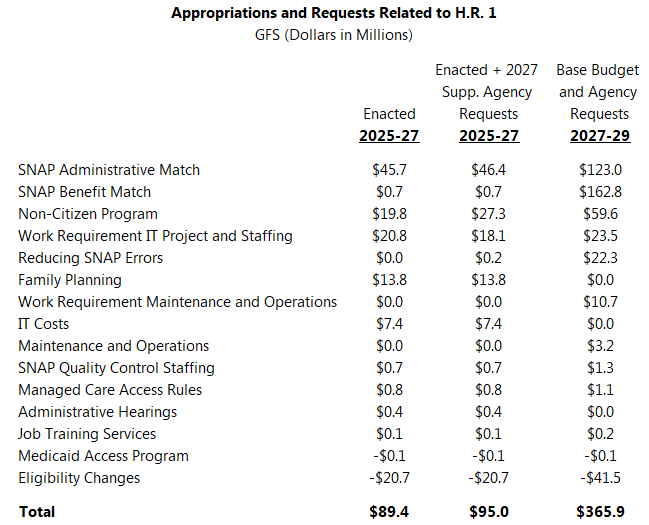
So far, the costs that the state has funded or that agencies are proposing to fund are relatively low. Washington appropriated $89.4 million from the general fund–state (GFS) in the 2026 supplemental budget to address some of the changes, mainly in the HCA and DSHS.
The funding adopted last year included:
- $45.7 million to fund the increased state share of SNAP administrative costs. (Effective Oct. 1, 2026, states must fund 75% instead of 50% of the administrative costs.)
- $20.8 million for IT work and staffing related to the new work requirements.
- $19.8 million to maintain services for certain lawfully-present immigrants expected to lose Medicaid coverage due to H.R. 1.
The DSHS and HCA 2027 supplemental budget requests propose increasing 2025–27 appropriations related to H.R. 1 by a net of $5.6 million, mainly to increase funding for services for certain lawfully-present immigrants expected to lose Medicaid coverage.
Based on the DSHS and HCA budget requests for 2027–29, it looks like carry-forward level changes would add $51.7 million, maintenance level changes would add $167.1 million, and new policy proposals would add $57.8 million in funding related to H.R. 1. The estimated 2029–31 cost of proposed maintenance level changes would be $189.4 million and new policy would be $50.7 million. (The budget requests do not provide the four-year cost of carry-forward level changes.)
The largest change would be $162.8 million for the SNAP benefit match, at the maintenance level. As I wrote previously, this was assumed in the outlook for the 2026 budget, but it wasn’t included in the carry-forward. The carry-forward adds $76.2 million for the SNAP administrative match.
At the policy level, DSHS proposes adding $22.3 million in 2027–29 and $18.7 million in 2029–31 to reduce the state’s SNAP payment error rate below 6% by increasing staff capacity, making technology changes, and adding customer education resources. (According to the proposal, Washington’s error rate was 6.06% for federal fiscal year 2024 and 6.98% for federal fiscal year 2025.) Also at the policy level, HCA proposes adding $19.9 million in 2027–29 and $19.9 million in 2029–31 to provide state-funded Medical Care Services coverage for clients who could lose Medicaid coverage due to the H.R. 1 changes to eligibility for certain lawfully-present non-citizens.
All told, it looks like state agencies are requesting $365.9 million related to H.R. 1 for 2027–29, including the base budget carried over from 2025–27 and carry-forward level, maintenance level, and policy level changes. As I wrote at the beginning of the year, federal spending reductions related to H.R. 1 are not the cause of Washington’s budget problem. The amount that agencies are proposing to spend related to H.R. 1 for 2027–29 is larger than the amount appropriated for that purpose in 2025–27, but it is still a very small portion of overall state spending.
(Previous posts on the 2027–29 budget requests are available here.)
Tags: 2027 agency requests