1:32 pm
March 18, 2019
In a new report, the Washington State Institute for Public Policy (WSIPP) compares higher education funding in Washington to 11 other states. (The Legislature requested the report in the 2018 supplemental budget.) It looks at how higher education is funded in these states. (WSIPP chose Colorado, Georgia, Illinois, Kansas, Minnesota, Ohio, Oregon, Tennessee, Texas, Virginia, and Wisconsin as comparison states, based on their similarities to Washington on “size, structure, and governance of postsecondary education.”) For example,
Compared to similar states, Washington four-year institutions have a greater ability to engage directly in the budgeting process. However, Washington institutions are also subject to tuition caps and salary and benefit mandates set by the legislature. As a result, Washington institutions have less control over their funding than institutions in several comparison states.
The report also provides some funding level comparisons. To compare funding levels, WSIPP used data from the State Higher Education Executive Officers Association (SHEEO). (This data set includes both two-year and four-year institutions.)
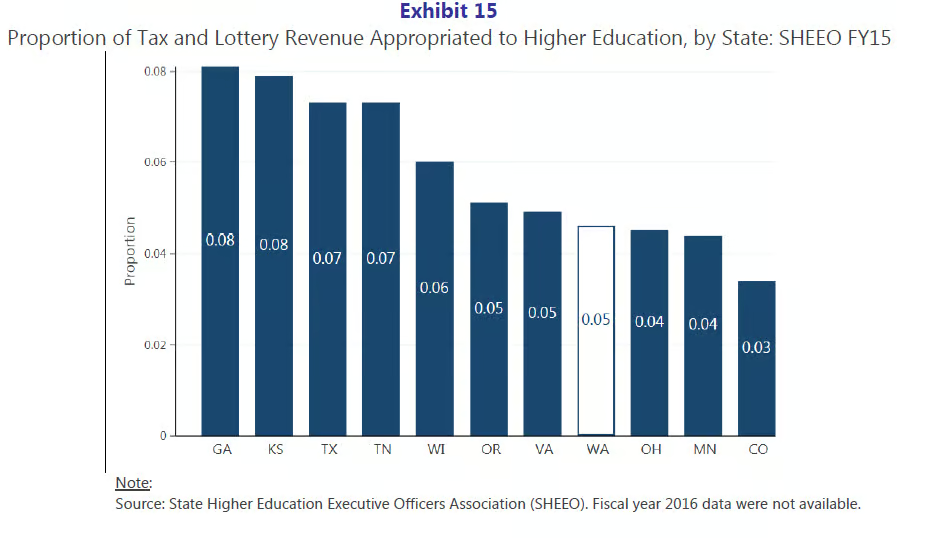
The chart below is from the report; it shows that higher education appropriations account for a smaller proportion of tax and lottery revenues in Washington than in eight of the comparison states.
WSIPP also finds, “Washington distributes a larger share of appropriated dollars to higher education via need-based student financial aid, rather than through general purpose disbursement to institutions.”
The SHEEO data does not differentiate between two-year and four-year institutions, so in the report’s appendix WSIPP uses different data from the Integrated Postsecondary Education Data System to show trends between the two-year and four-year schools and between states from 2004 to 2016:
- Four-year institutions in each state “became increasingly dependent on tuition revenue.”
- “For states with larger proportions of public enrollment in the two-year sector, such as Washington, four-year institutions saw larger decreases in the proportion of revenue from appropriations.”
As the charts below show, the reduction in the proportion of revenue from appropriations in Washington was the ninth largest for two-year schools, but the fourth largest for four-year schools.

Finally, the report notes that during economic downturns, Washington reduces appropriations for higher education by more than the average comparison state.
One reason for that is that under Washington’s constitution, funding K–12 education is the state’s paramount duty. (Moreover, K–12 and other mandatory spending programs cannot be cut during recessions, while higher education is considered discretionary spending.)
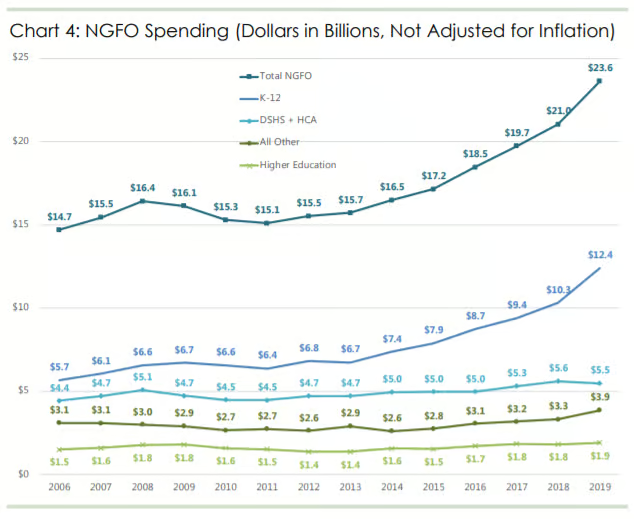
As we showed in our recent review of state spending, Washington increased spending on K–12 by 88.8 percent from 2008 to 2019. This K–12 spending has crowded out spending on other state priorities, including higher education, which increased just 6.6 percent over the same period. Thus, as K–12’s share of spending from funds subject to the outlook increased from 40.0 percent in 2008 to 52.5 percent in 2019, higher education’s share of spending decreased from 10.9 percent in 2008 to 8.1 percent in 2019. (Including tuition, higher education’s share of spending decreased from 14.8 percent in 2008 to 13.6 percent in 2019.)
As of fiscal year 2019, the state is in compliance with the McCleary decision on K–12 funding (though the full biennial impact will first be felt in the upcoming 2019–21 biennium), so there will be less pressure on other areas of the budget going forward.