
11:21 am
May 8, 2025
According to the Washington State Standard, Gov. Ferguson has been asked to veto the temporary business and occupation (B&O) tax surcharge on income over $250 million that is included in ESHB 2081. As I wrote yesterday, this provision of the bill would increase revenues to funds subject to the outlook (NGFO) by $649 million in 2025–27 and $1.215 billion in 2027–29.
The Standard reports, “Paring that sum would force lawmakers to meet in special session to revise spending in the next budget that begins July 1, said House Majority Leader Joe Fitzgibbon, D-West Seattle.”
Vetoing the surcharge would put the operating budget out of balance, both in 2025–27 and over four years. However, that wouldn’t necessarily result in a special session.
The governor is required by statute to submit a budget to the Legislature that balances in the current and ensuing biennia (RCW 43.88.030(5)). The Legislature is required by statute to adopt a budget that balances in the current and ensuing biennia (RCW 43.88.055). But there is no requirement that the budget signed by the governor balance at all.
Indeed, since 2013 (the first year of the four-year balanced budget requirement), four budgets have not balanced over four years as signed by the governor. In each case, the Legislature had adopted budgets that balanced over four years, but vetoes and assumption changes pushed the unrestricted NGFO ending balances into negative territory. This did not force the Legislature into special session. Instead, the Legislature addressed the issues in the next budget.
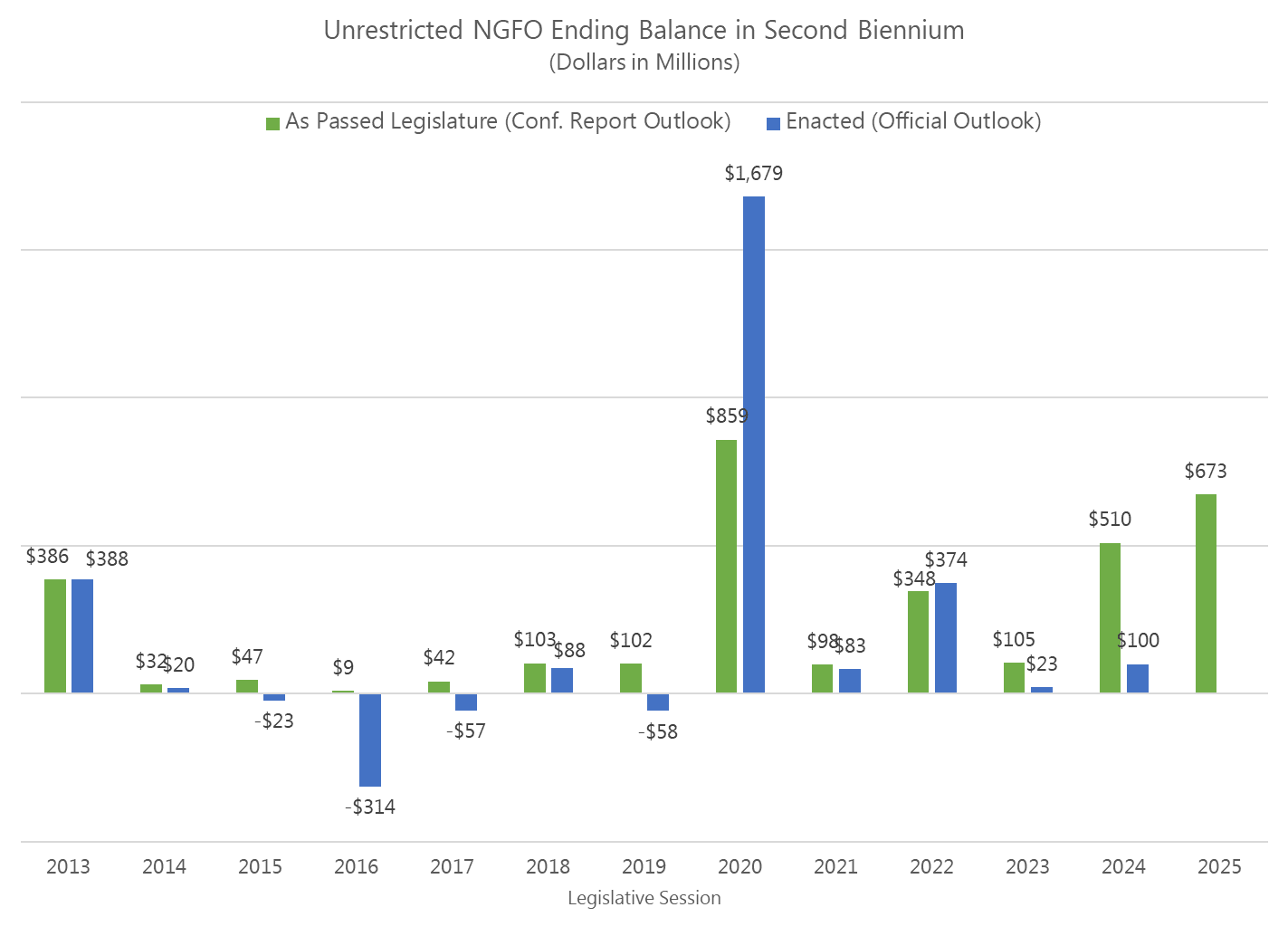
As passed by the Legislature, the 2025–27 budget leaves unrestricted NGFO ending balances of $225 million in 2025–27 and $673 million in 2027–29. Thus, to maintain balance, Gov. Ferguson could veto some combination of spending items and tax bills that would reduce the ending balances by up to those amounts. For example, if Gov. Ferguson vetoes the surcharge or other tax bills, he could also veto some of the new spending increases to maintain balance or minimize any imbalance. (This would be advisable for budget sustainability purposes, but he isn’t required by statute to do so.)
Depending on the size and timing of any imbalance, the Legislature could wait to address it until the regular session next year. (For example, vetoing the surcharge would not put the budget out of balance in FY 2026, the first year of 2025–27.) Or, as Rep. Fitzgibbon suggests, the Legislature could go into special session to address the issue. Under the constitution, the governor may convene special sessions. Alternatively, if two-thirds of the Legislature petitions, it may reconvene in a special session “solely to reconsider any bills vetoed” (Art. 3, Sec. 12).
Categories: Budget.