12:41 pm
January 18, 2023
In 2011, voters approved a constitutional amendment that requires a portion of any extraordinary revenue growth (EORG) to be deposited in the budget stabilization account (BSA, or the rainy day fund). This is a good budget practice because it forces the state to save extra money when revenues are especially high rather than unsustainably increasing spending to match the unusually high revenues.
Under the constitution (Article VII, Section 12), “extraordinary revenue growth” is defined as “the amount by which the growth in general state revenues for that fiscal biennium exceeds by one-third the average biennial percentage growth in general state revenues over the prior five fiscal biennia.” At the end of a biennium in which there is EORG, three-quarters of it must be transferred to the BSA (to the extent that it exceeds the regular, annual transfers to the BSA of 1% of general state revenues).
But the constitution includes a safety valve for times when economic conditions are not good: it specifies that no EORG transfer “shall occur in a fiscal biennium following a fiscal biennium in which annual average state employment growth averaged less than one percent per fiscal year.”
According to the Office of Financial Management, based on the Nov. 2022 revenue forecast, the state is experiencing EORG in the current biennium. The indicated transfer to the BSA is $481.7 million. However, state employment growth in 2019–21 averaged less than 1% each year (-1.9% in FY 2020 and -2.8% in FY 2021). Thus, the $481.7 million will not automatically be saved.
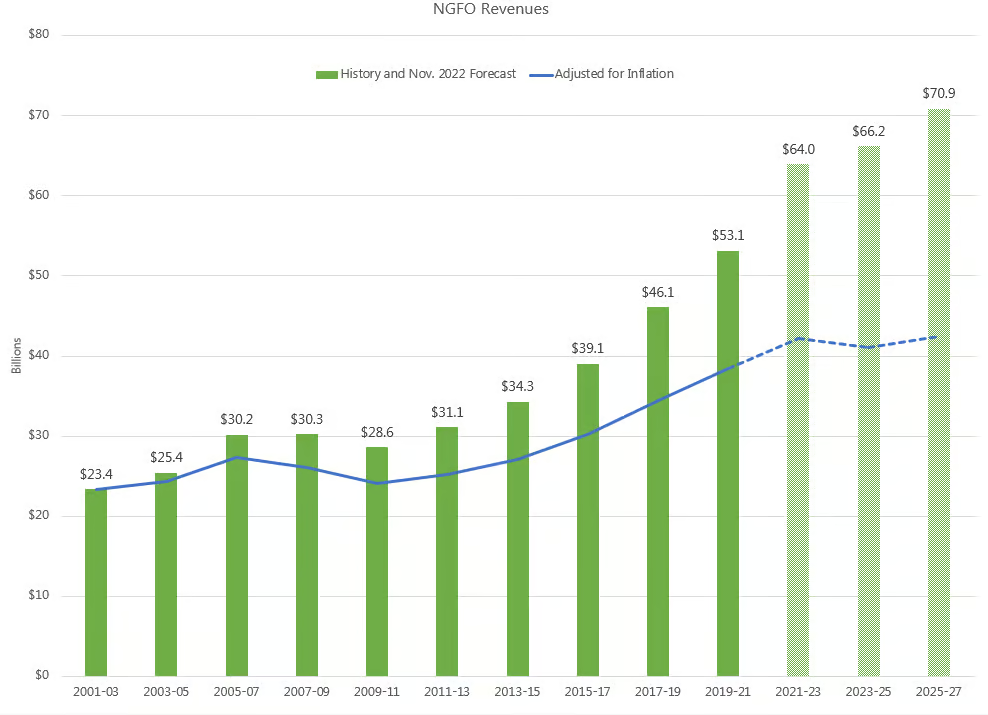
The EORG safety valve exists because it’s possible that revenues could spike as the state comes out of a recession in which revenues had declined; at such a time, it might be beneficial for the Legislature to have the extra funds at hand to address spending needs. But the employment losses last biennium were not accompanied by state revenue losses. As the chart shows, state revenues for funds subject to the outlook (NGFO) have increased considerably, despite the pandemic recession. Given that, the Legislature should follow the spirit of the constitutional provision and choose to save the $481.7 million.
As we noted in our policy brief on the 2011 constitutional amendment, if the EORG provisions had been in place previously, there would have been an EORG transfer of about $1.5 billion to the BSA in 2005–07. If that money had been saved instead of appropriated, the state would have been much better prepared for the Great Recession and many cuts could have been avoided.
(EORG transfers have been made to the BSA three times: $38 million in 2013–15, $925 million in 2015–17, and $1.648 billion in 2017–19. However, as we documented in a 2019 policy brief, the Legislature transferred most of the EORG back to the NGFO to help fund the response to the McCleary decision. Further, in 2018, the Legislature voted to shift funds from the general fund–state to a dedicated account to avoid increasing the required EORG transfer for 2017–19.)