
11:32 am
February 27, 2019
Several bills have been introduced in the Legislature that would affect the four-year balanced budget requirement. (This is a statutory requirement that the Legislature adopt budgets that balance over four years.)
HB 2090 would require that budgets balance over four years inclusive of any gubernatorial vetoes. If a veto “results in a projected maintenance level that exceeds available fiscal resources in the ensuing biennium, then the governor must make prioritized allotment reductions.” These reductions would have to eliminate the shortfall, and the bill sets out the order in which seven budget areas would have to be cut. Reductions would have to be made first in the Legislature, judiciary, and executive branch; reductions would be made last in non-basic K–12 education. (Basic education and payments of principal and interest on the state debt would be excluded from reductions.)
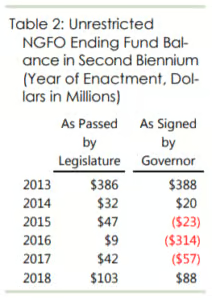
As we showed earlier this year, the Legislature has consistently passed budgets that balance over four years, but veto actions have put the budget out of balance in the second biennium in three of the six years the requirement has been in effect (see the table to the right).
SJR 8207 would amend the state constitution to require that the governor propose and the Legislature enact a four-year balanced budget. The resolution essentially mirrors the statute, except under the resolution, the governor would be required to propose a budget that balances over four years; the budget would not need to balance in the second biennium if employment growth is expected to be less than 1 percent and money is withdrawn from the rainy day fund (currently it need not balance only if money is withdrawn from the rainy day fund); and available resources would be adjusted for vetoes of operating budget bill items.
SB 5963 (scheduled for a hearing in Ways & Means today) would require that the estimated maintenance level for the second biennium “include an inflationary increase to salaries of public employees and wages and rates for providers considered employees solely for the purposes of collective bargaining.” In general, the maintenance level (the cost of continuing current services, adjusted for caseload and inflation) for the second biennium is estimated by applying a growth factor to the current cost of a program. But currently, growth factors are not applied to compensation items because the statute explicitly excludes collective bargaining agreements that have not been approved by the Legislature.
Finally, another bill concerns fiscal notes. SB 5636 was reported out of the Ways & Means Committee on Monday. Under the bill, a “dynamic fiscal impact statement” of proposed legislation could be requested by members of the Senate Ways & Means and House Finance committees. The “dynamic impact estimate” is defined as “an estimate of the net fiscal impact of a bill, resolution, or proposed legislation that takes into account behavioral changes of persons directly impacted by the legislation or proposed legislation and the effect that those behavioral changes may have on the economy as a whole.” Additionally, fiscal notes for bills concerning corrections, child welfare, and mental health would have to include (if requested) “an estimate of the fiscal impact of expenditure reductions or increases on other state or local program expenditures as well as any return on investment as a result of the legislation.”
The bill would also require that a work group “explore the establishment of a nonpartisan agency to conduct objective, impartial fiscal analysis on behalf of the legislature.” The work group would also study the accuracy of fiscal notes to see how the cost estimates of previous legislation matched up with the actual costs after enactment.
Categories: Budget , Categories.