12:12 pm
January 15, 2026
A new bill, sponsored by Sen. Gildon, would improve state budget transparency. As I wrote in October, there are some major holes in Washington’s fiscal data website, fiscal.wa.gov. There is not enough detail provided for either historical spending or the current budget to enable policymakers and the public to make informed evaluations of budget proposals.
In my October post, I showed how the Washington State Women’s Commission, for example, disappears into the black box of budget data. This post uses the Health Care Authority (HCA) as an example, with screenshots from the fiscal website. (The same issues exist across all agencies.)
Historical Expenditure Data
Currently, fiscal.wa.gov is required by statute to include “state expenditures by agency, program, and subprogram” (RCW 44.48.150(1)(b)). However, the website only presents subprogram data for the Department of Social and Health Services and the HCA.
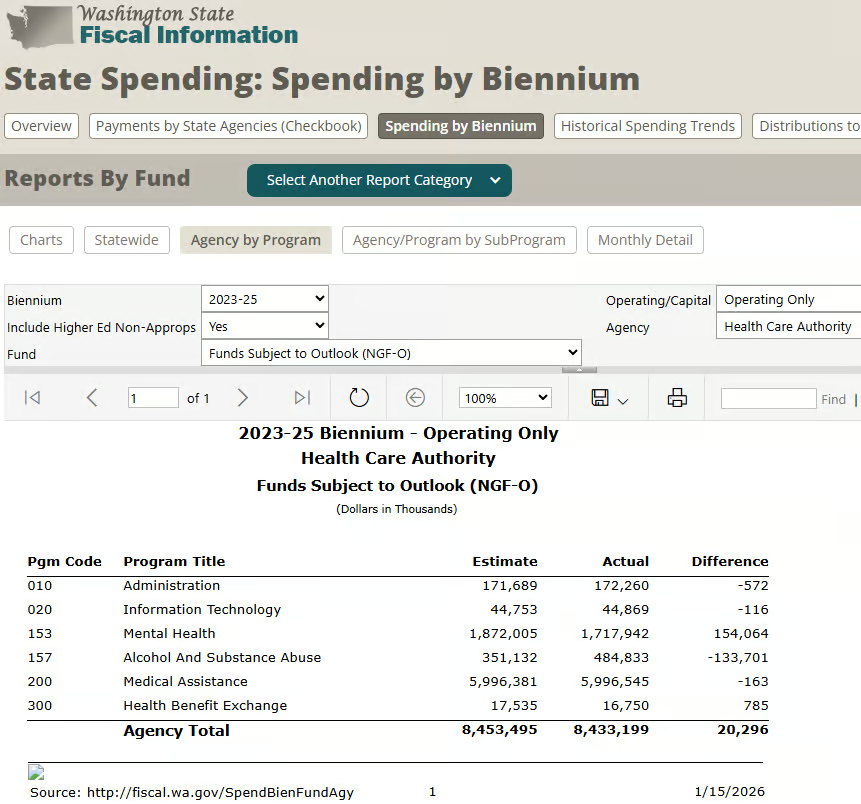
As Exhibit A shows, searching the HCA’s spending by program returns total HCA spending on administration, information technology, mental health, alcohol and substance abuse, medical assistance, and Health Benefit Exchange. These are useful categories, but they are very broad. Drilling deeper into these categories would provide useful information.
Exhibit A
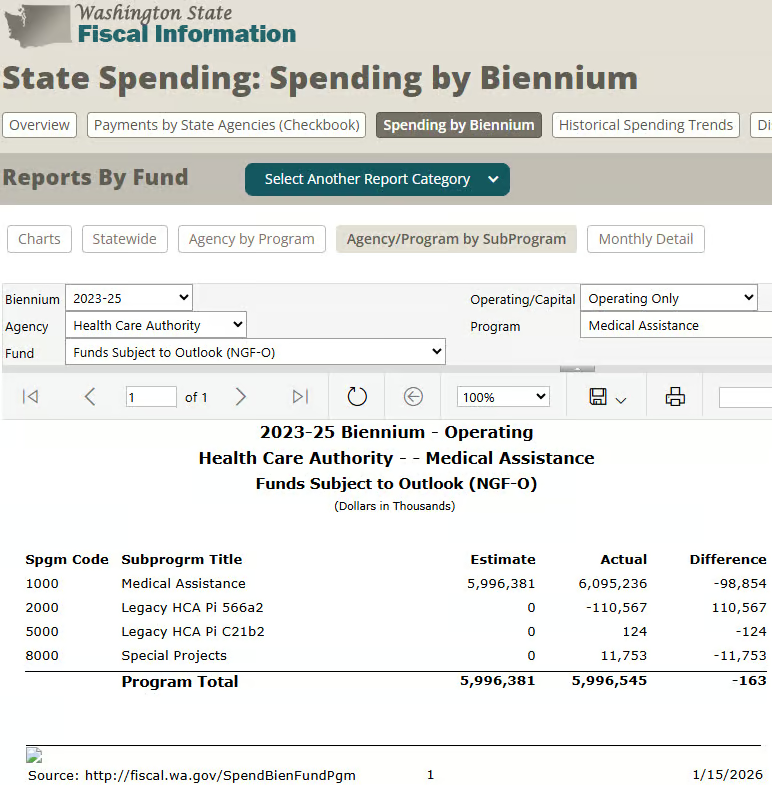
Unfortunately, even though the HCA is one of the agencies for which there is subprogram data, the subprogram data for HCA does not provide enough detail to illuminate spending trends. For example, Exhibit B shows that searching the HCA’s mental health program for subprogram spending returns just $546,000 for community services and $1.717 billion for “unknown.” Similarly, the subprogram spending provided for the medical assistance program is mostly placed in a category called medical assistance (Exhibit C).
Exhibit B

Exhibit C
Information on a Specific Budget
Fiscal.wa.gov is also currently required by statute to include “State agency budget data by activity” (RCW 44.48.150(1)(f)).
For each budget, spending changes are classified as carryforward, maintenance, or policy. The totals for each of these categories are displayed at fiscal.wa.gov, but the amount of information available on each differs.
- Carryforward level (CFL): The CFL moves current funding into the next biennium, after removing one-time spending items. There is no information shown about which programs or activities are included in the CFL, or how much they cost individually. This is a black box.
- Maintenance level (ML): This adjusts the CFL to reflect changes to caseload, enrollment, and inflation and to add in the impacts of new programs that are already required by statute. Effectively, the ML comprises the CFL plus the maintenance level change. In the fiscal.wa.gov report, the ML changes are shown individually along with their respective amounts, but there is no information about the total underlying costs of these programs or activities.
- Policy level (PL): This is new spending additions or reductions. The changes are listed individually along with their amounts, but again there is no information about any underlying costs of existing programs or activities. (The budget documents include a few sentences describing each new policy change.)
As an example, the enacted 2025–27 biennial budget for HCA’s community behavioral health program (Exhibit D), the CFL was $2.452 billion. There is no public information about what is included in that. All we know from the historical expenditure data (Exhibit B) is that $546,000 of spending in 2023–25 was for community services. (And there is no way to know if even that was included in the 2025–27 CFL or was meant to be one time spending for 2023–25.)
Exhibit D
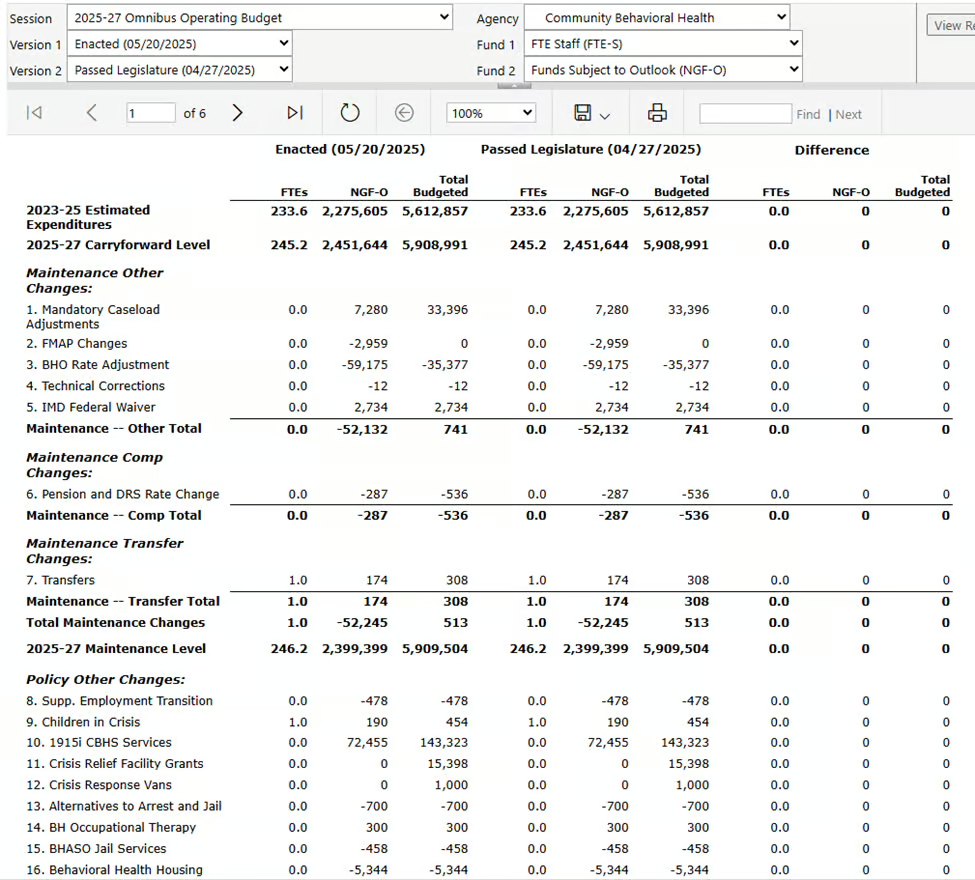
Because there is no information on the programs and activities included in the CFL, there is usually no way to assess how the maintenance and policy changes alter the total funding for the activity. For example, in Exhibit D there are ML changes of $7.3 million for mandatory caseload adjustments, but there is no indication of the total funding for the corresponding program in the CFL. There is a PL change of $300,000 for BH occupational therapy. The accompanying description is, “Funding is provided in FY 2026 to continue grants to support efforts to incorporate occupational therapists in behavioral health agency settings.” There is no way to know how much was spent on these grants in 2023–25.
More broadly, the statewide carryforward level for 2025–27 was $72.4 billion. We can tell how much of that was assigned to each agency, but beyond that there is no way in the public data to tell what programs and services were included. Maintenance level changes added $4.4 billion and policy level changes added $1.0 billion. The components of these changes are listed in the budget data, but the underlying $72.4 billion is not itemized in any way.
SB 6177
Sen. Gildon’s proposal, SB 6177, would amend the statute about what must be included at fiscal.wa.gov. First, it would clarify that the historical spending data must include subprogram data for all agencies and programs. Second, it would clarify that budget data by activity must also be provided at the carryforward level. Third, it would require the website to include balances of each fund. (The Legislature often makes transfers from other accounts to the funds subject to the outlook, but there’s no way for the public to tell what, if anything, is left in the original accounts.)
If enacted, I hope that these changes would be implemented so that we can answer questions like these:
- How much does the state spend on discretionary Medicaid programs?
- How much does the state spend on Medicaid overall?
- How much have we spent on permanent supportive housing over time?
- How much do we spend on UW’s Burke Museum?
- How much do we spend on urban forest assistance?