
11:48 am
September 11, 2026
Yesterday I reviewed the economics literature on the question of whether wealthy people move in response to tax increases. It’s an important question because the revenue impact of the new income tax is uncertain. The extent to which people (and their incomes) move out of state will have implications for the state budget.
Unfortunately, there’s no way to know how migration will impact state income tax revenues ahead of time. The best source of data on incomes and migration comes from the Internal Revenue Service (IRS), but there is a serious lag. Migration data related to tax returns filed in 2023 were released earlier this year, and Statistics of Income data for CY 2023 were released in August.
This means that the IRS data now encompass the first few years of Washington’s capital gains tax. Like the income tax, the capital gains tax is targeted at high-income individuals. Consequently, the IRS data for these years could hint at potential behavioral responses to the income tax. That said, we’re working with only a few years of data, and there were several years of uncertainty as to the legality of the capital gains tax. (People might not have changed their behavior immediately.) The data are suggestive only at this point.
The IRS migration data set includes the distribution of returns by size of adjusted gross income (AGI) going back to 2012. (The highest AGI category included is AGI of $200,000 or more.) The 2023 migration data reflect returns filed in 2023, on income earned in 2022. That said, the exact dates of taxpayer moves are not known. For example, the 2022 data could include moves made in 2021 before or after the enactment of the capital gains tax (in Spring 2021). Similarly, the 2021 migration data could include people who moved before filing their taxes but after the capital gains tax bill passed. (Moreover, as I wrote yesterday, tax policy is not the only reason people move.)
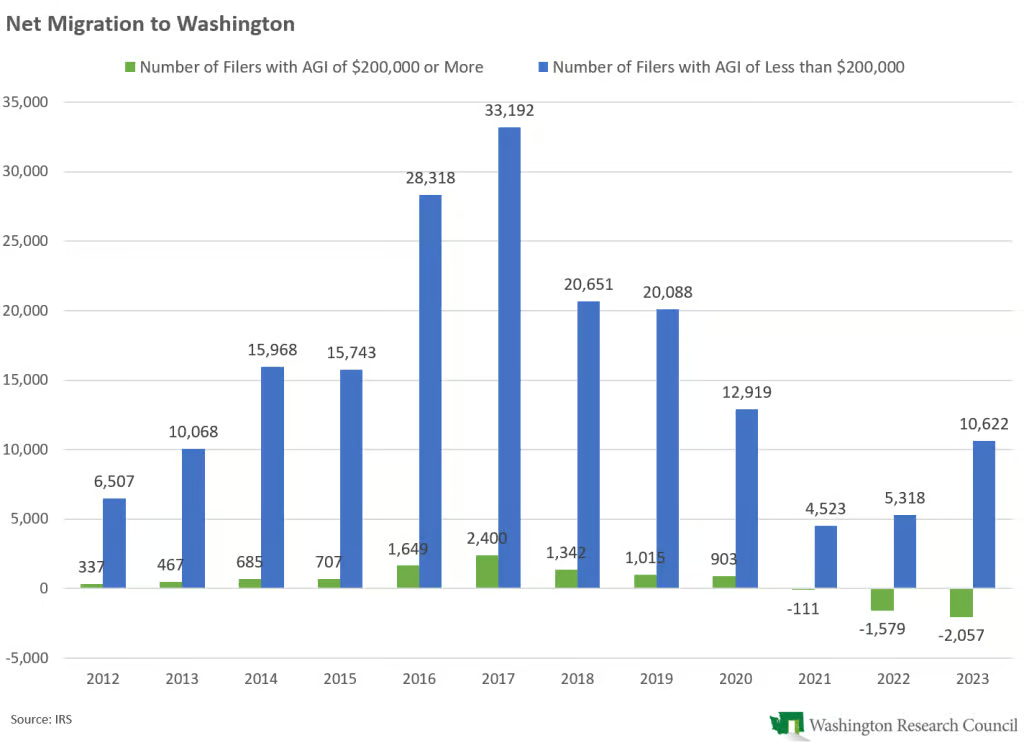
That said, according to the migration data, Washington has gained net taxpayers (measured by the number of returns) each year going back at least to 2012. However, in 2021, 2022, and 2023, Washington experienced a net outflow of taxpayers with AGI of at least $200,000.
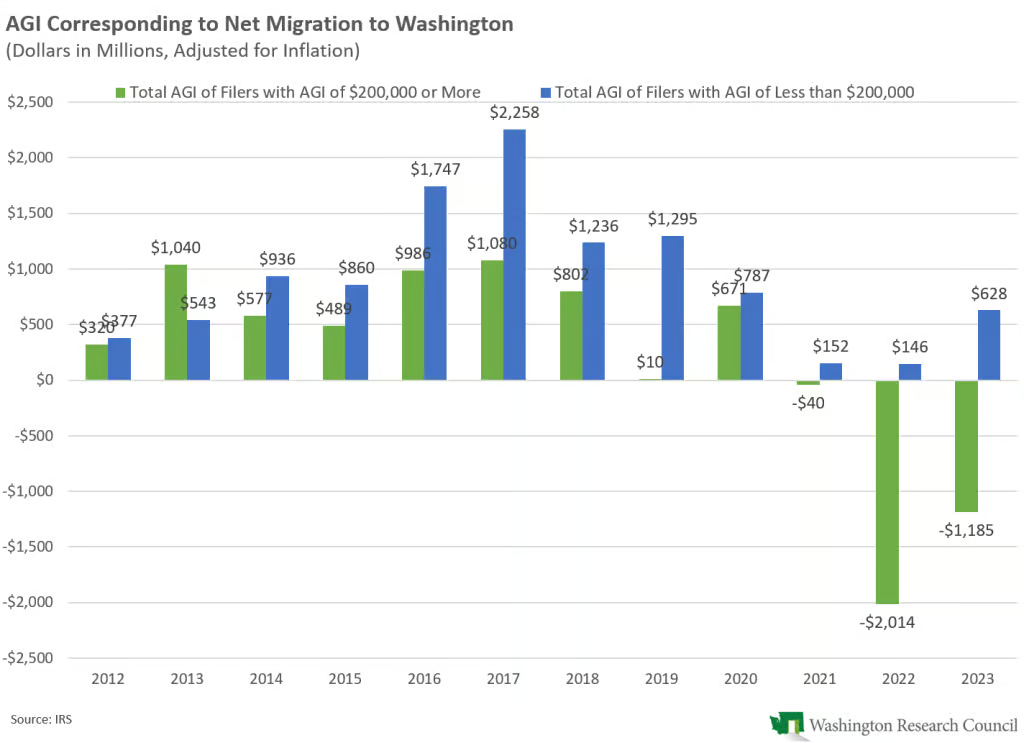
The migration data set also includes the AGI of filers leaving a state compared to the AGI of filers moving to a state. For example, in 2023, filers with more than $200,000 in AGI who moved to Washington from elsewhere had AGI of $4.447 billion (reflecting 2022 activity). Filers who moved out of Washington had AGI of $5.632 billion (reflecting 2022 activity). It is not strictly correct to say that therefore Washington lost $1.185 billion in AGI due to net migration. The data not only can’t show exactly when the move took place, it can’t tell where the income was earned. Instead, the data reflect the change in address as of the tax filing date. For example, a 2023 tax return of a mover out of Washington could have been filed by someone who moved on July 1, 2022. If so, not all their 2022 earnings would have taken place in Washington. With that caveat in mind, the substantial shifts in AGI among high-earning movers in 2021, 2022, and 2023 could reflect people moving away in response to the capital gains tax.
Meanwhile, the Statistics of Income data set from the IRS provides information on the number of returns and amount of AGI for Washington residents by AGI category. This data set includes more AGI categories than the migration data, including a top range of $1 million or more. Importantly, in this data set, data for 2023 represent tax year 2023 activity that is reflected in tax returns filed in 2024.
Although the number of total Washington returns with AGI of $1 million or more increased by 8.5% in 2023, the amount of AGI reported by those filers declined by 12.8% (adjusted for inflation). The AGI declines among this group were deeper in 2022 and 2023 than among filers in the rest of the country with $1 million or more in AGI. (Note, in the chart below, the volatility of AGI for millionaires compared to the year-over-year stability of AGI for those with less than $1 million a year.)

The Seattle Times has a nice chart showing the millionaire “density” in Washington compared to the U.S. The number of filers making $1 million or more per 1,000 tax returns has been higher in Washington than in the U.S. since 2016. However, the amount of millionaire AGI in Washington per millionaire filer has been lower than in other states since 2020, and the gap widened considerably in 2023.

The economics literature suggests there will be a behavioral response to the income tax, but the impact to state revenues is unclear at this point. IRS migration data show that, among movers, Washington has lost high-earning taxpayers on net since the enactment of the capital gains tax. Further, millionaire AGI in Washington declined in 2022 and 2023 by more than in other states.
Together, the IRS data suggest that the capital gains tax could have dampened AGI growth among high earners in Washington. If the income tax induces additional taxpayers to move or otherwise limit their earnings, revenue collections could be lower than anticipated.
Categories: Tax Policy.