
12:11 pm
September 10, 2026
With the income tax, Washington’s tax structure will become more volatile—especially because it is targeted at taxpayers with income over $1 million. The volatility makes it a difficult tax to forecast in general; for Washington, it will be especially hard to forecast in the beginning as it is a brand new tax. When it is difficult to forecast revenues, it is harder to craft sustainable budgets.
One pressing question is how taxpayers will respond to the tax. There is time before the tax is effective to move out of state or otherwise rearrange affairs to lessen exposure to the tax. Will such activities reduce revenue collections below their current forecast?
The Washington State Standard reports that, as part of the fiscal impact statement for I-645 (which would repeal the income tax), the Department of Revenue increased its estimate of the number of taxpayers who would pay the income tax, from 21,000 to 25,000. According to the Standard, “State revenue analysts plugged in numbers and concluded that 4,000 households just below the $1 million threshold now will be above it by the time the tax kicks in.”
This is plausible. There were 21,530 taxpayers in Washington with adjusted gross income (AGI) of at least $1 million in 2022, which was the most recent year of data when the fiscal note for the income tax bill (ESSB 6346) was written earlier this year. New data from the Internal Revenue Service shows that the number of Washington taxpayers with AGI of at least $1 million increased to 23,370 in 2023.
On the other hand, the fiscal note for ESSB 6346 assumed, “In response to the new tax, affected taxpayers do not reduce taxable income.” It implicitly also assumed that no one moves out of state.
It is impossible to say today how the income tax will affect the number of wealthy taxpayers in Washington. Certainly, there have been several high-profile moves over the past few years. At the same time, taxes are not the only thing that matters. People choose where to live for a variety of reasons.
The economics literature is unsettled on this question. In a 2020 paper published in the Journal of Economic Perspectives, economists Kleven, Landais, Muñoz, and Stantcheva reviewed the literature and found “growing evidence that taxes can affect the geographic location of people both within and across countries. This migration channel creates another efficiency cost of taxation with which policymakers need to contend when setting tax policy.”
Proponents of Washington’s income tax have cited the work of sociologist Cristobal Young and economist Ithai Lurie as evidence that millionaires do not move in large numbers in response to higher taxes. In a 2025 paper published in the American Journal of Sociology, Young and Lurie looked at how millionaire migration patterns changed due to federal legislation in 2017 that capped the state and local tax deduction (which made high-income-tax states less competitive) and the pandemic (which weakened embeddedness). Young and Lurie write,
In a world of frictionless mobility, tax incentives would be a powerful driver of top earner migration, making it difficult for high-tax states to compete for taxpayers alongside low-tax states within a borderless federal system. Conversely, in a world shaped purely by embeddedness, strong social ties, opportunity networks, and deep-rooted attachments to place create an equilibrium where few would migrate during their prime working years, regardless of tax differentials. When both incentives and embeddedness are in play, individuals weigh their options: Top earners may be willing to relocate, but only if the financial incentives exceed the value of their place-specific social capital.
Young and Lurie found that that the neither the federal tax reform nor baseline tax rates “influenced the likelihood of migrating across state lines. The rich in high-tax states do not move any more often than those in low-tax states.” However, when looking only at movers, the paper found, “Migration tends to flow from high-tax to low-tax states, and migration flows are larger when the tax advantage is greater.”
Further, the paper found, “COVID-19 weakened elites’ embeddedness, making them more responsive to tax incentives for relocation.”
To me, the results of the Young and Lurie paper (that embedded millionaires won’t necessarily move, but if they do, it will be to low-tax states) suggest that even if Washington’s income tax doesn’t cause a mass exodus of our current millionaires (who may understandably be embedded in our lovely state), it will mean that fewer millionaires from other states will consider moving to Washington in the future, because Washington will no longer have the advantage of no general income tax. That unseen impact—the what-could-have-been—will be difficult to quantify.
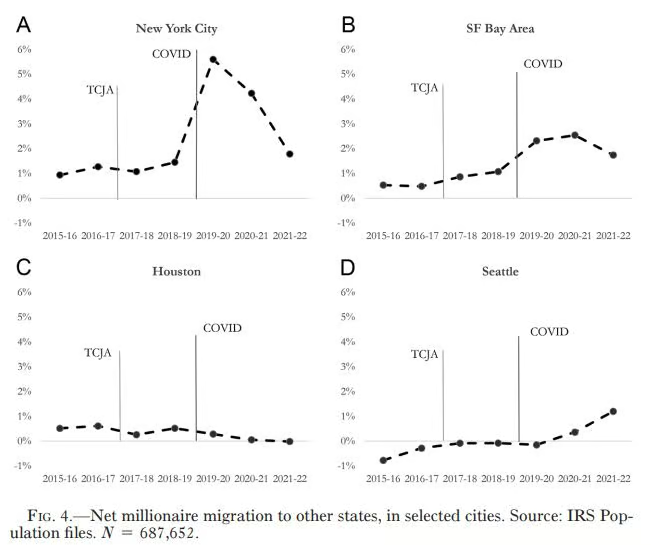
Notably, the Young and Lurie paper includes four charts showing net millionaire migration to other states from New York City, the San Francisco Bay Area, Houston, and Seattle over the period studied (2015 to 2022). The authors write, “The pandemic immediately set off a wave of top earner migration out of New York City and the Bay Area, but not from the low-income tax cities of Houston or Seattle.” Further, they write that before the 2017 federal tax reform, “Seattle saw net in-migration of millionaires, but this inflow dissipated despite the favorable tax environment following the reform. During the first-year shock of the pandemic, Seattle experienced no migration change at all; as the pandemic has eased in subsequent years, the city’s out-migration has edged up.”
Indeed, their data shows that millionaires left Seattle on net in 2020–2021 and 2021–2022. The paper offers no explanation for Seattle’s millionaire out-migration, but I suspect that Washington’s capital gains tax and Seattle’s payroll expense tax are factors. The payroll expense tax was enacted in 2020 and the capital gains tax was enacted in 2021.
According to the Seattle Times, Young “estimates that Washington’s new 9.9% income tax on the rich would result in a net loss of 1.9% of the state’s $1 million-plus earners. That works out to 475 of Washington’s 25,000 high-earners.” It’s not clear what assumptions Young made for this estimate. Assuming 1.9% turns out to be accurate, it doesn’t tell us much about the revenue impact. Which 475 will move? Are they millionaires, centimillionaires, or billionaires? Revenue collections will depend on the answer.
Meanwhile, in a 2024 paper published in the American Economic Journal: Economic Policy, the economists Joshua Rauh and Ryan Shyu studied the 2012 passage of Proposition 30 in California. The ballot measure increased income tax rates by 3 percentage points on taxpayers with over $500,000 in taxable income (or $1 million for married couples).
The authors found “a substantial increase in the outflow of high-earning taxpayers from California in response to Proposition 30,” particularly for taxpayers with income over $2 million. They also found that taxpayers who remained in California reduced their earnings, either by reducing their labor supply or offshoring income. They found that taxpayer responses “combined to undo 55.6 percent of the revenue gains from taxation that otherwise would have accrued to California in the absence of behavioral responses over the first 3 years of the reform (2012–2014).”
Similarly to Young and Lurie, Rauh and Shyu find that “the out-migration effect is strongest in the direction of states with zero state taxes, is small but discernible in the direction of low-tax states, and is not visible in the direction of medium- and high-tax states. This is consistent with the strong salience of tax considerations in relocation decisions.”
Categories: Tax Policy.