11:00 am
October 12, 2022
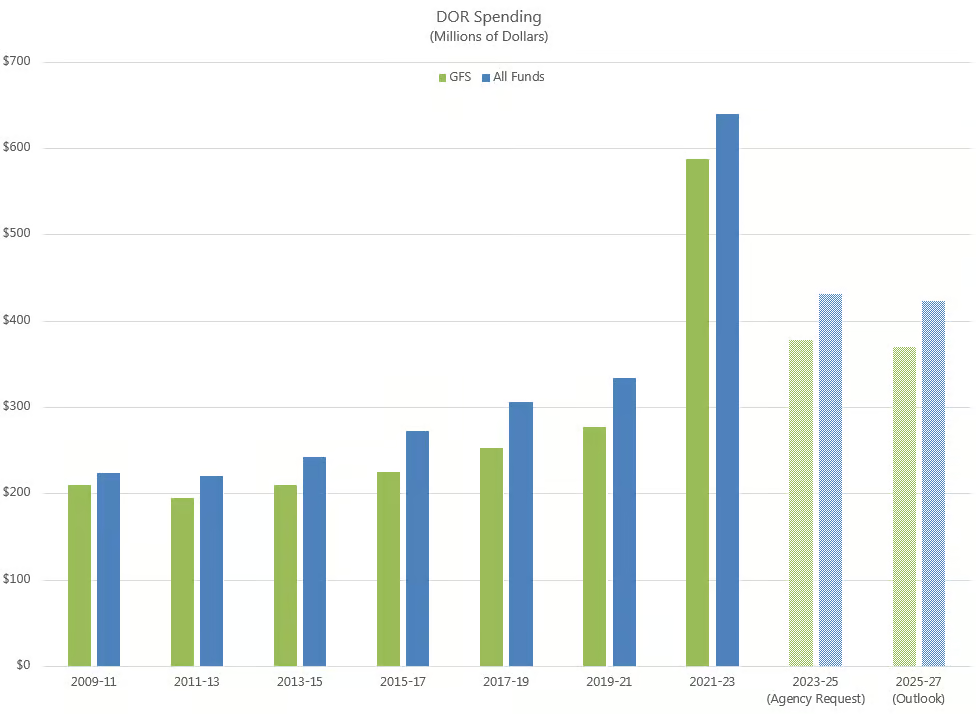
The Department of Revenue (DOR) is one of just 10 agencies that have requested smaller general fund–state (GFS) budgets for 2023–25 than 2021–23. It is asking for a GFS budget reduction of $290.4 million (by far the largest reduction among the agencies). This is due to DOR’s request for a technical correction to the accounting of the working families tax credit (WFTC).
In DOR’s budget request, carry-forward and maintenance level changes total $233.0 million and policy level reductions total $442.4 million (for a total net reduction of $290.4 million).
The most significant items in the request are related to the WFTC. The WFTC (RCW 82.08.0206) will provide sales tax refunds to eligible low-income people. The first refunds will be paid in calendar year 2023. The 2021–23 budget (as amended by the 2022 supplemental) appropriates $232.0 million GFS for FY 2023 remittances under the program.
As DOR notes in its budget request, “A conflict exists between the Working Families Tax Credit legislation, that treats the payments as a reduction of State sales tax revenue, and the budget bill, which includes an appropriation requiring payments be treated as expenditures.” This creates a problem for DOR, so it “is requesting that the appropriation authority provided in the 2023-25 biennium carryforward level of the budget be removed at policy level which will allow the department to issue the payments as a reduction of revenue as required by ESHB 1297.” Thus, the request includes a policy level reduction of $464.0 million for 2023–25.
Aside from technical accounting considerations, DOR explains that removing the appropriation would be preferable because:
- Refunds will be issued once a year. “The payments are anticipated to occur mainly in April and will hit the appropriation all at once, which makes it difficult to estimate if the appropriation amount will be sufficient to cover these payments.”
- Because of the April timing, by the time DOR knows if they need additional appropriations for a year, “session will have ended.”
- If the refunds are treated as appropriations, forecasting their amount would fall to DOR or the Caseload Forecast Council. If they are treated as tax reductions, the Economic and Revenue Forecast Council can incorporate them into the revenue forecast.
All told, “Treating WFTC refunds as a reduction of revenue will be significantly easier and use less staff time to administer than if appropriated.”
Additionally, DOR’s budget request includes $27.6 million GFS in 2023–25 and $26.7 million in 2025–27 “for continued support of the implementation” of the WFTC program. Another $24.1 million in 2023–25 and $20.7 million in 2025–27 is requested (at maintenance level) to fund remaining IT implementation costs related to the WFTC program.
Note that although 2023–25 GFS spending requested by DOR represents a decline of 35.6% compared to 2021–23, it would be an increase of 36.3% compared to 2019–21.
(Previous posts on agency budget requests are here.)
Tags: 2023-25 , 2023-25 agency requests