1:07 pm
November 12, 2024
The Office of Financial Management (OFM) estimates that “the magnitude of the operating budget deficit is between $10 and $12 billion over the four-year period.” OFM is asking agencies “to propose operating and transportation budget reductions, starting with pauses or delays of programs, and to identify savings options for both the 2025 supplemental budgets and 2025–27 budgets.”
OFM does not show how it came up with the $10–$12 billion estimate. (In October, the director of OFM said that the projected shortfall was $5–$7 billion over four years.) Based on our analysis of agency budget requests, I suspect that the $10 billion estimate is too high.
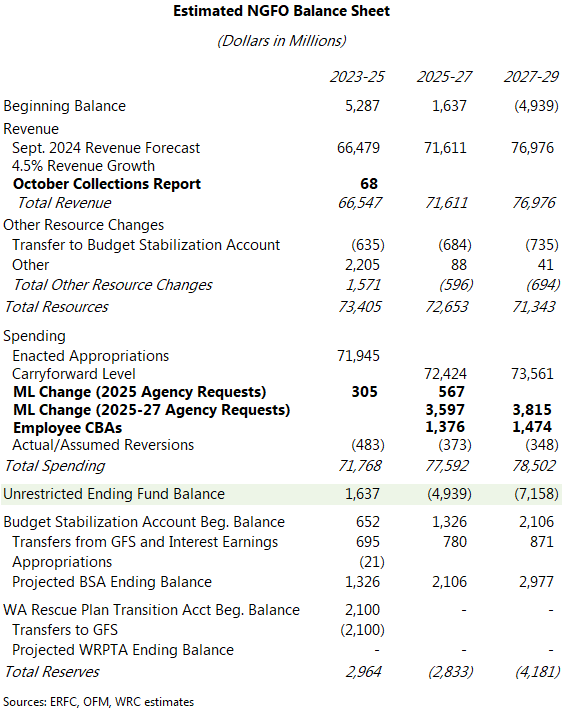
Below is our updated outlook. We estimate that the cost of continuing current services will exceed resources by $7.158 billion over the four-year period. This is based on the maintenance level (the cost of continuing current services, adjusted for enrollment and inflation) spending requested by agencies, the estimated cost of the collective bargaining agreements, and the September 2024 revenue forecast. Perhaps OFM is including some new policy items in its shortfall estimate.
We’ll know more over the next few weeks, as the November caseload and revenue forecasts are released. Regardless of which estimate ends up being closest to the truth, it is clear (based on currently available information) that there is a substantial shortfall.
I disagree with OFM, however, about its causes. In its memo to agencies, OFM writes, “This deficit is due to the recent revenue forecasts that were adjusted down and the increase in caseloads and the cost to maintain existing programs.”
Compared to the February revenue forecast (on which the current budget was based), the September revenue forecast is down by just $608 million through 2027–29. It didn’t help matters, but the revenue forecast decrease is not the cause of the problem. (Further, 2025–27 revenues are forecasted to be $5.132 billion higher than 2023–25 revenues.)
As we showed in a recent policy brief, the estimated shortfall is the result of legislative spending choices. The Legislature chose to increase appropriations in 2023–25 by 15.8% over 2021–23, at a time when biennial revenues were expected to increase by 3.5%. Now that bill is coming due.
Tags: 2025-27