
2:43 pm
November 17, 2025
Transportation revenues are now expected to total $8.135 billion in 2023–25, $8.842 billion in 2025–27, and $10.833 billion in 2027–29. Over this three-biennia period, the November transportation revenue forecast is $67.0 million less than forecasted in September, but it is still $69.0 million higher than expected in the transportation budget enacted this year.
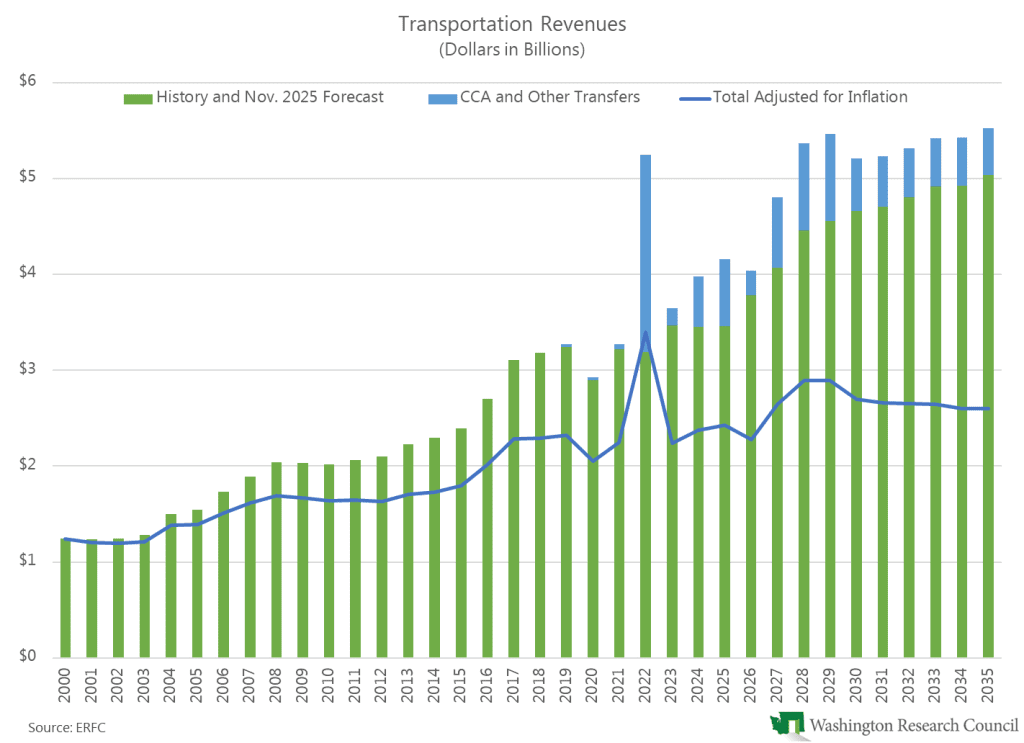
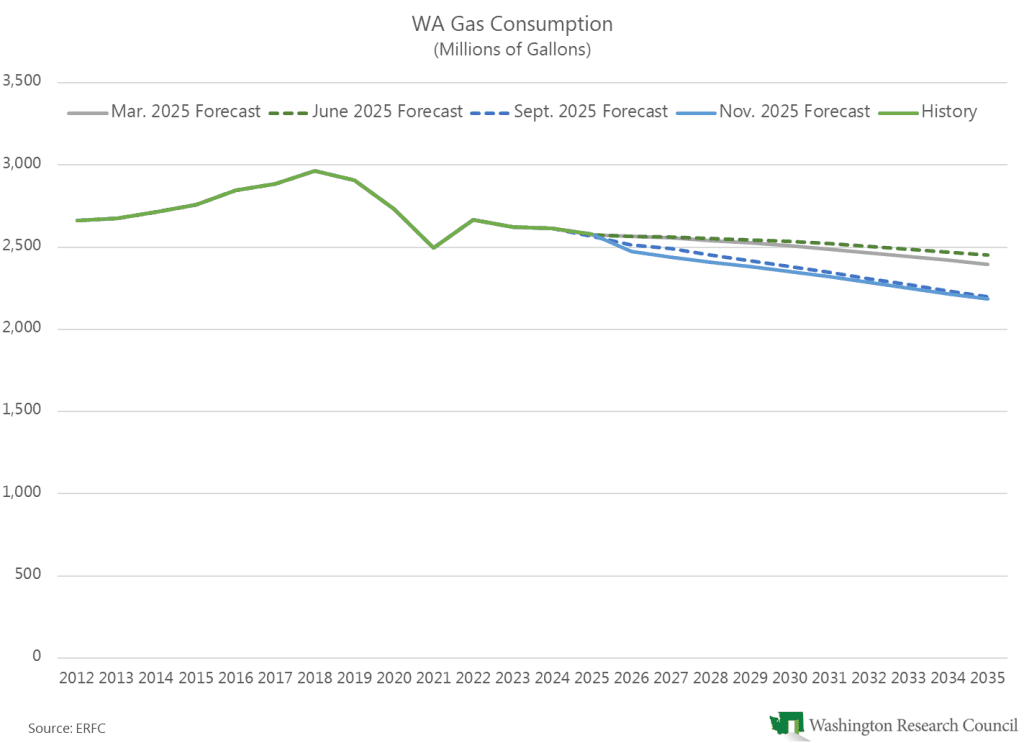
Inflation-adjusted transportation revenues are expected to decline each year beginning in 2029. Even though the gas tax rate will automatically increase by 2% a year going forward, gas consumption is down over the forecast period compared to the other forecasts this year. Consequently, adjusted for inflation, motor vehicle fuel tax revenues are expected to decrease by 6.6% from 2026 to 2035. Over the same time period, total transportation revenues (excluding transfers and adjusted for inflation) are forecasted to increase by 10.8%.
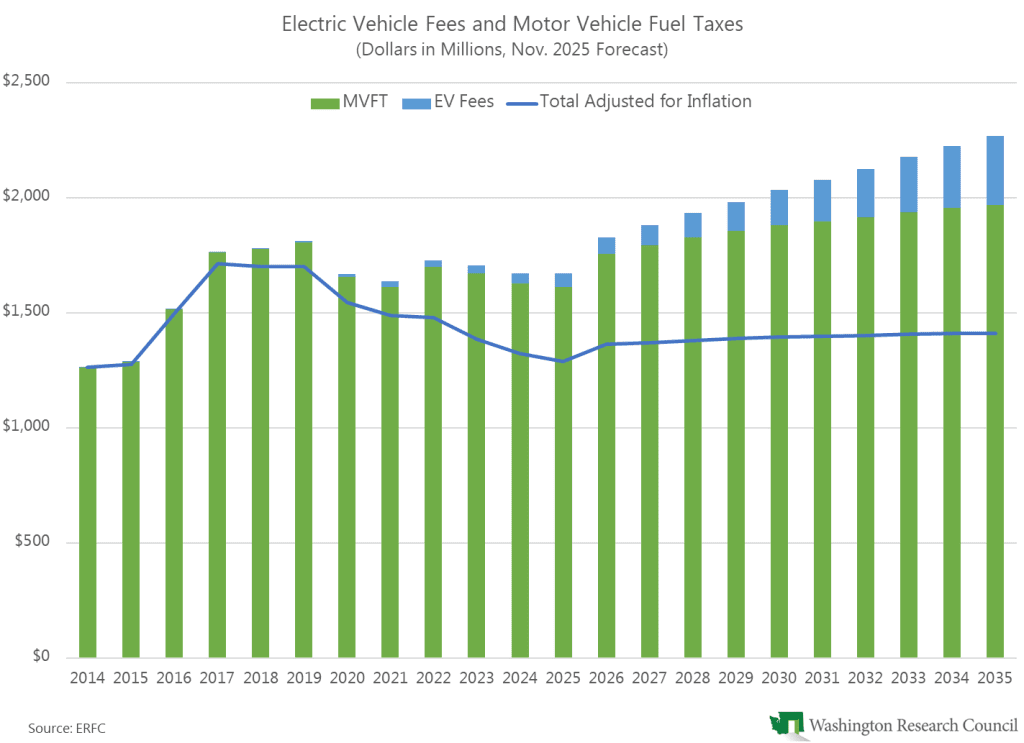
Although some of the decline in inflation-adjusted gas tax revenues will be offset by increases in electric vehicle collections, their combined revenues are expected to increase by just 3.4% from 2026 to 2035.
Finally, the November forecast includes a major downward revision to the transfers of Climate Commitment Act (CCA) carbon emission auction revenues to the transportation budget. The June 2025 forecast of the auction revenues (which is calculated by the Department of Ecology) included FY 2030 for the first time. Beginning in FY 2030, Ecology estimates that auction revenues will be below the amount that is statutorily dedicated to transportation. By statute, transportation is supposed to receive $359.1 million each year from 2026 through 2037. Now, the transportation revenue forecast assumes that the transportation budget will receive $317.5 million in 2030 and $300 million in each year from 2031 through 2035. (Note that if auction revenues remain below $359.1 million, there will be no auction revenues available for the operating or capital budgets.)
Categories: Budget , Transportation.