2:44 pm
February 23, 2023
The state operating budget is not developed from scratch. The starting point for a new budget is the maintenance level of the last budget. The maintenance level (ML) is the cost of current services, adjusted for inflation and caseload changes (the number of people who are expected to use entitlement programs).
The Caseload Forecast Council approved a new caseload forecast on Feb. 10. This forecast will feed into the legislative operating budget proposals. (Gov. Inslee’s budget proposal was based on the November 2022 caseload forecast.) Depending on the magnitude of the changes between the November and February forecasts, they could increase or decrease estimated ML spending. If the ML increases substantially, new policy spending could be crowded out.
Overall, it does not appear that the new February forecast will move the needle much in either direction compared to November. For the most part, caseloads are tracking pretty closely to the November estimates. Further, a very preliminary and incomplete estimate from the Office of Financial Management suggests that the new caseload forecast could decrease 2021–23 general fund–state (GFS) spending by $41 million and increase 2023–25 GFS spending by $207 million. (For context, the governor’s budget assumes a maintenance level of $65.6 billion for 2023–25.)
That said, there are a few notable points in the forecast about the Early Childhood Education and Assistance Program (ECEAP); the Aged, Blind and Disabled Assistance program (ABD); and Medicaid.
First, for ECEAP, compared to the November forecast, the 2021–23 caseload is estimated to be 5.5% lower and the 2023–25 caseload is estimated to be 2.3% lower. ECEAP enrollment in Sept. 2022 was still 15.2% below Sept. 2019. The forecast notes, “The caseload has been impacted both by delayed deployment of funded program slots into classrooms and lower enrollment rates within the slots currently available.” Nevertheless, “This forecast assumes that the available program slots will approach maximum funded levels during the 2023-24 school year.”
During the meeting, Caseload Forecast Council staff added that the Department of Children, Youth, and Families
has had difficulty deploying some of the additional funded slots that were provided by the Legislature into the classrooms so that they are actually available for enrollment. Historically, virtually all of the funded slots have been available by November. In 2019, the November funded slot count was 34 more than the number of actually available enrollment spaces and in November 2022 it was 981 unavailable funded slots.
Additionally, staff noted, “There is also a lower than pre-pandemic rate of utilization of those slots that are available to the public. So you have two factors at work here. One, the slots aren’t all available and the other is that the uptake rate is lower than it was.” One reason for that is that “not as many households are income-eligible for ECEAP as was previously the case.”
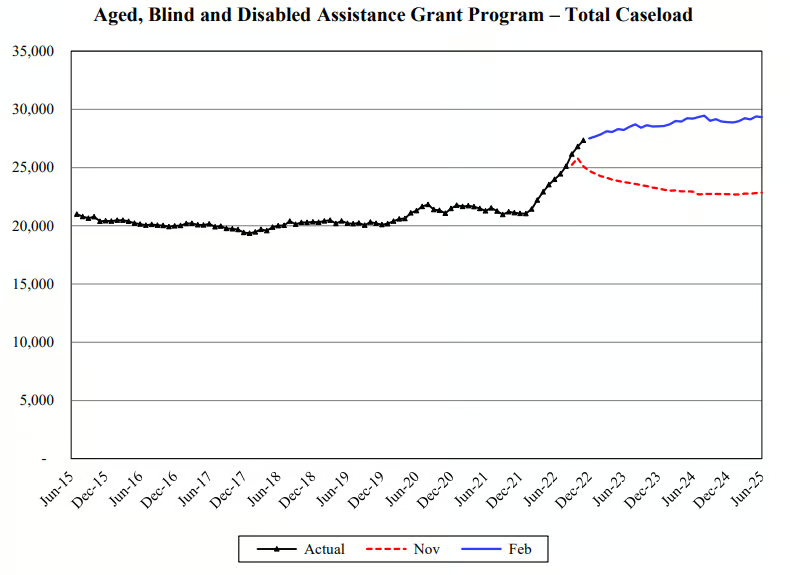
Second, the forecast for ABD increased significantly—the 2023–25 caseload is expected to be 26.0% higher than was forecasted in November. According to the forecast, the increase is due to “the re-opening of in-person community service offices” and legislative changes to the program. The legislative changes include expanding the program to individuals living in public mental institutions, increasing the grant, and cancelling mid-certification and eligibility reviews.
Third, the Medicaid caseload forecasts are adjusted to account for the end of the enhanced federal match for Medicaid and its continuous enrollment requirement. In November, the forecast had assumed that the continuous enrollment requirement would end in January 2023. Federal legislation adopted in December specified that the enhanced match will phase down and end at the end of Dec. 2023 and that states may begin to reevaluate eligibility on April 1, 2023.
Categories: Budget.