10:43 am
November 26, 2024
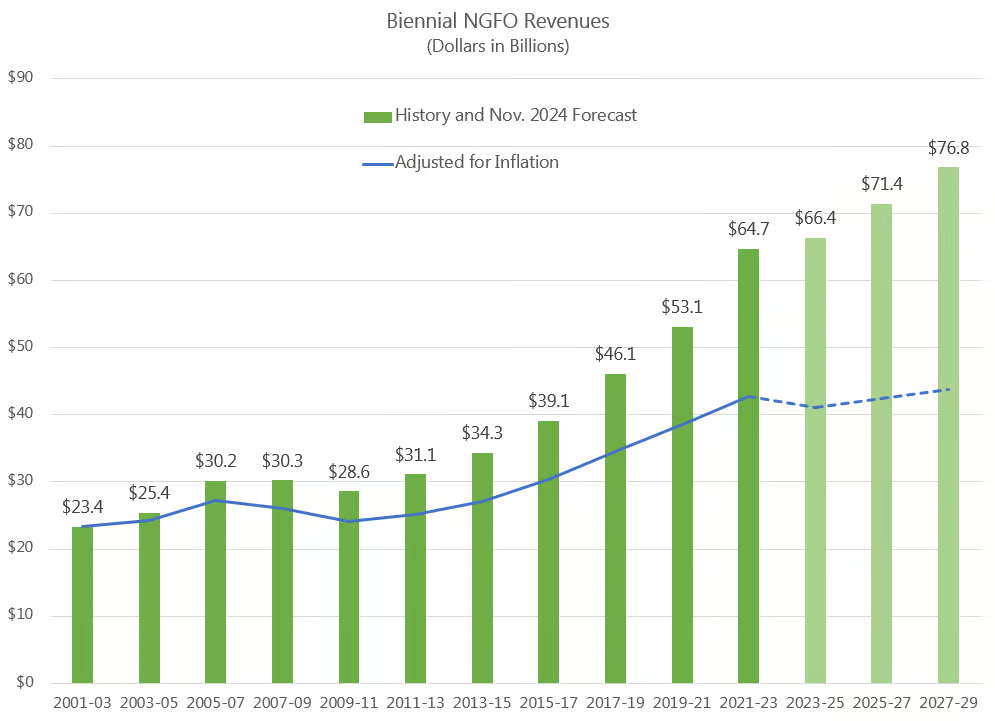
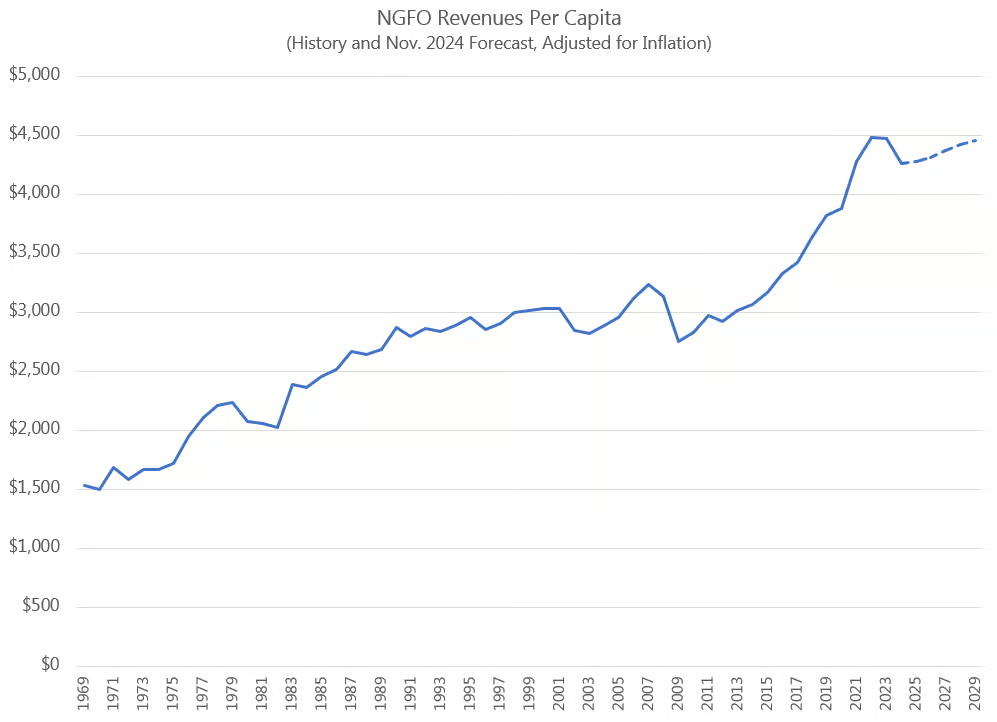
As Kriss wrote last week, state revenues are now expected to be lower than forecasted in September. Compared to the February revenue forecast (on which the current budget is based), revenues from funds subject to the outlook (NGFO) are now expected to be $1.008 billion lower through the outlook period (2023–25, 2025–27, and 2027–29).
Note, however, that even with the decline since February, revenues are still estimated to be $5.040 billion higher in 2025–27 than in 2023–25.
Meanwhile, the November caseload forecast was presented Nov. 13. The Office of Financial Management (OFM) estimates that the November caseload forecast will increase maintenance level (the cost of continuing current services, adjusted for enrollment and inflation) costs. OFM’s very preliminary and incomplete estimate is that the caseload forecast could increase costs by $453 million in 2023–25 and by $2.3 billion in 2025–27. (These numbers are compared to the February caseload forecast. OFM did not provide an estimate for 2027–29.)
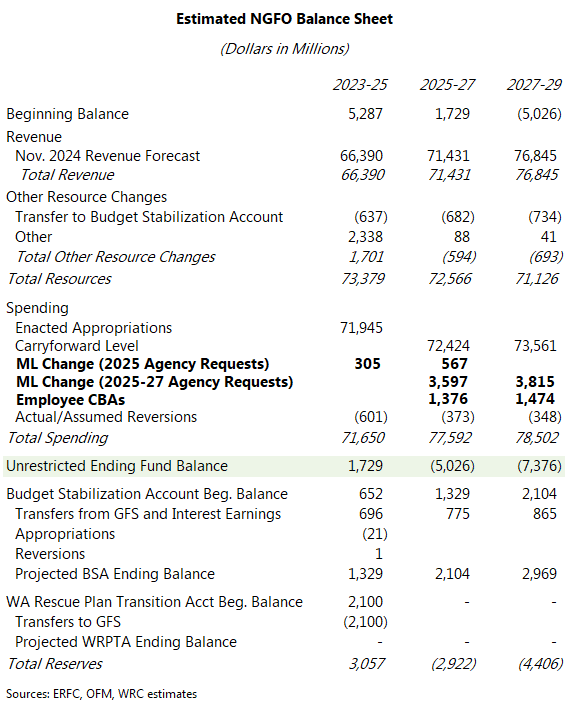
I have updated our estimate of the projected 2025–27 operating budget shortfall to incorporate the November revenue forecast. It is not possible at this time to update the outlook to reflect the new caseload forecast because our outlook is based on the maintenance level requests made by agencies. Some agencies included the June caseload forecast in their maintenance level requests and some did not. They have not yet updated their publicly available budget requests to reflect the November caseload forecast.
However, it does appear that the estimated maintenance level spending changes will be higher than shown in the outlook below. Indeed, if OFM’s current estimate of a $12 billion shortfall is correct, it implies that the maintenance level costs are about $6 billion higher over the outlook period. (There will be another revenue forecast and another caseload forecast before the Legislature adopts a 2025–27 operating budget.)
Even though revenues are lower than previously expected, the estimated budget shortfall is the result of legislative spending choices.