8:46 am
February 25, 2020
In terms of funds subject to the outlook (NGFO) plus the workforce education investment account (WEIA), the House Appropriations Committee chair proposes increasing 2019–21 operating appropriations by $1.188 billion. That’s $49.3 million higher than the $1.139 billion increase proposed by the Senate Ways & Means Committee chair.
The maintenance levels in the two proposals are nearly the same, except the House chair would increase maintenance level spending by $300,000 more than the Senate chair (the difference comes in the budgets for the House of Representatives and the Senate).
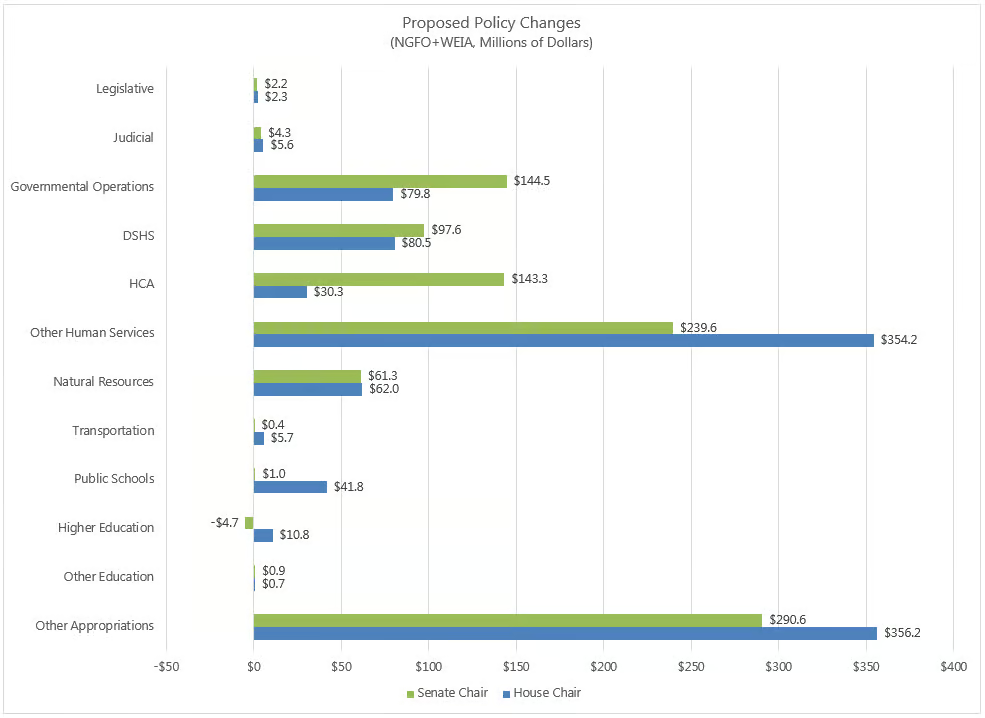
New NGFO+WEIA policy spending would be $1.030 billion in the House chair’s proposal and $980.9 million in the Senate chair’s proposal. The chart below shows how these policy proposals are spread among the budget areas.
Some of the differences between the two:
- In governmental operations, a big area of difference is the Department of Commerce. The Senate chair would increase spending by $66.4 million for unmet need sheltering and $15.4 million for supportive housing. The House chair would increase spending by $25.0 million for a consolidated homeless grant. For the Housing & Essential Needs program, the Senate chair would appropriate $26.1 million and the House chair would appropriate $20.0 million.
- For the Health Care Authority, the Senate chair would add $25.0 million for increases to managed care rates for behavioral health services and $60.6 million for other managed care rate increases. The House chair assumes savings of $37.4 million due to a federal delay in reductions to disproportionate share hospital funding.
- In the Other Human Services area, the Department of Children, Youth, and Families includes many of the differences between the proposals. The Senate chair would increase spending by $20.3 million for the family assessment response project. A Working Connections Child Care (WCCC) caseload savings adjustment would increase spending by $15.5 million in the Senate chair’s proposal and $26.3 million in the House chair’s proposal. To increase WCCC rates, the House chair’s proposal would increase spending by $56.4 million and the Senate chair’s proposal would increase spending by $17.2 million.
- In Public Schools, spending for paraeducator training would increase by $17.0 million in the House chair’s proposal and by $12.6 million in the Senate Chair’s proposal. The House chair would increase spending for counselors in high poverty schools by $50.9 million. The Senate chair would increase spending for the special education safety net by $11.1 million and for the special education multiplier by $9.7 million. For a pupil transportation base adjustment, the House chair would increase spending by $38.9 million and the Senate chair would increase spending by $11.8 million. The Senate chair would also increase the excess transportation allocation by $29.5 million. By updating the school employees benefits board rates, the House chair would save $71.1 million and the Senate chair would save $54.8 million.
- In other appropriations, the House chair would increase benefits for retirees in the PERS Plan 1 and TRS Plan 1 by 3 percent ($17.7 million). The Senate would also increase these benefits, by $15.0 million (but this increase is spread among the budget areas). The Senate chair would appropriate $100.0 million to the climate resiliency account and $100.0 million to the UW behavioral health hospital account (but the spending would not happen this year). The House would appropriate $100.0 million to the housing trust fund and $75.0 million to a new permanent supportive housing account. The House would also appropriate $60.0 million to the self-insurance liability account. Both proposals would appropriate funds to the WEIA: $23.0 million from the Senate chair and $41.3 million from the House chair.
Tags: 2019-21