12:55 pm
February 24, 2026
The Senate Ways & Means Committee Chair’s supplemental operating budget proposal would increase 2025–27 appropriations from funds subject to the outlook (NGFO) by $2.286 billion. (Yesterday I provided an overview of the proposal.)
The increase in appropriations is comprised of a maintenance level (the cost of continuing current services, adjusted for enrollment and inflation) increase of $1.734 billion and net new policy of $551.6 million. The estimated effect of the net new policy in 2027–29 is to reduce spending by $426.4 million.
The net new NGFO policy for 2025–27 includes $1.566 billion in policy increases and $1.014 billion in policy reductions.
Major proposed NGFO policy increases include (for 2025–27 unless otherwise noted):
- $978.9 million to backfill the state liability account and increase related central services charges to agencies ($42.7 million in 2027–29).
- $71.0 million to restore assumed Medicaid program integrity savings that will not be realized.
- $64.4 million in funding from cannabis revenue distributions ($93.7 million in 2027–29).
- $52.0 million for various changes in response to federal H.R. 1 ($219.7 million in 2027–29).
- $25.0 million for the Office of Refugee and Immigrant Assistance.
- $15.0 million for UW’s Center for Behavioral Health and Learning ($30.5 million in 2027–29).
- $84.0 million in 2027–29 for debt service on capital budget projects.
- $25.4 million in 2027–29 to operate Stafford Creek Corrections Center beyond FY 2027.
Proposed policy reductions include (for 2025–27 unless otherwise noted):
- -$239.9 million by shifting funding for the higher education institutions from the NGFO to the institutions of higher education operating fees account. (The operating fees account would then be backfilled using the institutions’ capital budget building accounts.)
- -$168.0 million from various changes to Working Connections Child Care enrollment and rate policies pursuant to SB 6353 (-$689.4 million in 2027–29).
- -$70.1 million for the disproportionate share hospital program, assuming that federal reductions will be delayed (-$36.1 million in 2027–29).
- -$59.1 million by reducing local effort assistance enhancements by $100 per pupil (-$48.3 million in 2027–29).
- -$50.0 million from shifting funding for WorkFirst from the NGFO to other accounts.
- -$39.0 million by reducing the Transition to Kindergarten program (-$103.0 million in 2027–29).
- -$33.0 million from 1.5% administrative reductions to most agencies (-$67.5 million in 2027–29).
- -$34.7 million to move the Apple Health expansion population from managed care to fee-for-service (-$47.2 million in 2027–29).
- -$24.0 million by shifting funding for emergency housing to the Washington housing trust account.
- -$21.1 million by reducing school bus depreciation payments (-$42.2 million in 2027–29).
- -$14.0 million by reducing the maximum Running Start enrollment (-$30.4 million in 2027–29).
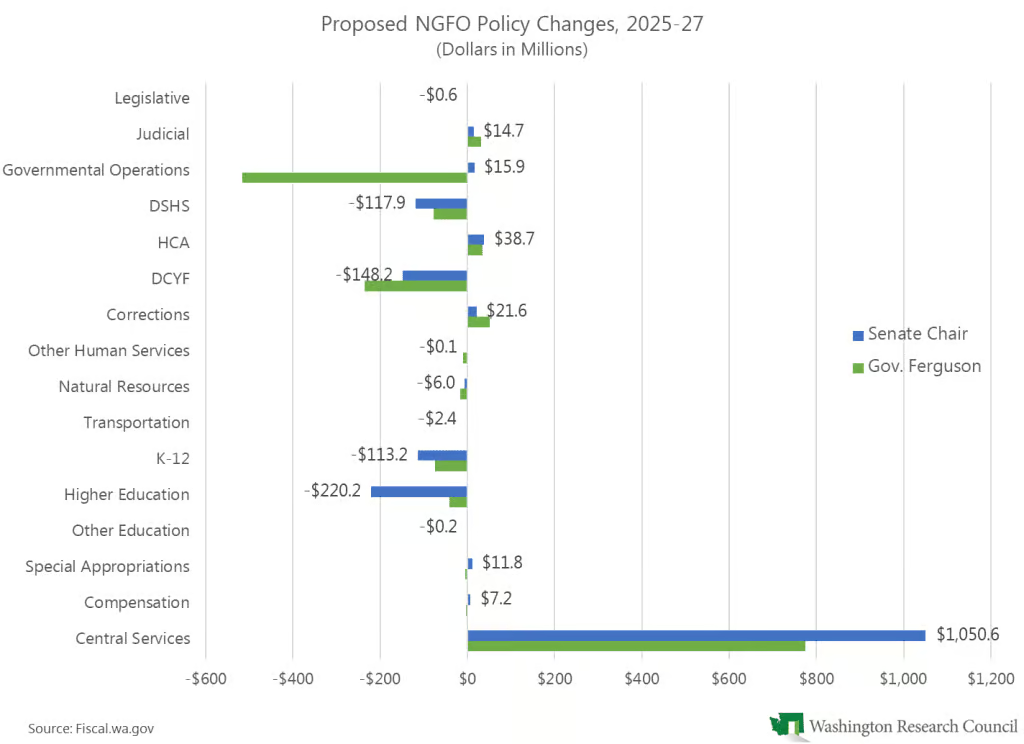
The chart below compares policy changes in the Senate Chair’s proposal to those in Gov. Ferguson’s proposal, by budget area. (The big difference in governmental operations is that the Senate Chair would fund the Working Families Tax Credit from the NGFO while the governor proposed using climate commitment act dollars.)
Some notable budget provisos include:
- The Joint Legislative Audit and Review Committee would be required to “review auditing, accountability, and risk management practices across Washington’s state agencies” (Sec. 103).
- The Office of the State Actuary would be required to review the Board of Volunteer Firefighters and Reserve Officers Relief and Pension Funds to see if the current fire insurance premium tax “provides sufficient funding” (Sec. 107).
- The Office of the State Treasurer would be required to “analyze how public banking tools can be applied to leverage and extend existing legislative appropriations for infrastructure” (Sec. 122). Additionally, a public bank work group would be established (Sec. 155).
- The Employment Security Department would be required to evaluate the solvency of the paid family and medical leave program and potential changes to the program (Sec. 232).
- The Washington State Institute for Public Policy would be required to study state programs that have “increased the overall rate of students who enroll in postsecondary education within one year of high school graduation” (Sec. 606).
Finally, note that although the Senate Chair’s proposal would implement E2SHB 2034, the outlook does not assume any revenues from the bill.
Tags: 2026 supplemental